

SEO


Practical steps to increase your chances of being featured in Google's AI-generated answers.
When you search on Google, you'll often see a box at the top of the results with an AI-generated summary. This is an AI Overview.
Instead of showing you a list of links and letting you click through, Google's AI reads multiple web pages, synthesises the information, and presents an answer directly. It often includes citations to the sources it used.
For website owners, this creates both a challenge and an opportunity.
The challenge: users might get their answer without clicking through to your site.
The opportunity: if your content is cited, you gain visibility and credibility at the very top of search results.
This guide covers how to optimise your content so Google's AI is more likely to use it in these overviews.
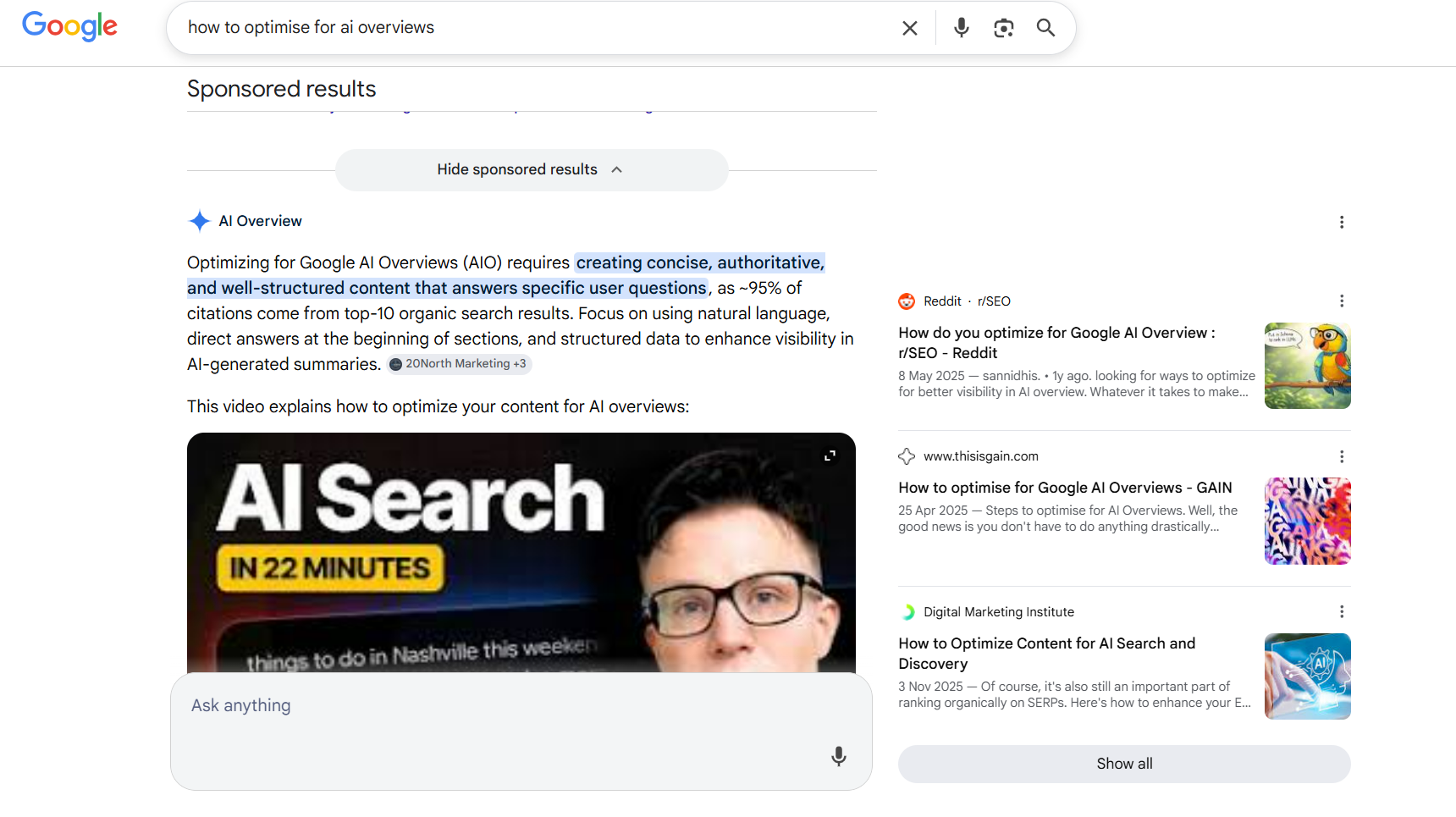
AI Overviews appear for informational queries where Google's AI can synthesise a helpful answer
Being cited in an AI Overview can drive significant visibility, even if some users don't click through
Content structure is critical — clear headings, direct answers, and logical organisation help AI understand your content
You can't guarantee inclusion, but you can improve your chances with the right approach
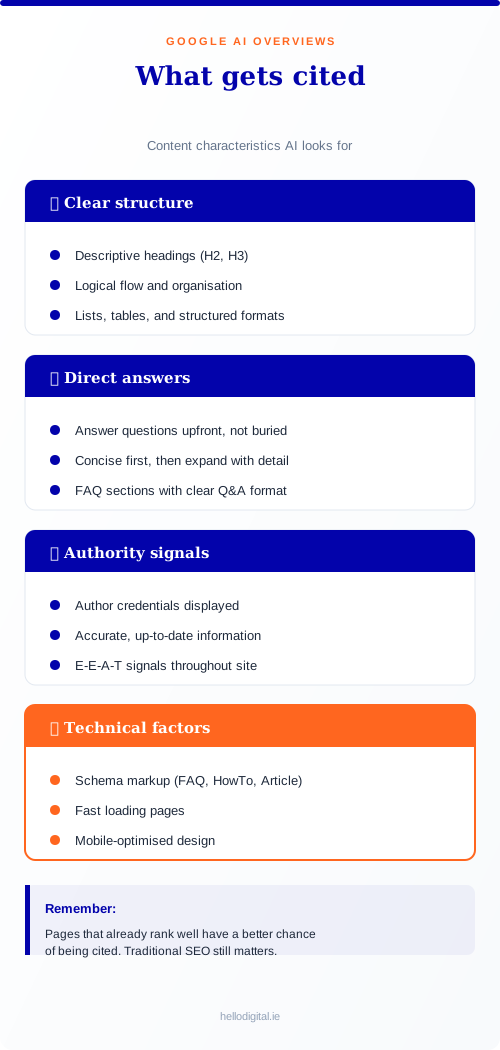
Pages that already rank well have a better chance of being cited
E-E-A-T signals matter — AI prioritises trustworthy, authoritative sources
This isn't about tricks — it's about creating genuinely helpful, well-structured content
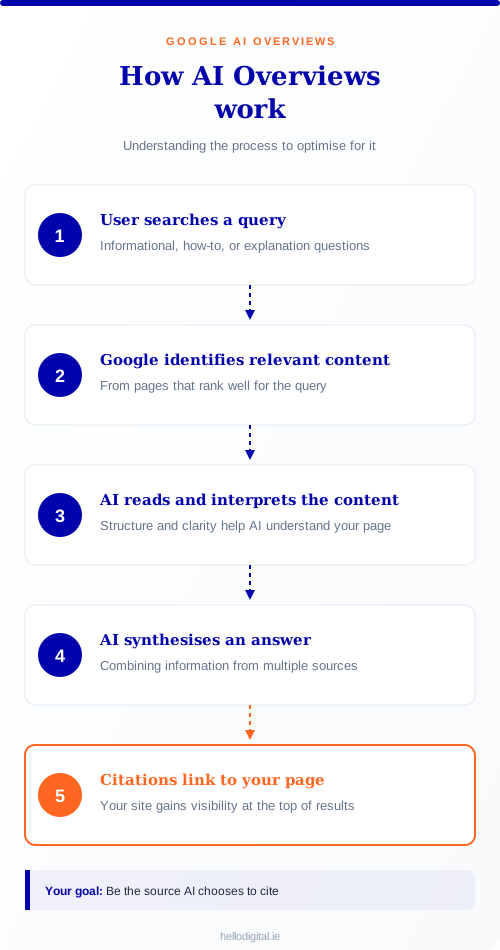
Understanding how Google generates these answers helps you optimise for them.
When someone searches a query that triggers an AI Overview, Google's AI:
Identifies relevant content from pages that rank well for the query
Reads and interprets the content on those pages
Synthesises an answer combining information from multiple sources
Adds citations linking to the pages it used
The AI doesn't just copy text. It summarises, combines perspectives, and creates a new response. But it needs source material to work with — and that's where your content comes in.
AI Overviews appear most often for:
Informational queries — "how does X work," "what is Y"
Process questions — "how to do X," "steps for Y"
Comparison queries — "X vs Y," "difference between X and Y"
Explanation queries — "why does X happen," "what causes Y"
They appear less often for:
Navigational queries — searches for specific websites or brands
Transactional queries — searches with clear purchase intent
Very simple queries — where a featured snippet or quick answer suffices
Sensitive topics — health, finance, and legal queries sometimes excluded
Google's AI tends to cite content that:
Directly answers the question being asked
Comes from authoritative, trustworthy sources
Is clearly structured and easy to parse
Provides accurate, up-to-date information
Adds genuine value beyond what other sources offer
How you structure your content significantly affects whether AI can use it effectively.
Your headings should tell both readers and AI exactly what each section covers.
Less effective:
"Getting started"
"Things to consider"
"More information"
More effective:
"How to set up your Google Business Profile"
"Factors that affect conveyancing timelines"
"Common mistakes when applying for a visa"
Use H2 for main sections and H3 for subsections. This hierarchy helps AI understand the structure of your content.
When your content answers a question, put the answer near the top of the relevant section — not buried in the third paragraph.
Less effective: "Many people wonder about timelines for this process. There are several factors involved, and it really depends on your specific situation. Generally speaking, most people find that..."
More effective: "This process typically takes 4–6 weeks. The exact timeline depends on complexity and documentation. Here's what affects it..."
AI looks for content that directly addresses queries. If your answer is hidden, it may not be found.
Organise content in a way that makes sense:
Start with the most important information
Progress logically through subtopics
Group related information together
Use transitions that clarify relationships
A well-organised page is easier for AI to parse and extract relevant sections from.
Consider adding summary boxes or key takeaways that condense your main points. These give AI clear, concise content to potentially feature.
Where appropriate, use:
Bullet points for lists of items
Numbered lists for steps or sequences
Tables for comparisons
Definition formats for explaining terms
These formats are easier for AI to parse than dense paragraphs.
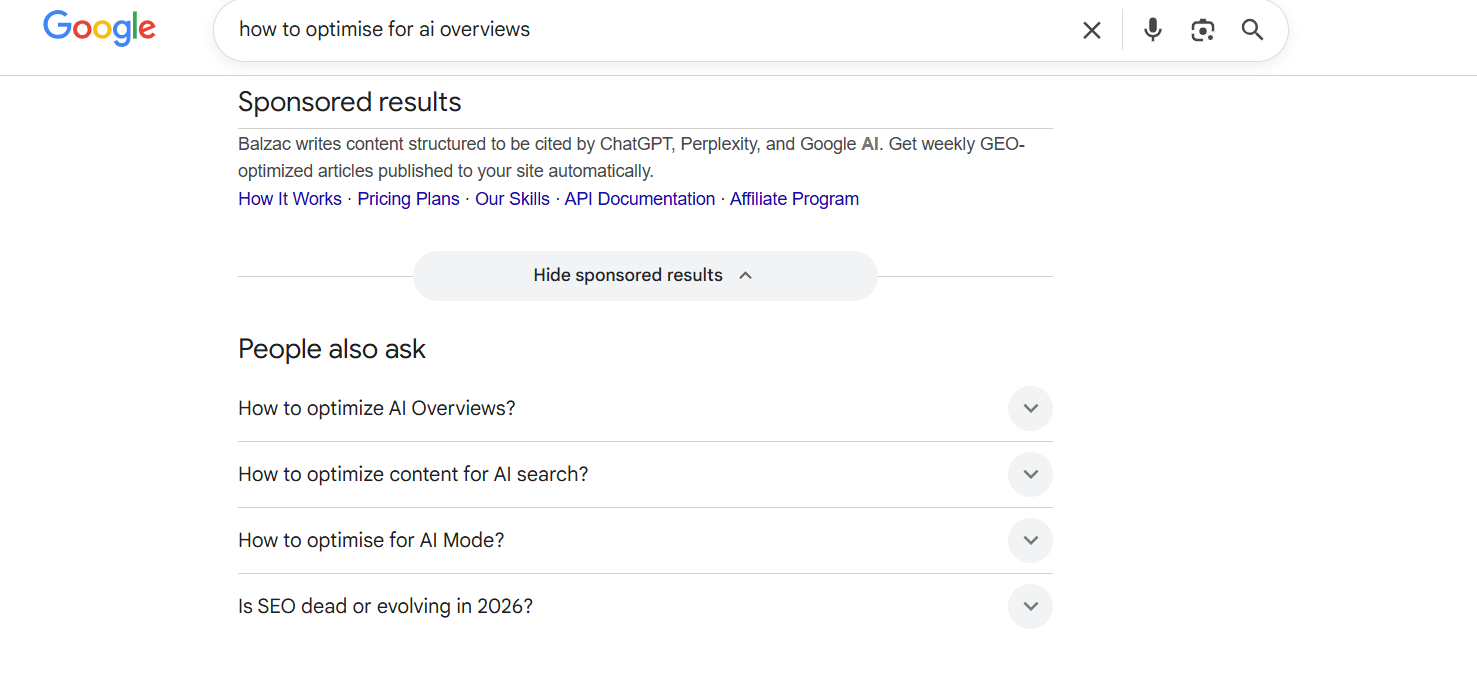
AI Overviews often appear for question-based queries. Structuring content around questions improves your chances.
Research what questions people search for in your area:
Use Google's "People also ask" boxes
Check your Search Console for question-based queries
Talk to your customers about what they wanted to know
Look at forums, social media, and review sites
For each question you address:
State the question clearly — as a heading or at the start of a section
Provide the direct answer — in the first sentence or two
Expand with context — add detail, nuance, and supporting information
Anticipate follow-ups — address related questions nearby
Question as H2: How long does conveyancing take in Ireland?
Direct answer: Conveyancing typically takes 8–12 weeks from sale agreed to completion.
Context: The exact timeline depends on several factors including chain complexity, mortgage approval, and how quickly documentation is provided. Straightforward transactions can complete faster; complex chains may take longer.
Follow-up addressed: What can delay the process? Common delays include...
Dedicated FAQ sections work well for AI Overviews:
Group related questions together
Keep answers concise but complete
Use FAQ schema markup (covered later)
Update regularly based on new questions
Google's AI prioritises content from trustworthy sources. Strengthening your authority improves your chances of being cited.
Experience, Expertise, Authoritativeness, and Trustworthiness all matter:
Experience: Show you've actually done what you're writing about. Reference your track record, include case studies, share practical insights.
Expertise: Display credentials. For professional topics, show qualifications. Attribute content to knowledgeable authors.
Authoritativeness: Build recognition in your field. Get mentioned by other reputable sources. Participate in your industry.
Trustworthiness: Be accurate. Keep content updated. Display contact information. Use HTTPS. Be transparent about who you are.
For content on important topics:
Attribute articles to named authors
Include author bios with relevant credentials
Link to author profiles
Use author schema markup
This helps AI understand that qualified people created your content.
AI Overviews need to provide accurate information. This means:
Fact-check your content
Cite sources where relevant
Update content when information changes
Add "last updated" dates
Remove or update outdated content
Stale or inaccurate content is less likely to be cited.
Beyond individual pages:
Clear contact information
About page explaining who you are
Privacy policy and terms
Professional website design
Secure connection (HTTPS)
These contribute to Google's overall assessment of your site's trustworthiness.
Technical factors help AI understand and use your content.
Schema markup is code that explicitly tells search engines what your content is about.
Relevant schema types for AI Overviews:
FAQPage — for FAQ sections
HowTo — for process/tutorial content
Article — for blog posts and guides
LocalBusiness — for local service pages
Person — for author profiles
Schema doesn't guarantee AI Overview inclusion, but it helps Google understand your content structure.
If you're not technical:
WordPress plugins like Yoast or RankMath can add schema
Many website builders have built-in schema options
You can test your markup with Google's Rich Results Test
Faster pages are more likely to rank well, and ranking well increases AI Overview chances:
Optimise images
Minimise unnecessary code
Use caching
Consider a content delivery network (CDN)
Most searches happen on mobile. Ensure:
Responsive design
Readable text without zooming
Tap-friendly buttons and links
Fast mobile loading
Some content types are particularly suited to AI Overview inclusion.
"What is X" queries often trigger AI Overviews. Clear, authoritative definitions with context perform well.
"How to" content with clear steps is frequently featured. Number your steps, explain each clearly, and include expected outcomes.
"X vs Y" queries often show AI Overviews that synthesise differences. Tables and side-by-side comparisons work well here.
"Why does X happen" or "what causes Y" queries benefit from clear cause-and-effect explanations.
Queries with local intent (e.g., "how to register a business in Ireland") benefit from locally-relevant, specific content that larger generic sites may not provide.
Some approaches are unlikely to help — or may hurt.
Pages with little substantive content won't be cited. AI needs material to work with. Depth matters.
Unnaturally repeating keywords doesn't help AI understand your content better. Write naturally for humans.
If your content is very similar to other pages (yours or others'), it's less likely to be featured. Offer unique value.
Content with clearly old information (outdated dates, defunct processes, old statistics) is less likely to be trusted and cited.
Walls of text without clear headings make it hard for AI to extract relevant sections. Structure your content clearly.
AI is designed to provide helpful, accurate answers. Content that exaggerates, misleads, or sensationalises is less likely to be featured.
Track how your content performs in AI Overviews.
Search Console shows:
Queries that drive impressions and clicks
Changes in click-through rates (which may indicate AI Overview impact)
Pages that rank well for informational queries
Look for queries where you rank well but clicks have dropped — this may indicate AI Overviews are answering directly.
Regularly search for key queries and note:
Whether AI Overviews appear
Whether your content is cited
What content is being cited instead
How the AI summarises the topic
This manual observation helps you understand the landscape.
Based on what you observe:
Update pages that aren't being cited
Improve structure on underperforming content
Add content addressing gaps you notice
Keep successful pages fresh and accurate
No. You can improve your chances with good structure, authority, and relevance, but Google's AI makes these decisions algorithmically. There's no guaranteed formula.
Yes. Being cited builds brand awareness and credibility. Users see your name as a trusted source, even if they don't click through on that particular search.
No. The fundamentals — helpful, accurate, well-structured content — remain the same. AI Overview optimisation is an additional layer, not a complete overhaul.
Not entirely. AI Overviews appear for some queries, but traditional results still appear below them. Many queries don't trigger AI Overviews at all.
AI Overviews can change as Google's index updates and as its AI evolves. Being cited today doesn't guarantee being cited tomorrow — freshness and accuracy matter.
Create content to help your audience. If it's genuinely useful, well-structured, and authoritative, it has a better chance of appearing in AI Overviews. Don't create thin content solely to game the system.
Indirectly, yes. Backlinks help your pages rank well, and ranking well increases your chances of being cited in AI Overviews. But the direct factors are content quality, structure, and authority.
The principles are the same, but local businesses have an advantage for locally-specific queries. Content about your specific area, with local expertise, can outperform generic national content.
Clear, descriptive headings (H2, H3)
Direct answers near the top of sections
Logical flow and organisation
Summary sections or key takeaways
Lists and structured formats where appropriate
Identify questions your audience asks
Address questions directly in headings
Provide concise answers then expand
Include FAQ sections with schema
Author information on content
Credentials and expertise displayed
Accurate, up-to-date information
Clear contact and business information
HTTPS and professional site design
Schema markup implemented
Fast page loading
Mobile-optimised design
Clean, crawlable site structure
Monitor Search Console for changes
Manually check key queries
Update content regularly
Iterate based on what works
Optimising for AI Overviews is part of a broader AI SEO strategy. For an introduction to how AI is changing search, see What is AI SEO and how is it different from traditional SEO?.
If you're noticing traffic changes and wondering if AI search is the cause, read Is AI search affecting your traffic? How to tell and what to do.
For help optimising your website for AI-powered search, I offer AI SEO services for small Irish businesses. Get in touch for a free consultation →
Alessandro Boscolo Conway — Hello Digital
I'm a Dublin-based freelance SEO and digital marketing consultant with over 20 years of experience, including time on Google Ireland’s Search Quality team.
I run Hello Digital, a consultancy that helps startups and small businesses across Ireland grow online through clear strategy, expert delivery, and practical support.
I've worked with over 50 Irish companies to improve their visibility, generate better leads, and grow sustainably through SEO and digital marketing.
I'm a certified Google Partner and a trusted advisor to e-commerce brands, local services, and fast-growing startups.
- Based in Dublin, 20+ years of experience
- Former Googler, certified Google Partner, SEO strategist, and performance marketer
- Trusted by 50+ Irish startups, e-commerce brands, and local businesses
- Learn more about Hello Digital