

SEO


Understanding how search is changing and what it means for your website's visibility.
If you've used Google recently, you may have noticed something different. Before the familiar blue links, there's often a box at the top with a summarised answer — written by AI.
This is Google's AI Overview. It pulls information from multiple websites, synthesises it, and presents a direct answer to your question. Bing does something similar with Copilot. ChatGPT and other AI assistants are now being used as search tools too.
For website owners, this changes things. The goal is no longer just ranking on page one. It's being the source that AI chooses to reference, quote, or summarise.
This is where AI SEO comes in.
AI SEO builds on traditional SEO — it's an evolution, not a replacement
The goal shifts from ranking to being cited, summarised, or featured by AI
Content structure matters more than ever — AI needs to understand your content quickly
E-E-A-T (experience, expertise, authority, trust) is even more important for AI visibility
Small businesses can benefit significantly — clear, focused content often outperforms larger competitors
You don't need to rewrite your entire site — targeted improvements to key pages are usually enough
AI SEO is the practice of optimising your website and content so that AI-powered search features can find, understand, and reference it.
This includes:
Google AI Overviews — the AI-generated summaries at the top of Google search results
Bing Copilot — Microsoft's AI assistant integrated into Bing search
ChatGPT and other AI assistants — increasingly used as alternatives to traditional search
Voice assistants — Siri, Alexa, and Google Assistant, which pull from web content
AI SEO isn't a completely new discipline. It builds on the foundations of traditional SEO — quality content, technical health, good site structure. But it adds a layer of focus on how AI systems interpret and present your content.
Think of it this way: traditional SEO helps you rank. AI SEO helps you get cited.
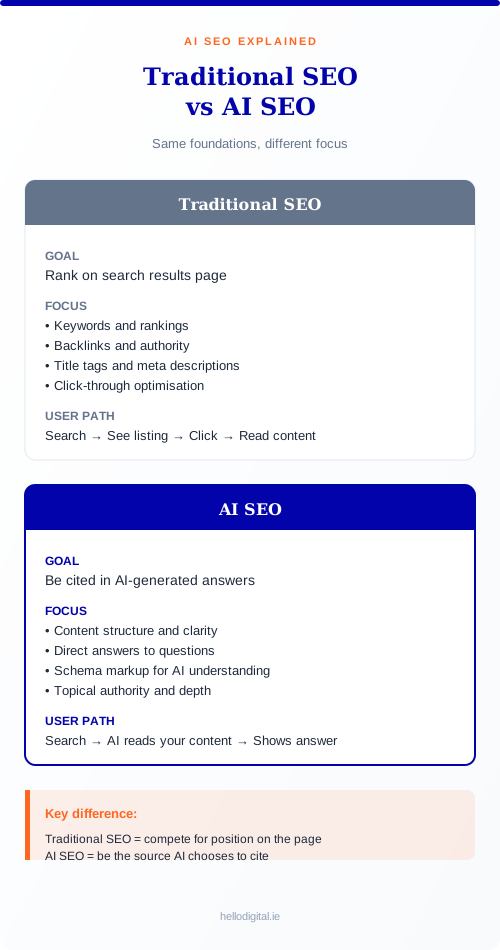
Traditional SEO and AI SEO share the same foundation, but they differ in emphasis and execution.
Ranking for specific keywords
Earning clicks from search results pages
Building backlinks to increase authority
Optimising title tags and meta descriptions for click-through
Technical factors like page speed and mobile-friendliness
Being selected as a source for AI-generated answers
Structuring content so AI can easily extract and summarise it
Providing clear, direct answers to questions
Building topical authority across related subjects
Using schema markup to help AI understand your content
Creating content that works for conversational queries
In traditional SEO, you're competing for position on a results page. Users see your listing, decide whether to click, and then read your content.
In AI SEO, the AI reads your content first, decides whether it's trustworthy and relevant, and may present it directly to users — sometimes without them ever visiting your site.
This means your content needs to be:
Clearly structured — so AI can parse it easily
Directly useful — answering questions without unnecessary padding
Authoritative — demonstrating genuine expertise
Well-organised — with logical headings, summaries, and sections
AI-powered search isn't a future trend — it's happening now.
Google has been rolling out AI Overviews across more search queries and more countries. For many informational searches, the AI summary is the first thing users see. Some users get their answer without scrolling further.
More people are using conversational AI directly. Instead of typing keywords into Google, they're asking ChatGPT or Bing Copilot questions. These tools pull from web content, but they don't show traditional search results.
Some websites have seen traffic drops as AI Overviews answer questions that previously drove clicks. Others have seen increases by being featured prominently in AI-generated answers.
This isn't just an issue for large publishers. Local businesses, service providers, and small e-commerce sites all appear in AI-generated results. How your content is structured affects whether you're included.
AI SEO involves several practical tactics. Here's what it actually means for your website:
AI systems need to understand your content quickly. This means:
Clear headings that describe what each section covers
Short paragraphs that make distinct points
Bullet points and lists for scannable information
Summary sections at the start of articles
FAQ sections with direct question-and-answer format
AI looks for content that directly answers questions. Instead of burying the answer in paragraph five, lead with it. You can expand and add context afterward, but the core answer should be easy to find.
Less effective: "Many people wonder about the timeline for this process. There are several factors to consider, including complexity, availability, and other variables. Generally speaking, in most cases..."
More effective: "This process typically takes 4–6 weeks. The exact timeline depends on complexity and availability. Here's what affects it..."
Schema markup is code that helps search engines understand what your content is about. For AI SEO, relevant schema types include:
FAQ schema for question-and-answer content
HowTo schema for process explanations
LocalBusiness schema for local services
Article schema for blog posts
This structured data helps AI systems categorise and use your content appropriately.
AI systems favour sources that demonstrate depth on a topic. Rather than one page trying to cover everything, a cluster of related content — a hub with supporting articles — signals expertise.
This is the hub-and-spoke model: a main page covering a topic broadly, with linked articles going deeper on specific aspects.
Experience, Expertise, Authoritativeness, and Trustworthiness matter even more for AI visibility. AI systems are designed to surface reliable information, so they look for:
Clear author credentials
Evidence of real-world experience
Accurate, up-to-date information
Trust signals like contact details and professional affiliations
There are some misconceptions worth clearing up.
AI SEO is about optimising for AI-powered search — not about using ChatGPT to generate your content. In fact, low-quality AI-generated content often performs poorly because it lacks the depth, accuracy, and originality that AI systems are looking for.
You still need the fundamentals: a technically sound website, quality content, good user experience, and relevant backlinks. AI SEO builds on these — it doesn't replace them.
AI systems are sophisticated. Tricks that might have worked for traditional SEO — keyword stuffing, thin content, manipulative tactics — won't work here. AI SEO rewards genuinely helpful, well-structured content.
Small businesses often have an advantage. A focused local business with clear expertise in a specific area can outperform larger competitors who produce generic content. AI systems value clarity and authority, not just scale.
You don't need to overhaul your entire website. Here's a practical starting point:
Look at your most important pages — service pages, top blog posts, product pages. Ask:
Is the content clearly structured with descriptive headings?
Does it directly answer the questions your audience asks?
Is it up to date and accurate?
Does it demonstrate your expertise?
Update your key pages with:
Clear H2 and H3 headings that describe each section
A summary or key takeaways near the top
FAQ sections where relevant
Short paragraphs and bullet points for readability
Implement relevant schema on your pages. If you're not technical, most modern CMS platforms have plugins that make this straightforward.
If you have a main service page, consider creating supporting blog content that links back to it. This hub-and-spoke approach builds the topical authority AI systems look for.
Track how your content appears in AI Overviews and featured snippets. Tools like Google Search Console show some of this data. Note which queries trigger AI-generated answers and whether your content is being cited.
No. The underlying changes in search are real — Google AI Overviews, Bing Copilot, and ChatGPT are all affecting how people find information. AI SEO is the practical response to these changes.
No. Most websites need targeted improvements to key pages, not a complete rewrite. Focus on your most important pages first.
No. AI SEO builds on traditional SEO. The fundamentals — quality content, technical health, good user experience — still matter. AI SEO adds another layer of optimisation.
Look for drops in traffic to informational pages that previously performed well. Check Google Search Console for queries where you rank well but clicks have declined. These could indicate AI Overviews are providing answers directly.
Yes. Local searches trigger AI-generated answers too. How your content is structured affects whether you're mentioned in those answers.
Like traditional SEO, it varies. Some improvements — like better content structure — can show results within weeks. Building topical authority takes longer, typically months.
It's worth monitoring, but not panicking. The goal is to be the source AI cites. Well-structured, authoritative content is more likely to be referenced, which can actually increase visibility.
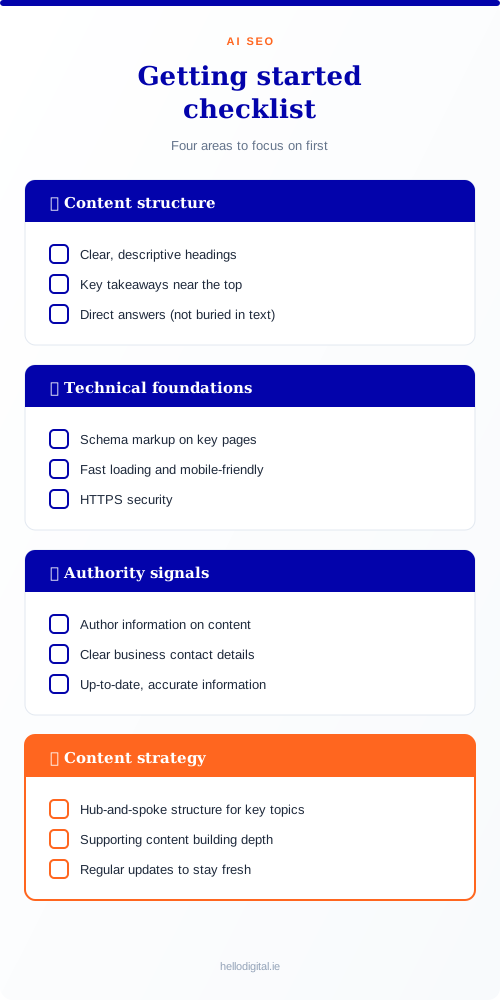
Content structure
Clear, descriptive headings (H2, H3)
Key takeaways or summary near the top
Direct answers to questions (not buried in text)
FAQ sections where relevant
Short paragraphs and bullet points
Technical foundations
Schema markup on key pages
Fast page loading
Mobile-friendly design
HTTPS security
Authority signals
Author information on content
Clear business contact details
Evidence of expertise and experience
Up-to-date, accurate information
Content strategy
Hub-and-spoke structure for key topics
Supporting content that builds topical depth
Regular updates to keep content fresh
AI SEO is an evolution of what you're probably already doing — with a sharper focus on how AI systems read and use your content.
If you're wondering whether AI search is affecting your traffic, or how to adapt your content strategy, I can help. I offer AI SEO services specifically for small Irish businesses, including audits, content restructuring, and ongoing optimisation.
Get in touch for a free consultation →
For more on specific AI SEO tactics, see our guides on optimising for Google AI Overviews and content structure for AI search.
Alessandro Boscolo Conway — Hello Digital
I'm a Dublin-based freelance SEO and digital marketing consultant with over 20 years of experience, including time on Google Ireland’s Search Quality team.
I run Hello Digital, a consultancy that helps startups and small businesses across Ireland grow online through clear strategy, expert delivery, and practical support.
I've worked with over 50 Irish companies to improve their visibility, generate better leads, and grow sustainably through SEO and digital marketing.
I'm a certified Google Partner and a trusted advisor to e-commerce brands, local services, and fast-growing startups.
- Based in Dublin, 20+ years of experience
- Former Googler, certified Google Partner, SEO strategist, and performance marketer
- Trusted by 50+ Irish startups, e-commerce brands, and local businesses
- Learn more about Hello Digital