

SEO


A page can contain the right information and still make that information hard to find. Long introductions, vague headings, buried answers and sections that mix several ideas together make it harder for both people and search systems to identify the part of the page that answers a specific question.
That matters more as search moves beyond a list of blue links. AI search systems can pull information from different pages and use individual passages to build an answer. Your content therefore needs enough structure and context for the right passage to make sense when it is retrieved.
When I work on AI SEO, I focus on how the page is organised before worrying about special formats or supposed AI optimisation tricks. The page needs a defined purpose, descriptive headings, direct answers where they belong, enough context to avoid ambiguity, and information worth citing.
The sections below show how I structure content with those requirements in mind.
Give each page one defined purpose based on the search intent it needs to satisfy.
Use descriptive H2s and H3s that make the subject of each section obvious.
Put the main answer close to the heading, then add the detail, evidence and context.
Make sections understandable on their own without repeating the same information across the page.
Use lists, tables and numbered steps only when they suit the information.
Name important entities, services, locations and relationships explicitly to reduce ambiguity.
Add first-hand experience, data, examples, professional judgement and primary sources so the page contains information worth citing.
Connect related pages with relevant internal links rather than treating each article as an isolated resource.
Make sure important content is crawlable, indexable and available in the rendered page.
Avoid artificial AI optimisation tactics such as forcing every heading into a question, creating near-duplicate pages for prompt variations or chopping content into meaningless fragments.
AI search does not treat every query as a request to find one page containing one exact answer. Google says AI Overviews and AI Mode can use query fan-out, running several related searches across subtopics and data sources before building a response.
That changes how I think about content structure. A page still needs to work as a complete piece of content, but the individual sections also need to make sense when a search system identifies them as relevant to a narrower part of the user's question.
For example, a page about choosing an SEO consultant might contain separate sections on costs, experience, reporting and contract terms. Someone asking an AI search engine “What should I ask an SEO consultant about reporting?” may only need the reporting section. A heading such as “What should SEO reporting include?” gives both the reader and the search system much more information than “Reporting” or “Things to consider”.
Microsoft's guidance for AI search makes a similar point: use clear headings and organise information into sections that can be understood independently while remaining part of a coherent page.
The goal is not to chop an article into artificial fragments. It is to make the relationship between the question, the section and the answer obvious.
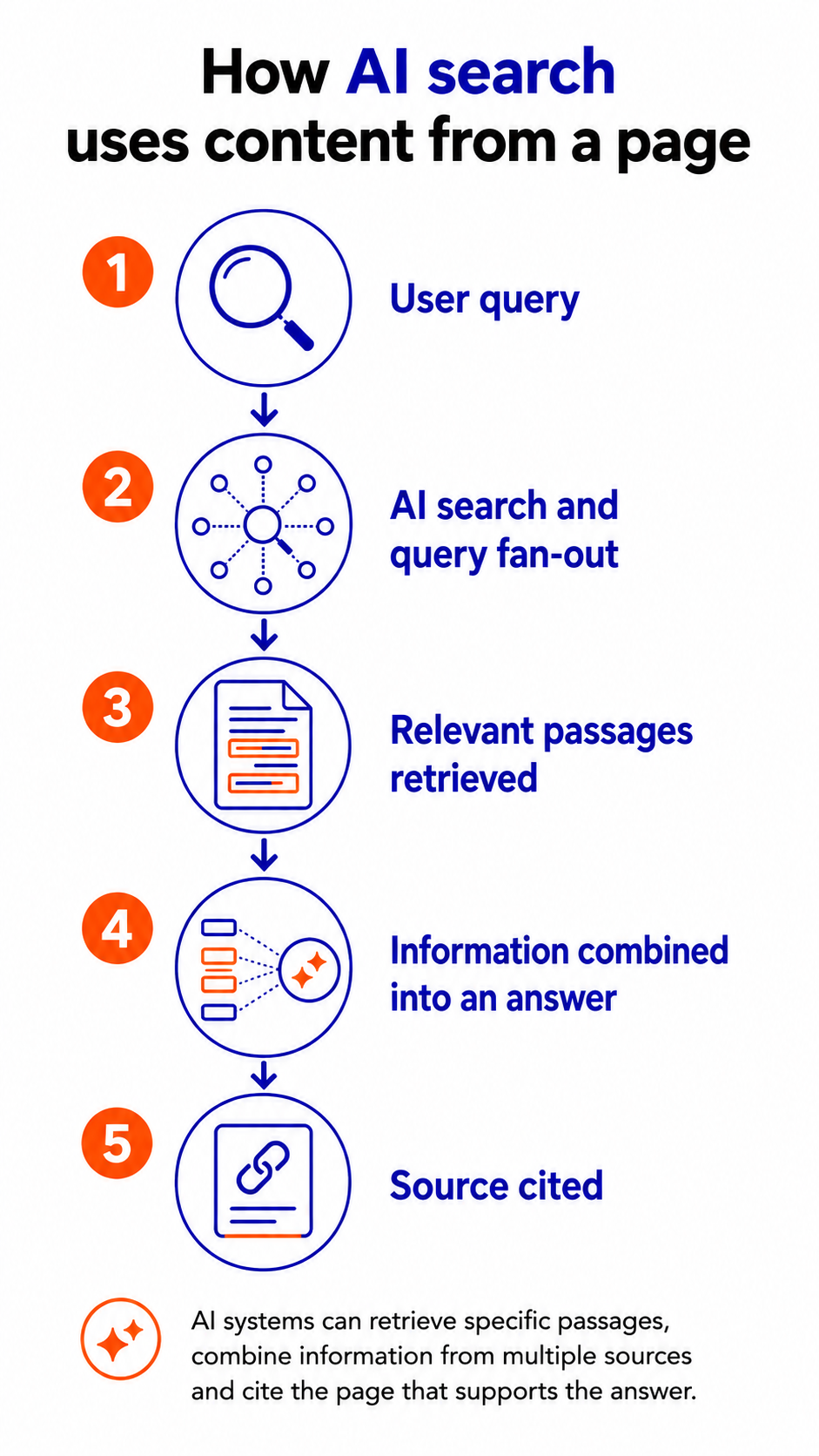
Before I think about headings, formatting or AI citations, I decide what the page is actually there to answer.
A page built around one defined search intent is easier to structure because every section has a reason to exist. If the page starts trying to answer several loosely related intents, the hierarchy becomes less obvious and the useful information gets diluted.
For example, a page targeting “how much does SEO cost?” should concentrate on pricing, what affects the cost, different pricing models and what a business should expect for its budget. It does not also need to explain how SEO works, how long SEO takes and how to choose an SEO agency in equal depth. Those questions can be addressed elsewhere and connected through internal links.
I use the same principle when planning SEO content. The primary query gives me the page's central purpose, while related searches and questions help determine which supporting sections belong underneath it.
That does not mean targeting one exact keyword. People can phrase the same underlying question in dozens of ways, and AI search can expand a query into related searches. The important distinction is between different wording for the same intent and different intents competing for space on the same page.
Once the purpose is defined, the heading structure becomes much easier to build.
Headings should tell the reader what they are about to learn. They also give search systems a stronger signal about the subject of the content underneath them.
A heading such as “How long does SEO take to work?” is more useful than “Timescales” because it defines the question the section answers. The same applies to headings such as “What affects the cost of SEO?”, “Which pages should you optimise first?” or “How should internal links be structured?”
I try to avoid headings such as:
Things to consider
Important information
Other factors
More details
Our approach
They may make sense when you are already reading the page, but they carry very little meaning on their own.
Descriptive headings do not all need to be questions. A heading such as “SEO pricing models” or “Technical problems that can prevent indexing” can be just as specific.
The wording should match the information underneath it. Questions work well when the section gives a direct answer. Descriptive statements often work better for categories, comparisons, processes or groups of related points.
I apply the same principle when improving existing pages as part of an SEO content audit. A weak heading structure is often a sign that the page itself has not been organised around distinct questions or topics.
| Weak structure | Better structure |
|---|---|
| Things to consider | What affects the cost of SEO? |
| More information | How long does SEO take to work? |
| Our approach | How I measure SEO performance |
| Services | Which SEO services does a small business need? |
| Important points | What should you check before hiring an SEO consultant? |
| A long paragraph covering several unrelated ideas | Separate sections for cost, timescales, reporting and deliverables |
| Repeating the same answer in several sections | One complete answer in the section where it belongs |
| “This can improve performance” | “Descriptive internal links help search engines understand how related pages connect” |
| A list added purely to make the page easier to scan | A list used because the information is genuinely a set of steps, criteria or examples |
| Several pages targeting “appear in AI search”, “show up in AI search” and “rank in AI search” | One page owning the broader AI search visibility intent |
The next step is making sure the answer appears where the heading leads the reader to expect it.
Once a heading sets an expectation, the section should answer it quickly.
If someone reaches a section called “How much does local SEO cost?”, I do not make them read three paragraphs of background before giving them a price range or explaining what affects the cost. The answer should appear near the start, followed by the detail needed to understand it.
The same principle applies to AI search. When the relevant information is buried beneath introductions, anecdotes or loosely related commentary, the passage becomes harder to identify and use.
A useful section often follows a simple order:
Give the direct answer.
Explain the factors or conditions that affect it.
Add examples, evidence or professional judgement where they improve the answer.
Link to supporting information when the reader needs more depth.
The exact format will vary. A complex question may need several paragraphs, a comparison may work better as a table, and a process may need numbered steps.
I use the same approach when creating SEO-friendly content: make the information easy to locate first, then give the reader enough context to make sense of it.
The aim is not to make every section short. It is to remove unnecessary distance between the heading and the information the reader came for.
A section should make sense even when someone lands directly on it or when an AI system retrieves only that part of the page.
That does not mean repeating the whole article in every section. It means giving enough context for the reader to understand what the section refers to without relying on vague wording or information several paragraphs earlier.
For example, instead of writing:
This can affect performance.
write:
Poor internal linking can make it harder for search engines to understand which pages are most important.
The second version names the subject and the consequence. It is easier to understand on its own and less likely to become ambiguous when the passage is viewed outside the surrounding article.
I avoid phrases such as:
this helps
this shows
these factors
that approach
the above
when the reader has to look backwards to work out what they mean.
Repeating the actual subject is often better, even if it makes the sentence slightly longer.
The same applies to entities. If a section refers to a product, service, location, person or organisation, name it clearly rather than assuming the surrounding context will always be available.
Good structure should reduce ambiguity without making the writing repetitive.
Formatting should reflect the type of information you are presenting.
If a process has a sequence, use numbered steps. If several items belong to the same group, a bullet list can make them easier to scan. If the reader needs to compare options, a table may communicate the differences faster than several paragraphs.
For example:
Numbered steps work well for processes and instructions.
Bullet lists suit features, criteria, examples or groups of related points.
Tables are useful for comparisons, specifications, pricing or differences between options.
Paragraphs are still the right choice when an idea needs explanation or qualification.
The mistake is turning everything into lists because they look easier for AI systems to process. A page made up of disconnected bullets can lose the context and reasoning that make the information worth using in the first place.
I also avoid breaking a straightforward paragraph into several artificial sections simply to create more headings. Structure should make the content easier to follow, not make the page look more optimised.
When the format matches the information, both readers and search systems can identify the relationship between individual points more easily.
Specific language matters when a passage can be retrieved outside the full page.
If I write “it works well for small businesses”, the reader has to know what it refers to. If I write “local SEO works well for small businesses that rely on customers in a defined service area”, the meaning is complete.
The same applies to products, services, locations, people and organisations. Name the subject when it matters.
Useful context can include:
the exact service being discussed
the type of customer or business
the location, when location changes the answer
the timeframe
the product or feature name
the organisation or source behind a claim
For example, “SEO for solicitors in Ireland” is more precise than “SEO for professional services” if the advice depends on legal-market competition, local search behaviour or the way firms present services online.
Context also matters for internal links. Anchor text such as technical SEO consultant tells the reader and search systems more than a generic link such as “learn more”.
The aim is to remove ambiguity without making the copy mechanical. Name the important entities, relationships and conditions when they affect the meaning of the section.
Structure can make information easier to retrieve, but structure alone does not make a page worth citing.
AI search systems still need something useful to work with. Pages that simply repeat the same definitions, tips and summaries already available elsewhere give search systems little reason to choose them over stronger sources.
I look for information that adds something specific, such as:
first-hand experience
original examples
data from your own business or clients
a documented process
expert interpretation
comparisons based on real criteria
case studies
primary-source evidence
A page becomes more valuable when it explains what the information means and how to act on it.
For example, listing ten SEO metrics is easy. Explaining which three matter most for a particular type of business, why they matter and when I would ignore the others adds professional judgement that cannot be reproduced by simply summarising another article.
The same principle applies to SEO content creation. I do not want every page to be a longer version of what already ranks. I want it to contain something a reader, journalist, search engine or AI system could reasonably choose as a source.
External sources matter too. When a claim depends on research, product documentation or a platform's own guidance, I link to the primary source rather than presenting the claim without evidence.
Good AI search content therefore needs both retrievable structure and information worth retrieving.
A well-structured page should not sit in isolation.
Internal links help show how the page fits into a wider subject and give readers a path to the next piece of information they need. They also help search systems understand relationships between pages, especially when several pages cover different parts of the same topic.
For example, an article about structuring content for AI search can link to:
a broader AI SEO service
a deeper article on tracking visibility in AI search
supporting content on Google AI Overviews
relevant service pages such as SEO content creation or technical SEO
The important part is relevance. I do not add internal links simply to increase link count. Each link should help explain the subject, provide the next level of detail or connect the page to a commercial service that genuinely relates to the reader's problem.
Anchor text should tell the reader what they will find.
A link labelled “how to track your visibility in AI search” is more informative than “read more”. Descriptive anchors also make the relationship between the two pages easier to understand.
Internal linking works best when the site has a clear topic structure behind it. A cluster of related pages covering distinct parts of AI search gives both readers and search systems more context than a collection of disconnected articles.
Good content structure only matters if search systems can actually access the content.
Important information should be present in the page itself, available to search engines and not hidden behind interactions or technical implementations that prevent it from being crawled or indexed.
The main text, headings, links and supporting information should be available in the rendered page. Be careful with content that only appears after a user action, relies heavily on JavaScript or sits inside elements that search engines may not process as reliably as ordinary page content.
I pay particular attention to:
important copy loaded dynamically
content hidden behind tabs or accordions
internal links generated only after interaction
pages blocked from crawling or indexing
canonical tags pointing somewhere else
important pages that are difficult to reach through internal links
The issue is not whether a page looks fine in a browser. The question is whether the content you want retrieved is actually available to search systems.
Structured data can give search engines additional information about a page, but it does not replace the visible content or compensate for poor structure.
I use schema when it accurately describes information that already exists on the page. I do not treat it as a shortcut for making content understandable. The same principle applies when deciding whether schema helps SEO.
Before trying to make a page more “AI-friendly”, make sure the content can be crawled, indexed and understood in the first place.
AI search has created a new layer of optimisation advice, but some of it encourages people to make content worse.
I avoid tactics that exist mainly to satisfy an assumed AI preference rather than improve the page.
Questions work when the user is actually asking a question. They are not automatically better than descriptive headings, and turning every H2 into a question can make an article feel repetitive and mechanical.
A page should have logical sections because the subject requires them. I would not split a coherent explanation into dozens of tiny sections simply because AI systems may retrieve individual passages.
The section still needs enough context to make sense as part of the page.
Repetition can make a page look comprehensive while adding very little. If one section already answers a question properly, the next section should move the topic forward rather than restating the same point with different wording.
Queries such as:
how to appear in AI search
how to show up in AI search
how to rank in AI search
how to improve AI search visibility
may represent the same underlying intent.
Creating a separate page for every wording variation can lead to overlapping content and cannibalisation. I decide which intent each URL owns before I start writing.
The same principle applies across traditional SEO. My approach to keyword targeting is based on search intent and page purpose, not creating one URL for every keyword variation.
Schema, tables, lists, accordions and other structural elements should describe or present the content better. None of them compensates for weak information, unclear writing or a page with no defined purpose.
AI optimisation should improve the page, not leave the reader with content that feels like it was written for a machine.
Before I publish or update a page, I run through the structure from the reader's point of view and from the point of view of a search system trying to identify the most relevant passage.
I check:
whether the page has one defined purpose
whether each H2 and H3 describes the content underneath it
whether the main answer appears close to the heading
whether sections can be understood without relying on vague references
whether lists, tables or steps are being used because they suit the information
whether important entities, locations, services and products are named clearly
whether the page contains something worth citing, not just a summary of existing material
whether relevant internal links connect the page to the wider topic
whether the important content is crawlable and indexable
whether any section repeats information already covered elsewhere on the page
A page can pass every individual check and still feel fragmented.
I read the finished article from top to bottom to make sure the sections build on one another, the level of detail is consistent and the page answers the original search intent without drifting into neighbouring topics.
That final read is important because AI SEO still depends on the same basic requirement as good SEO content: the page has to be useful as a complete resource, not just a collection of passages that look optimised in isolation.
Not necessarily. Question headings work well when the section answers a specific question, but descriptive headings can be just as effective. The heading should make the subject of the section obvious.
No. A section should be as long as necessary to answer the point properly. Shorter sections are not automatically easier for AI systems to understand or more likely to be cited.
They can help when the information suits that format. A comparison belongs in a table, a process may need numbered steps, and a group of related items may work well as bullets. Formatting alone will not make weak content more visible.
Structured data can provide additional context about a page, but it does not replace the visible content or good page structure. Schema should accurately describe information already present on the page.
Only when the prompts represent genuinely different search intents. Different wording does not always justify another URL. Creating several pages around the same underlying question can lead to overlapping content and cannibalisation.
Track the same commercially relevant prompts over time and record whether your brand is mentioned, whether your website is cited and which pages are being used. I cover the full process in how to track your visibility in AI search.
Structuring content properly gives AI search systems a better chance of understanding what your pages cover and identifying the information worth retrieving.
But content structure is only one part of the picture. Technical accessibility, topical coverage, authority, citations, internal linking and how your brand appears across the wider web can all affect whether your business is surfaced in AI-generated results.
As part of my AI SEO services, I help businesses identify where they are missing from AI search, which pages need attention and what changes are most likely to improve visibility.
Get in touch if you want me to review how your website is currently performing in AI search.
Alessandro Boscolo Conway — Hello Digital
I'm a Dublin-based freelance SEO and digital marketing consultant with over 20 years of experience, including time on Google Ireland’s Search Quality team.
I run Hello Digital, a consultancy that helps startups and small businesses across Ireland grow online through clear strategy, expert delivery, and practical support.
I've worked with over 50 Irish companies to improve their visibility, generate better leads, and grow sustainably through SEO and digital marketing.
I'm a certified Google Partner and a trusted advisor to e-commerce brands, local services, and fast-growing startups.
Based in Dublin, 20+ years of experience
Former Googler, certified Google Partner, SEO strategist, and performance marketer
Trusted by 50+ Irish startups, e-commerce brands, and local businesses