

SEO


A practical, ethical approach to attracting more clients through search tailored to small solicitor firms in Ireland and Dublin.
This guide is written for solicitors and small law firms in Ireland, particularly those based in Dublin and surrounding areas. If you want to attract more qualified enquiries from people actively searching for legal services, understand how search engines evaluate legal websites, and build a sustainable online presence without gimmicks or shortcuts, this guide will help.
You can expect to learn how to improve your local visibility in Google, create content that builds trust, and implement practical SEO strategies suited to the realities of running a small legal practice with limited time and resources.
SEO for solicitors is about being found when potential clients search for legal help in your area and practice areas — not about tricks or manipulation.
Local SEO (particularly Google Business Profile optimisation) delivers the highest return on investment for most Irish solicitors.
Legal websites are held to higher standards by Google due to their "Your Money or Your Life" (YMYL) classification.
Trust signals — credentials, client reviews, professional affiliations — directly influence both rankings and conversions.
Content should demonstrate genuine expertise through accurate, helpful information rather than keyword stuffing.
A well-structured website with clear practice area pages and location targeting outperforms scattered, thin content.
AI search tools like Google AI Overviews and ChatGPT are changing how people research legal services — content that directly answers questions performs best.
Sustainable results come from consistent effort over months, not quick fixes.
When someone in Dublin needs a solicitor for conveyancing, a family law matter, or an employment dispute, their first step is almost always the same: they search online. SEO for solicitors is the practice of ensuring your firm appears prominently in those searches — and that your website convinces visitors to make contact.
For small solicitor firms in Ireland, effective SEO represents one of the most cost-efficient ways to attract new clients. Unlike traditional advertising, which interrupts people who may not need your services, search marketing connects you with people at the exact moment they're looking for legal help.
This guide takes an ethical, long-term approach. There are no tricks or manipulative tactics here. Instead, you'll learn how to build a website and online presence that genuinely serves potential clients whilst also performing well in search engines. The two goals aren't in conflict — in fact, they're increasingly aligned as search engines become better at identifying truly helpful content.
The legal services market in Ireland has particular characteristics that affect your SEO strategy:
High concentration of firms in Dublin creates intense competition for Dublin-based searches
Local intent is strong — people typically want a solicitor they can visit in person
Practice area specialisation matters — generalist searches are less common than specific queries like "conveyancing solicitor Dublin" or "employment law solicitor Dublin 2"
Trust and reputation are paramount — referrals remain important even when people search online
Many firms have historically underinvested in their online presence, creating opportunities for those who act
Legal services fall into what Google calls "Your Money or Your Life" (YMYL) categories. These are topics where poor-quality information could significantly harm users. As a result, Google applies stricter quality standards to legal websites than to many other industries.
| Factor | What it means for you |
|---|---|
| Content accuracy | Must be well-researched and ideally reviewed by qualified solicitors |
| Author credentials | Professional standing matters more than in other sectors |
| Trust signals | Professional body memberships, testimonials, and transparent contact information carry significant weight |
| Content depth | Thin, generic content performs particularly poorly; specificity is rewarded |
| Reputation signals | Reviews and mentions across the web influence your visibility |
Legal services involve significant decisions and often substantial fees. Potential clients take longer to convert and require more reassurance than someone buying a product online. Your website must build trust quickly, demonstrate relevant expertise, provide clear next steps, and reduce the perceived risk of making contact.
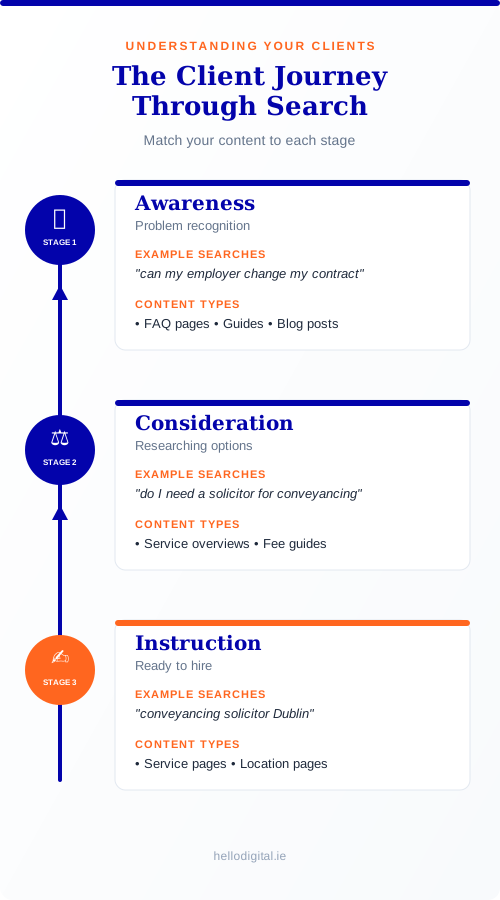
Effective SEO requires understanding how potential clients move from initial awareness of a legal need to instructing a solicitor. Different types of content serve different stages of this journey.
At this stage, people know they have a problem but may not yet understand the legal dimensions or that they need a solicitor. They search for information rather than services.
Example searches: "can my employer change my contract", "what happens if I can't pay my mortgage", "rights when buying a house Ireland"
Content that serves this stage: FAQ pages, educational guides, blog posts explaining legal concepts in plain English
The person now understands they likely need legal help and is researching options. They may be comparing types of legal services or evaluating whether to use a solicitor at all.
Example searches: "do I need a solicitor for conveyancing", "employment solicitor vs HR", "cost of making a will Ireland"
Content that serves this stage: Service overview pages, fee guides, process explainers
The person has decided to instruct a solicitor and is now choosing which one. These are your highest-value searches.
Example searches: "conveyancing solicitor Dublin", "employment law solicitor Dublin 2", "best family solicitor near me"
Content that serves this stage: Service pages with clear calls to action, location pages, testimonials, case study summaries
|
Journey Stage |
Search Intent |
Content Type |
Primary CTA |
|---|---|---|---|
|
Awareness |
Informational |
Guides, FAQs, Blog posts |
Learn more |
|
Consideration |
Investigational |
Service overviews, Fee guides |
Get a quote |
|
Instruction |
Transactional |
Service pages, Location pages |
Contact us |
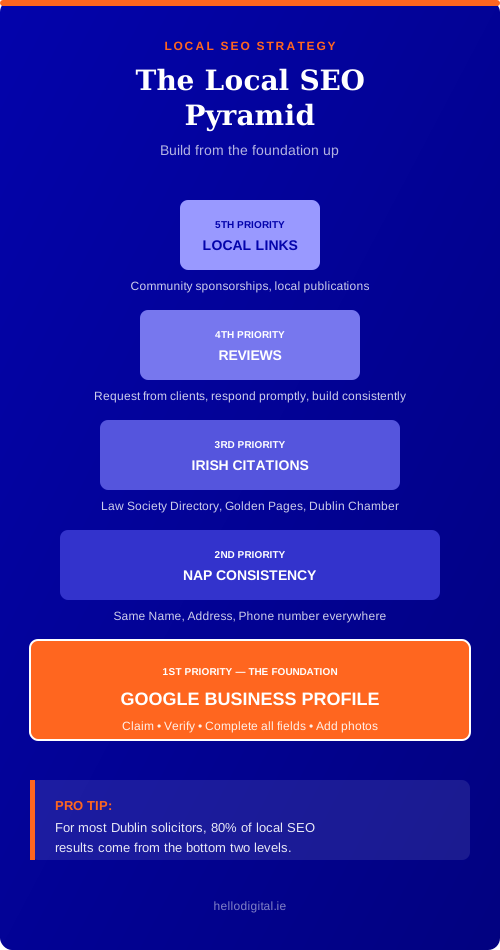
For most solicitor firms, local SEO delivers the highest return on investment. When someone searches for "solicitor Dublin" or "conveyancing solicitor near me," Google prioritises local results. Appearing in these results can generate a steady stream of enquiries from people ready to instruct.
Your Google Business Profile (GBP) is the single most important local SEO asset. It determines whether you appear in the local map pack and provides crucial information to potential clients.
Claim and verify your profile at business.google.com. For most firms, this involves receiving a postcard with a verification code.
Choose accurate categories. Select "Solicitor" as your primary category. Add secondary categories for your practice areas (e.g., "Family Law Attorney," "Real Estate Attorney"). Note: Google uses American terminology; choose the closest match.
Complete every field. Fill in opening hours, phone number, website URL, and appointment links. Incomplete profiles rank lower.
Write a compelling description. Use all 750 characters. Include your practice areas, location (Dublin, specific areas served), and what distinguishes your firm. Include target keywords naturally.
Add high-quality photos. Upload images of your office exterior, interior, and team members (with permission). Profiles with photos receive significantly more engagement.
Post updates regularly. Share news, legal updates relevant to clients, or firm announcements
Respond to all reviews. Thank positive reviewers; address negative reviews professionally
Keep information current. Update hours for holidays, add new services, remove outdated information
Use the Q&A feature. Add common questions and answers proactively
Track insights. Monitor how people find your profile and what actions they take
NAP stands for Name, Address, and Phone number. Search engines use NAP consistency across the web as a trust signal. Inconsistent information confuses both search engines and potential clients.
Choose one exact format for your firm name, address, and phone number. Use this identical format everywhere — your website, Google Business Profile, directories, social media, and any other online presence.
Citations are mentions of your business on other websites, typically in directories. Irish-specific citations are particularly valuable for local SEO.
Law Society of Ireland Solicitors Directory (essential — verify your listing is accurate)
Golden Pages (goldenpages.ie)
Trustpilot
Local Dublin directories
Industry-specific legal directories
Dublin Solicitors Bar Association
Relevant specialist associations for your practice areas
Local Chamber of Commerce (Dublin Chamber, etc.)
Reviews significantly influence both rankings and conversion rates. A firm with numerous positive reviews will outperform competitors in search results and convert more visitors into enquiries.
Ask satisfied clients directly at the conclusion of a matter
Make it easy by providing a direct link to your Google review page
Time requests appropriately—ask when positive outcomes are fresh, but be sensitive to the nature of the legal matter
Never offer incentives—paid or incentivised reviews violate Google's policies
Avoid review generation services that often create fake reviews
For positive reviews: Thank the reviewer personally. Mention specific aspects of the service if appropriate. Keep responses professional.
For negative reviews: Respond promptly and professionally. Acknowledge concerns without being defensive. Offer to discuss the matter offline. Never reveal confidential client information. Remember that your response is visible to all potential clients.
Links from other local websites strengthen your local SEO. Focus on genuine relationships rather than artificial link building.
Local business associations and chambers of commerce
Sponsorship of community events, sports clubs, or charities
Guest articles in local publications
Participation in legal clinics or pro bono programmes
Speaking at local business events
Collaboration with complementary professionals (accountants, estate agents, financial advisers)
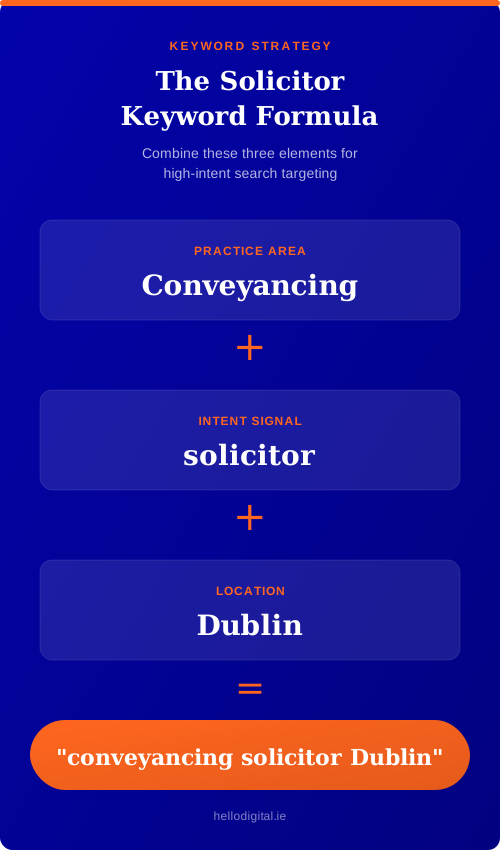
Effective keyword strategy combines practice area terms, intent signals, and location modifiers. The goal is to identify searches most likely to generate quality enquiries and create content that serves those searches.
Most valuable solicitor keywords follow this pattern:
[Practice area] + [intent signal] + [location]
Examples: "conveyancing solicitor Dublin", "employment lawyer consultation Dublin", "divorce solicitor fees Ireland"
List your practice areas: Conveyancing, family law, employment law, personal injury, wills and probate, commercial law, etc.
Add intent variations: Include terms like "solicitor," "lawyer," "legal advice," "help," "services," "near me," "cost," "fees," "free consultation"
Layer in locations: Dublin, Dublin 2, Dublin 4, specific suburbs, surrounding counties
Use Google autocomplete: Type your practice areas into Google and note suggested completions
Check "People also ask": These questions reveal what potential clients want to know
Review competitor keywords: Look at what terms competitors target in their page titles and content
|
Practice Area |
High-Intent Keywords |
Informational Keywords |
|---|---|---|
|
Conveyancing |
conveyancing solicitor Dublin, house purchase solicitor, conveyancing fees Dublin |
conveyancing process Ireland, how long does conveyancing take, first-time buyer solicitor costs |
|
Family Law |
divorce solicitor Dublin, family law solicitor, child custody lawyer Dublin |
divorce process Ireland, separation agreement, access rights Ireland |
|
Employment Law |
employment solicitor Dublin, unfair dismissal lawyer, redundancy solicitor |
unfair dismissal Ireland, constructive dismissal, employment rights |
|
Personal Injury |
personal injury solicitor Dublin, accident claims solicitor, medical negligence lawyer |
personal injury claims Ireland, how to claim compensation, injury claim time limits |
|
Wills & Probate |
wills solicitor Dublin, probate solicitor, estate planning lawyer |
making a will Ireland, probate process, inheritance tax Ireland |
Keyword cannibalisation occurs when multiple pages on your site compete for the same search terms. This confuses search engines and dilutes your ranking potential.
Assign one primary keyword target to each page
Create a clear hierarchy: main service page targets broad terms; sub-pages target specific variations
Use a keyword mapping spreadsheet to track which page targets which terms
Consolidate similar content rather than creating multiple thin pages
Use internal linking to establish the primary page for each topic
Each major practice area deserves a dedicated page. Structure these pages to serve both informational and transactional intent:
Clear H1 with practice area and location (e.g., "Conveyancing Solicitors Dublin")
Opening paragraph explaining the service and who it helps
What the service includes (scope of work)
Your approach or what distinguishes your service
Process overview (what clients can expect)
Pricing information (even if indicative)
Relevant credentials and experience
Clear call to action
FAQ section addressing common questions
If you serve multiple areas (Dublin plus surrounding counties), create location pages only if you can add genuine value. Thin location pages that simply swap place names are penalised.
Good location pages include:
Specific information about serving that area (local court familiarity, etc.)
Genuine local knowledge
Directions or accessibility information
Local testimonials or case examples
Substantial unique content
A well-structured website helps both search engines and visitors find what they need. For a small solicitor firm, simplicity and clarity are more important than complexity.
Primary navigation (visible on every page):
Home
About Us (team, credentials, firm history)
Practice Areas / Services (dropdown to individual pages)
Areas We Serve (if relevant)
Testimonials / Client Reviews
Legal Resources / Guides (if you have educational content)
Contact
Organise practice area pages in a logical hierarchy:
/services/ (overview of all practice areas)
/services/conveyancing/
/services/conveyancing/first-time-buyers/
/services/family-law/
/services/family-law/divorce/
/services/family-law/child-custody/
/services/employment-law/
/services/wills-probate/
Each page should link to related pages within its category and to the parent category page.
For most small Dublin firms, a single well-optimised website serves better than attempting to create pages for every suburb. However, if you genuinely serve multiple distinct areas with physical presence or specific expertise, consider creating dedicated location pages — but only if you can add substantial unique content.
Link from general pages to specific pages (services overview → individual service pages)
Link between related services (conveyancing → wills; employment law → commercial disputes)
Link from blog posts and guides to relevant service pages
Use descriptive anchor text ("our conveyancing services" rather than "click here")
Ensure every important page is reachable within three clicks from the homepage
Use this on-page SEO checklist for every important page on your site.
☐ Include primary keyword near the beginning
☐ Include location for local pages
☐ Keep under 60 characters
☐ Make it compelling (not just keyword stuffing)
☐ Include firm name at the end
Example: "Conveyancing Solicitors Dublin | [Firm Name]"
☐ Summarise page content clearly
☐ Include primary keyword naturally
☐ Include a call to action
☐ Keep under 155 characters
☐ Make unique for each page
Example: "Experienced conveyancing solicitors in Dublin. Fixed-fee quotes for house purchases and sales. Contact us for a free initial consultation."
☐ One H1 per page containing primary keyword
☐ Use H2 for main sections
☐ Use H3 for subsections within H2s
☐ Maintain logical hierarchy (never skip levels)
☐ Include relevant keywords in subheadings where natural
☐ Keep URLs short and descriptive
☐ Include primary keyword
☐ Use hyphens between words
☐ Avoid unnecessary parameters or numbers
☐ Use lowercase only
Good: example.ie/services/conveyancing-dublinPoor: example.ie/page.php?id=123&cat=services
Implement structured data to help search engines understand your content:
LocalBusiness / LegalService Schema (homepage and contact page):
Business name, address, phone
Opening hours
Geographic area served
Practice areas
Aggregate rating (if you have reviews)
Organisation Schema:
Firm name and logo
Contact information
Social media profiles
FAQ Schema:
Add to pages with FAQ sections
Can enable rich results in search
Person Schema (solicitor profile pages):
Name and credentials
Job title
Areas of expertise
Professional memberships
☐ Use descriptive file names (conveyancing-team-dublin.jpg, not IMG_1234.jpg)
☐ Add alt text describing image content
☐ Compress images for web (aim for under 200KB for photos)
☐ Use appropriate formats (JPG for photos, PNG for graphics, WebP where supported)
☐ Ensure images are responsive for mobile
☐ Ensure sufficient colour contrast for text
☐ Add alt text to all meaningful images
☐ Use descriptive link text
☐ Ensure site is navigable by keyboard
☐ Provide transcripts for any video content
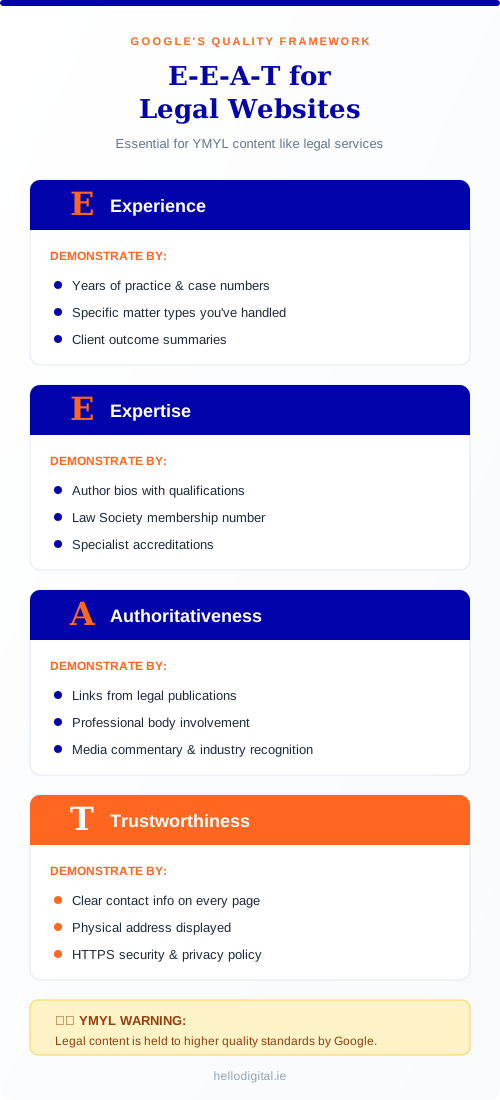
E-E-A-T stands for Experience, Expertise, Authoritativeness, and Trustworthiness. For legal websites, demonstrating these qualities is essential for ranking and for converting visitors into clients.
Show that your firm has hands-on experience with the legal matters you handle:
Include years of experience and case numbers ("Over 500 property transactions completed")
Share case studies or outcome summaries (being careful about confidentiality)
Discuss your process and approach in detail
Reference specific types of matters you've handled
Author Information
Every substantive page should have clear authorship:
Author bio with qualifications (name, position, credentials)
Law Society membership number
Areas of specialisation
Professional photo
Link to full profile page
Credential Display
Prominently display:
Law Society of Ireland membership
Specialist accreditations
Relevant certifications
Years qualified
Previous firm experience (if notable)
Obtain links and mentions from authoritative sources
Publish thought leadership content
Contribute to legal publications
Speak at industry events
Maintain active professional body involvement
Contact and transparency
Clear contact information on every page
Physical office address
Multiple contact methods (phone, email, contact form)
Law Society registration details
Professional indemnity insurance mention
Content integrity
Clear editorial policy
Content review by qualified solicitors
Regular content updates
Correction of errors when identified
Proper sourcing and references (Irish statutes, court decisions where relevant)
Include a clear disclaimer on legal content pages:
"The information on this website is for general guidance only and does not constitute legal advice. Every situation is different, and you should seek advice from a qualified solicitor regarding your specific circumstances."
When discussing Irish law, reference appropriate sources:
Irish statute citations where relevant
Court decisions where appropriate
Law Society guidance
Citizens Information resources
Government publications
This demonstrates expertise and helps readers verify information.
SEO brings visitors to your website; conversion optimisation turns them into enquiries. For legal services, trust is the primary driver of conversion.
Visitors need to quickly understand whether you handle their type of matter:
Clear service descriptions
Specific examples of matters handled
Indication of typical client types
Clear boundaries (what you do and don't handle)
Where possible, provide pricing information:
Fixed fees for standard services (wills, conveyancing)
Fee ranges for more complex matters
Clear explanation of how fees are calculated
What's included in the fee
When additional costs might arise
Even indicative information builds trust. "From €950 plus VAT for standard conveyancing" is more helpful than no pricing information.
Set clear expectations about communication:
How quickly you respond to enquiries
Typical timeframes for different matters
How you keep clients updated
Availability for urgent matters
Display relevant credentials prominently:
Law Society logo and membership confirmation
Specialist panel memberships
Award recognition (if genuine and relevant)
Insurance panel memberships
Professional body logos
Display Google reviews on your website
Include written testimonials (with permission)
Consider video testimonials for higher impact
Include specific outcomes where appropriate
Ensure testimonials are genuine and verifiable
Where confidentiality allows, case studies demonstrate capability:
Anonymise client details appropriately
Focus on challenge, approach, and outcome
Highlight your specific contribution
Use realistic, professional language
Obtain client consent where necessary
Every service page should include clear next steps:
"Request a callback" for those who prefer phone
"Send an enquiry" with a simple contact form
"Book a consultation" if you offer scheduled meetings
Display phone number prominently
Avoid aggressive or salesy language
Technical SEO ensures search engines can effectively crawl, index, and rank your website. For most small solicitor firms, getting the basics right is sufficient.
Google uses Core Web Vitals as ranking factors. The three key metrics:
|
Metric |
What it measures |
Target |
|---|---|---|
|
Largest Contentful Paint (LCP) |
How quickly main content loads |
Under 2.5 seconds |
|
Interaction to Next Paint (INP) |
How quickly page responds to interaction |
Under 200 milliseconds |
|
Cumulative Layout Shift (CLS) |
How stable the page is as it loads |
Under 0.1 |
Check your scores using Google PageSpeed Insights (pagespeed.web.dev).
Most legal searches now happen on mobile devices. Ensure:
Your site is fully responsive
Text is readable without zooming
Buttons and links are easily tappable
Phone numbers are clickable
Forms work properly on mobile
Pages load quickly on mobile connections
Ensure Google can find and index your important pages:
Submit an XML sitemap through Google Search Console
Check for pages blocked by robots.txt unintentionally
Remove noindex tags from pages you want ranked
Fix broken internal links
Ensure important pages are linked from the homepage
Use canonical tags to indicate the preferred version of pages when similar content exists at multiple URLs. This is particularly important if your CMS creates duplicate URLs.
A common issue for solicitors is similar content across location pages. Avoid:
Creating multiple pages with only location names changed
Copying competitor content
Using template content without substantial customisation
Having the same content accessible at multiple URLs
Your website must use HTTPS:
Obtain and maintain an SSL certificate
Redirect all HTTP traffic to HTTPS
Ensure all resources (images, scripts) load over HTTPS
Check for mixed content warnings
This is non-negotiable for any site handling sensitive enquiries.
Irish websites must comply with GDPR and the ePrivacy Directive:
Implement a compliant cookie consent mechanism
Don't load tracking cookies before consent
Provide clear information about cookie purposes
Allow users to withdraw consent easily
Document your cookie use in a privacy policy
Implement analytics to measure performance:
Google Analytics 4 for traffic and behaviour data
Google Search Console for search performance and technical issues
Set up goal tracking for enquiry submissions and phone clicks
Ensure analytics complies with your cookie consent implementation
Links from other reputable websites remain an important ranking factor. For solicitors, quality and relevance matter far more than quantity. Focus on earning links through genuine relationships and valuable content.
Other professionals you work with (accountants, estate agents, financial advisers)
Local businesses you support
Clients' businesses (where appropriate)
Professional contacts from networking
Local sports clubs
Community events
Charity partnerships
School or education initiatives
Local business awards
Guest articles in Irish legal publications
Commentary for business media on legal issues
Local newspaper features
Industry newsletters
Podcast appearances
Law Society of Ireland
Dublin Solicitors Bar Association
Specialist practice area associations
Local chambers of commerce
Business and professional networks
Publish genuinely useful guides
Create resources others want to reference
Offer expert commentary on legal developments
Contribute to legal education
These tactics can result in penalties and damage your reputation:
Buying links from link farms or directories
Participating in link exchange schemes
Paying for guest posts on irrelevant sites
Using automated link building tools
Creating fake profiles or spam comments
Any approach that feels manipulative
The way people find information online is changing. AI-powered search tools like Google's AI Overviews, ChatGPT, Perplexity, and Microsoft Copilot are increasingly influencing how potential clients research legal services. Understanding this shift and adapting your content accordingly can give your firm an advantage.
AI search refers to systems that use large language models (LLMs) to generate direct answers to user queries, rather than simply listing links to websites. When someone asks "how long does conveyancing take in Ireland?", an AI search tool might synthesise information from multiple sources and present a conversational answer.
This doesn't replace traditional search entirely. People still click through to websites, particularly for complex decisions like choosing a solicitor. But AI search changes which content gets surfaced and how it's presented.
AI tools pull information from websites they consider authoritative and trustworthy. For legal queries, this means:
Content from established, credible sources is more likely to be cited
Well-structured, factually accurate information performs better
E-E-A-T signals (Experience, Expertise, Authoritativeness, Trust) matter even more
Content that directly answers specific questions gets prioritised
Potential clients are increasingly:
Asking conversational questions ("what should I do if my employer won't pay redundancy?")
Expecting direct answers before clicking through to websites
Using AI tools to compare and shortlist solicitors
Researching legal processes in more depth before making contact
Despite AI search growth, your website remains essential:
AI tools often cite sources, driving traffic to authoritative content
Complex decisions like choosing a solicitor still require website visits
Local searches with intent to hire still favour traditional results
Your Google Business Profile remains critical for local visibility
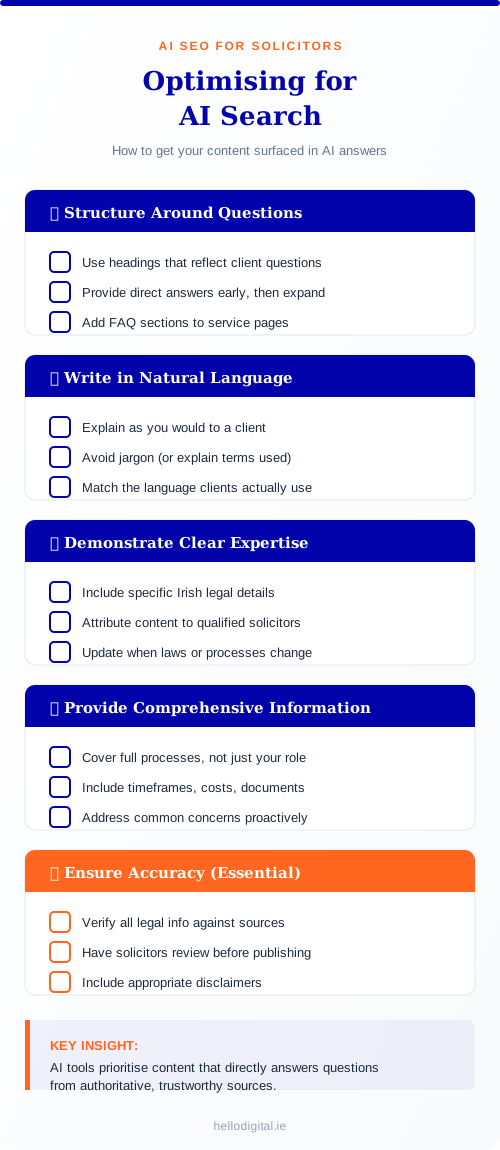
AI tools favour content that directly addresses user queries. Structure your content accordingly:
Use clear headings that reflect questions people ask
Provide direct answers early, then expand with detail
Address related questions within the same content
Include FAQ sections on service pages
Example structure for a conveyancing page:
Instead of starting with "Our conveyancing services...", consider:
AI models are trained on natural language patterns. Content that reads naturally tends to perform better:
Write as you would explain something to a client
Avoid excessive legal jargon (or explain terms when you use them)
Use the same language potential clients use in their queries
Keep sentences and paragraphs digestible
AI systems are designed to prioritise accurate, expert content — especially for legal topics:
Include specific details that demonstrate real knowledge
Reference Irish law and procedures specifically
Update content when legislation or processes change
Attribute content to named, qualified solicitors
AI tools synthesise information from multiple sources. Content that covers topics thoroughly is more likely to be referenced:
Answer the main question and anticipate follow-up questions
Cover the full process, not just your role in it
Include practical details (timeframes, costs, documents needed)
Address common concerns and misconceptions
AI can assist with your SEO efforts when used appropriately. Here's how to use it correctly:
AI tools can help with:
Identifying questions potential clients ask about your practice areas
Researching topics to ensure comprehensive coverage
Understanding how competitors position their services
Generating content outlines and structures
AI can assist with drafting, but requires careful oversight:
Some elements require human expertise:
Legal accuracy and compliance with Irish law
Specific advice tailored to client situations
Professional judgment and ethical considerations
Authentic experience and case examples
Relationship-building and trust signals
For legal content, accuracy isn't just an SEO consideration — it's a professional obligation:
Verify all legal information against authoritative sources
Have qualified solicitors review content before publishing
Update content when laws or procedures change
Include appropriate disclaimers about general information vs. legal advice
AI-generated content that lacks authenticity can harm trust:
Ensure content reflects your firm's genuine expertise
Include real examples from your practice (appropriately anonymised)
Write about topics you actually have experience with
Let your personality and approach come through
While you don't need to disclose AI assistance in content creation, consider:
The content should represent your genuine views and expertise
Information must be verified regardless of how it was drafted
Client-facing content should feel personal and authentic
AI-assisted content should meet the same quality standards as any other content
Review your current website content with AI search in mind:
Does each service page answer the key questions clients ask?
Is information structured clearly with descriptive headings?
Are answers direct and easy to extract?
Is content comprehensive enough to be a definitive resource?
Develop content specifically designed to answer client questions:
Review "People Also Ask" boxes in Google for your practice areas
Create dedicated FAQ pages for each service
Address common client concerns directly
Update content based on questions you receive from actual clients
Demonstrate comprehensive expertise in your practice areas:
Cover topics in depth rather than superficially
Create content clusters around core practice areas
Link related content together logically
Update and expand content over time
Stay informed about how AI search evolves:
Test how AI tools respond to queries about your practice areas
Monitor whether your content appears in AI-generated answers
Adapt your approach as AI search tools develop
Consider how new AI features might affect client behaviour
AI search represents an evolution, not a revolution, in how people find solicitors. The fundamentals remain:
Clients need to trust you before they hire you
Expertise and experience still differentiate firms
Local presence matters for legal services
Personal relationships drive referrals and repeat business
AI tools can help potential clients find you and understand what you do. But converting that visibility into client relationships still depends on demonstrating genuine expertise, building trust, and providing excellent service.
The solicitors who benefit most from AI search will be those who use it as a tool to better serve potential clients — providing clearer, more helpful information that answers real questions and demonstrates authentic expertise.
Avoid these frequently observed errors that undermine SEO performance:
The mistake: Creating multiple pages for different areas with essentially the same content, just swapping location names.
The fix: Either create genuinely unique content for each location or consolidate into one page that mentions all areas served.
The mistake: Using template content from website providers without substantial customisation, or copying competitor content.
The fix: Write original content that reflects your firm's genuine approach and expertise.
The mistake: Never asking clients for reviews, or failing to respond to reviews received.
The fix: Implement a systematic approach to requesting reviews from satisfied clients and respond to all reviews promptly.
The mistake: Purchasing links or participating in link schemes.
The fix: Audit your backlink profile, disavow harmful links, and focus on earning links through genuine relationships.
The mistake: Claiming the profile but never updating it, or not claiming it at all.
The fix: Complete your profile fully, add photos, post regularly, and respond to reviews.
The mistake: Having only a brief paragraph for each practice area.
The fix: Create substantial pages for each major practice area covering scope, process, pricing guidance, credentials, and FAQs.
The mistake: Failing to display Law Society membership, professional indemnity insurance details, or other trust signals.
The fix: Prominently display all relevant credentials and regulatory information.
The mistake: Operating without visibility into website performance or enquiry sources.
The fix: Implement Google Analytics and Search Console with proper consent management.
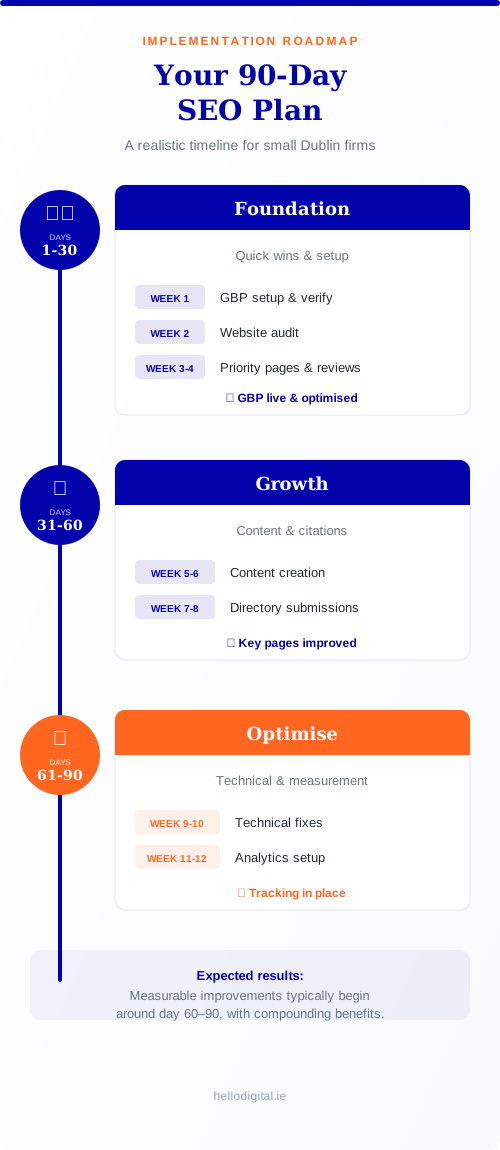
This practical plan is designed for a small Dublin firm with limited time. Focus on high-impact activities first.
☐ Claim and verify your Google Business Profile
☐ Complete all profile fields with accurate information
☐ Add high-quality photos of your office and team
☐ Write a compelling business description including practice areas and Dublin location
☐ Set accurate opening hours
☐ Check that contact information is consistent across your website
☐ Verify your site works well on mobile devices
☐ Confirm HTTPS is active and working
☐ Identify your top 5 practice areas to prioritise
☐ Set up Google Search Console and submit your sitemap
☐ Review and improve your homepage title and meta description
☐ Update your main practice area pages with better content
☐ Ensure each page has a clear call to action
☐ Add Law Society membership and credentials to relevant pages
☐ Create a simple process for requesting reviews
☐ Respond to any existing Google reviews
☐ Identify 5 satisfied clients to ask for reviews
☐ Create a direct link to your Google review page to share
☐ Create or improve 2 practice area pages with comprehensive content
☐ Add FAQ sections to key service pages
☐ Write one educational blog post addressing a common client question
☐ Ensure author credentials are visible on all content
☐ Audit your listings on key Irish directories
☐ Correct any NAP inconsistencies found
☐ Add your firm to 3–5 relevant directories you're missing from
☐ Continue requesting reviews (aim for 2–3 new reviews)
☐ Check Core Web Vitals scores and address obvious issues
☐ Fix any broken links identified in Search Console
☐ Optimise images for faster loading
☐ Implement schema markup on homepage and key pages
☐ Review Google Search Console data to identify opportunities
☐ Check which pages are ranking and for what terms
☐ Identify underperforming pages that need improvement
☐ Set up goal tracking in Google Analytics
☐ Plan next quarter's priorities based on data
Post 1–2 updates on Google Business Profile
Request reviews from satisfied clients
Publish or update 1–2 pieces of content
Monitor and respond to reviews
Check Search Console for issues
Review traffic and enquiry metrics
☐ Profile claimed and verified
☐ Correct primary category selected (Solicitor)
☐ Secondary categories added for practice areas
☐ Business name matches your official firm name exactly
☐ Address is accurate and matches website
☐ Phone number is correct (use main office line)
☐ Website URL is correct☐ Opening hours set accurately
☐ Business description uses all 750 characters
☐ Description includes practice areas naturally
☐ Description mentions Dublin/location
☐ At least 10 high-quality photos uploaded
☐ Office exterior photo included
☐ Office interior photos included
☐ Team photos included (with permission)
☐ Logo uploaded
☐ Posts published at least twice monthly
☐ All reviews responded to within 48 hours
☐ Q&A section populated with common questions
☐ Information updated for holidays/changes
☐ Insights reviewed monthly
.svg)
Page Title: [Practice Area] Solicitors Dublin | [Firm Name]
Meta Description: [Compelling 150-character description including practice area, location, and call to action]
H1: [Practice Area] Solicitors in Dublin
Opening Paragraph: Introduce the service and who it helps. Include primary keyword naturally. Establish relevance to Dublin/Ireland.
What We Help With (H2): List specific matters within this practice area. Use bullet points for scanability.
Our Approach (H2): Explain what distinguishes your service. Reference experience and credentials.
The Process (H2): Outline typical steps from first contact to matter completion. Set expectations.
Fees and Costs (H2): Provide pricing information where possible (fixed fees, ranges, or factors affecting cost). Be transparent.
Why Choose Us (H2): Credentials, experience, team qualifications. Include relevant statistics.
Frequently Asked Questions (H2): 5–8 questions addressing common client concerns. Use FAQ schema markup.
Call to Action: Clear next step with contact form, phone number, and/or booking link.
Author Information: Name, qualifications, Law Society number, photo.
Page Title: Solicitors in [Area] Dublin | [Firm Name]
Meta Description: [Description including area name, services offered, and call to action]
H1: Solicitors Serving [Area], Dublin
Opening Paragraph: Introduce your firm's connection to this area. Why clients in this location choose you.
Services Available (H2): List practice areas available to clients in this location.
Our [Area] Expertise (H2): Specific knowledge relevant to this area (local courts, property market knowledge, etc.). This section must contain genuinely unique content.
Visiting Our Office (H2): Directions, parking, accessibility information. Include embedded map if appropriate.
Client Testimonials from [Area] (H2): Reviews or testimonials from clients in this location (if available).
Contact Us (H2): Address, phone, contact form. Response time commitment.
Track these metrics monthly to measure progress:
Organic traffic (from Google Analytics)
Impressions in search (from Search Console)
Average position for priority keywords
Number of keywords ranking in top 10
Profile views
Search appearances (direct vs. discovery)
Website clicks from profile
Direction requests
Phone calls
Pages indexed
Core Web Vitals scores
Mobile usability issues
Crawl errors
Total Google reviews
New reviews this month
Average rating
Reviews responded to
Most solicitor firms begin to see meaningful improvements within 3–6 months of consistent effort, though competitive Dublin markets may take longer. Local SEO changes (Google Business Profile optimisation) often show results within weeks, while building organic search visibility requires sustained work over months. Expect gradual, compounding improvements rather than overnight transformation.
Budgets vary significantly depending on whether you manage SEO in-house or hire help. For a small firm handling SEO internally, expect to invest 5–10 hours monthly of someone's time. If hiring an SEO consultant or agency, reasonable monthly retainers for small firms typically range from €500–€2,000, depending on scope. The most important investment is consistent effort over time.
This depends on your available time and technical comfort. Many small firms successfully implement the basics themselves using guides like this one. Consider professional help if you lack time to implement consistently, need technical expertise for website changes, want to accelerate results in a competitive market, or prefer to focus on legal work rather than marketing.
For most Dublin solicitors, optimising your Google Business Profile offers the highest return on investment. It directly affects your appearance in local map results, provides essential information to potential clients, and can be fully optimised within a few hours. After GBP, focus on ensuring your website clearly communicates your practice areas and makes it easy to make contact.
There's no magic number, but having more genuine positive reviews than your direct competitors is a reasonable goal. For most Dublin practice areas, 20–50 quality reviews represents a strong position. However, review velocity (continuing to earn new reviews) matters as much as total count. Focus on building a sustainable system for requesting reviews rather than a one-time push.
Only if you can add genuinely unique, valuable content for each location. Thin location pages that simply swap place names perform poorly and can harm your site overall. For most small firms, a single page mentioning all areas served—or perhaps 2–3 pages for distinctly different regions—works better than attempting to target every postcode.
Yes, many of the highest-impact activities require no technical expertise: optimising your Google Business Profile, writing better content for practice area pages, requesting reviews from clients, and ensuring your contact information is accurate across the web. Some technical elements (schema markup, Core Web Vitals fixes) may require developer assistance, but you can make substantial progress on your own.
Focus on accuracy, credentials, and helpfulness. Ensure content is reviewed by qualified solicitors before publishing. Display author credentials prominently. Reference appropriate sources (statutes, Law Society guidance). Include clear disclaimers that content is general information, not legal advice. Update content regularly to maintain accuracy. These practices build trust with both Google and potential clients.
Alt Text: Descriptive text added to images that helps search engines understand image content and improves accessibility for screen readers.
Backlink: A link from another website to your website. Quality backlinks from relevant, authoritative sites improve your search rankings.
Canonical Tag: An HTML element that tells search engines which version of a page is the "master" version when similar content exists at multiple URLs.
Citation: A mention of your business name, address, and phone number on another website, typically in a directory listing. Consistent citations help local SEO.
Core Web Vitals: Google's metrics measuring page loading speed, interactivity, and visual stability. These are official ranking factors.
Crawling: The process by which search engines discover and read pages on your website using automated software (bots or spiders).
E-E-A-T: Experience, Expertise, Authoritativeness, and Trustworthiness. The qualities Google looks for when evaluating content quality, particularly important for legal websites.
Google Business Profile (GBP): Google's free tool for managing how your business appears in Google Search and Maps. Essential for local SEO.
H1, H2, H3: HTML heading tags that create a hierarchy of content on a page. H1 is the main heading; H2 and H3 are subheadings.
Indexation: The process by which search engines add your pages to their database so they can appear in search results.
Internal Link: A link from one page on your website to another page on the same website. Good internal linking helps both users and search engines navigate your site.
Keyword: A word or phrase that people type into search engines. Effective SEO involves understanding which keywords your potential clients use.
Keyword Cannibalisation: When multiple pages on your site compete for the same search terms, diluting your ranking potential.
Local Pack / Map Pack: The section of Google search results showing a map and 3 local business listings. Appearing here is crucial for local solicitors.
Meta Description: The summary text that appears below your page title in search results. Should be compelling and include relevant keywords.
NAP: Name, Address, Phone number. Keeping these consistent across all online listings is important for local SEO.
Organic Traffic: Visitors who reach your website through unpaid search results (as opposed to paid advertising).
Schema Markup: Code added to your website that helps search engines understand your content better and can enable rich results in search.
SERP: Search Engine Results Page. The page displayed after someone performs a search.
Title Tag: The HTML element that defines the title of a webpage. Appears as the clickable headline in search results.
YMYL: "Your Money or Your Life." Google's classification for topics where low-quality content could harm users, including legal, financial, and health topics. YMYL content is held to higher quality standards.
Effective SEO for solicitors isn't about tricks or shortcuts. It's about making your firm visible when potential clients search for the legal help you provide, and ensuring your website builds enough trust for them to make contact.
For small solicitor firms in Ireland, the fundamentals matter most: a well-optimised Google Business Profile, clear practice area pages, genuine client reviews, and consistent effort over time. You don't need to master every technical detail — focus on the activities that directly connect you with potential clients.
Start with the 30-day foundation in this guide. Claim and optimise your Google Business Profile, ensure your website clearly communicates what you do and how to contact you, and begin building a sustainable approach to earning reviews. These basics, executed consistently, will outperform any amount of tactical complexity.
Results take time. Expect gradual improvement over months, not overnight transformation. But the visibility and trust you build through ethical SEO create sustainable advantages that continue to compound.
If you'd like guidance specific to your firm's situation or simply want someone to handle this while you focus on legal work, let's talk.
I offer free initial consultations to discuss your SEO needs. No pressure, no obligation; just a straightforward conversation about whether I can help.
Disclaimer: This guide provides general information about SEO for solicitor websites. It does not constitute legal advice, marketing guarantees, or promises of specific results. Every firm's situation is different, and results depend on many factors including competition, effort invested, and market conditions.
Alessandro Boscolo Conway — Hello Digital
I'm a Dublin-based freelance SEO and digital marketing consultant with over 20 years of experience, including time on Google Ireland’s Search Quality team.
I run Hello Digital, a consultancy that helps startups and small businesses across Ireland grow online through clear strategy, expert delivery, and practical support.
I've worked with over 50 Irish companies to improve their visibility, generate better leads, and grow sustainably through SEO and digital marketing.
I'm a certified Google Partner and a trusted advisor to e-commerce brands, local services, and fast-growing startups.
- Based in Dublin, 20+ years of experience
- Former Googler, certified Google Partner, SEO strategist, and performance marketer
- Trusted by 50+ Irish startups, e-commerce brands, and local businesses
- Learn more about Hello Digital