Last updated: 23 August 2026
No. Running Google Ads does not make your website rank higher in Google’s organic results, and spending more on ads will not improve your SEO rankings. Paid and organic search use separate systems.
Where Google Ads can help is in the information it gives you. When I manage paid search alongside SEO, I can use search-term and conversion data to see which queries generate real business, understand search intent, identify gaps in organic visibility and decide which pages are worth prioritising.
That distinction matters because businesses sometimes see organic traffic change when Google Ads campaigns start or stop and assume one caused the other. There can be connections between paid and organic performance, but paying Google does not buy better organic rankings.
Quick takeaways
-
Google Ads does not improve your organic rankings, no matter how much you spend.
-
Paid traffic, bounce rate and time on site are not a shortcut to better SEO.
-
Google Ads can still support SEO by showing which search terms, offers and landing pages generate conversions.
-
Paid and organic results can compete for clicks, so changes in organic traffic after starting or stopping Ads do not automatically mean rankings changed.
-
The biggest SEO value in Google Ads is the data it gives you to make better decisions about keywords, search intent, content and landing pages.
Does running Google Ads affect your organic rankings?
Google Ads spend is not an organic ranking factor. Starting a campaign will not push your pages higher in the search results, increasing your budget will not improve their positions, and pausing your ads will not make Google lower them.
Google states explicitly that investment in paid search has no impact on organic rankings. The advertising auction and Google's organic ranking systems are separate.
The confusion usually starts when a business changes its Google Ads activity and notices organic traffic moving at around the same time. I would not treat that as evidence that the ads caused a ranking change.
Organic traffic can rise or fall because rankings changed, search demand changed, competitors gained visibility, an algorithm update occurred, or paid and organic listings started capturing a different share of the available clicks. You need to look at the underlying search data before drawing a connection between the two channels.
The same applies when someone claims their SEO improved after they increased their Google Ads budget. A correlation may be worth investigating, but the additional ad spend itself did not buy better organic positions.
Why can organic traffic change when Google Ads start or stop?
Paid and organic search are separate, but they compete for attention on the same results page. That can make changes in Google Ads performance look like SEO changes even when your organic rankings have not moved.
For example, if you already rank organically for a valuable query and then start showing an ad above the organic results, some users who might previously have clicked your organic listing may click the ad instead. Organic clicks can fall while your ranking stays exactly the same.
The reverse can happen when you pause a campaign. Some of the clicks previously going to your ads may shift to the organic listing, particularly for branded searches where your website already ranks prominently.
Advertising can also increase brand awareness. Someone may see your ads several times without clicking, then search for your business by name later. Google Ads can therefore contribute to more branded searches and organic visits without changing the ranking algorithm.
This is why I look beyond traffic when comparing paid and organic performance. Google Search Console can show whether organic impressions, clicks and positions actually changed, while Google Ads shows what happened to paid visibility. Looking at both prevents a change in click distribution from being mistaken for an SEO ranking gain or loss.
Google also provides a Paid & Organic report when Google Ads and Search Console are linked. It can show queries where your website appeared organically, where an ad appeared, and where both were present, which makes it easier to understand how the two channels are sharing search visibility.
How Google Ads can actually help your SEO
The value of Google Ads for SEO is in the data, not the ad spend. A well-run campaign can show you how people search, which queries generate enquiries or sales, and where your website is failing to capture valuable demand organically.
Find search terms that generate enquiries and sales
Keyword research tools can estimate search volume and competition, but they cannot tell you which searches are valuable to your business.
The Google Ads Search Terms report can. It shows many of the actual searches that triggered your ads and, when conversion tracking is set up properly, which of those searches produced enquiries, purchases or other valuable actions.
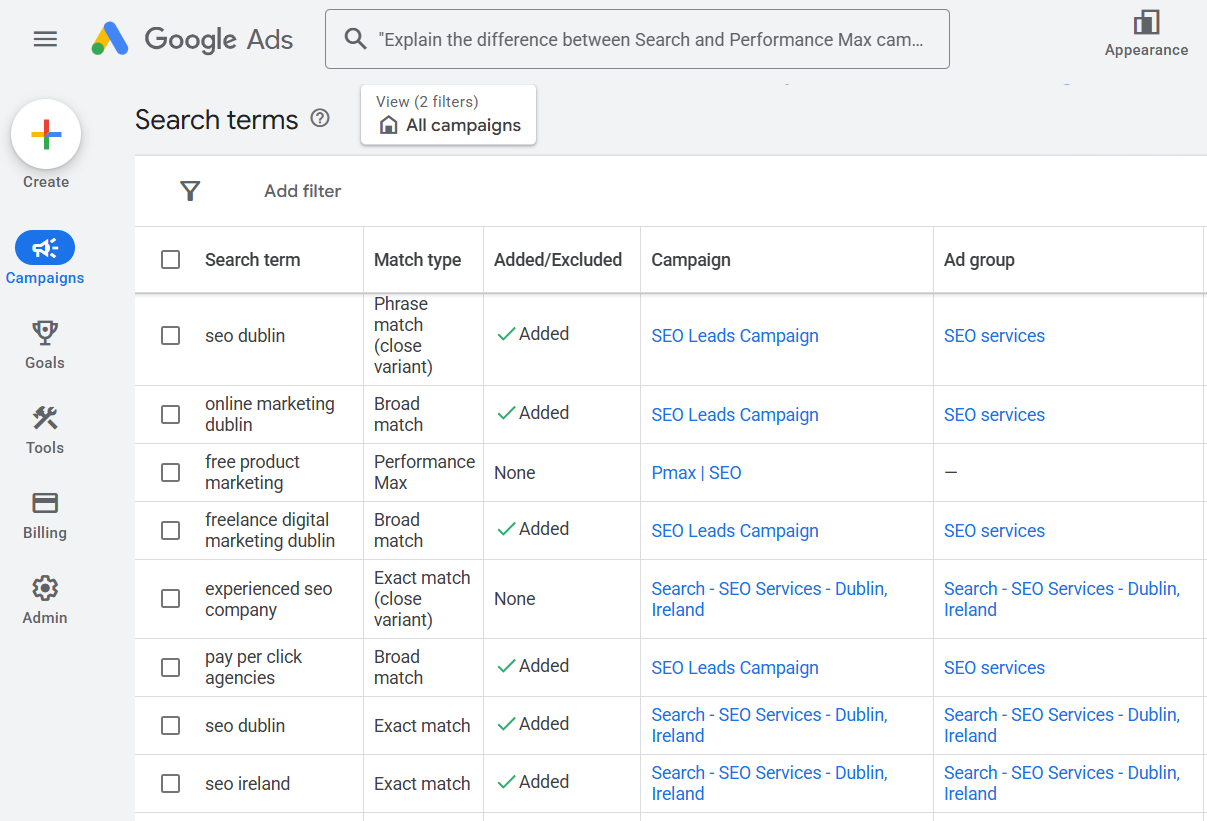
I use that information to separate keywords that simply generate traffic from those that show commercial potential. If a search term consistently produces qualified leads through Google Ads but the website has little organic visibility for it, that is a much stronger case for SEO investment than search volume alone.
Validate search intent before investing in SEO
Two keywords with similar wording can produce very different results.
One may attract people looking for information. Another may attract people ready to enquire. Google Ads gives you a faster way to test that intent before committing significant time to a new service page, landing page or piece of SEO content.
Conversion data is particularly valuable here. A high-volume keyword that rarely converts may be less important commercially than a lower-volume query that repeatedly produces the right type of customer.
Find gaps between paid and organic visibility
Google Ads and Search Console can also show where your business is relying too heavily on paid search.
If a query generates profitable paid traffic but your organic listing is weak or absent, it may deserve greater SEO priority. Conversely, if you already hold a strong organic position and paid clicks add little incremental value, you may decide that the budget is better used elsewhere.
I look at the two channels together rather than judging them independently. The objective is to understand where additional organic visibility could reduce dependence on paid traffic and where advertising is still filling a genuine gap.
Use paid campaigns to test messaging
Google Ads can give you relatively fast feedback on the language people respond to. Headlines, offers, pricing messages and different ways of describing a service can all be tested before you make broader changes to your website.
That does not mean taking the ad with the highest click-through rate and copying it into an SEO title tag. Paid and organic results work differently, and the most-clicked message is not automatically the best option for organic search.
I use ad performance as evidence. If certain wording repeatedly attracts the right users and contributes to conversions, it is worth considering when refining the corresponding organic page, its headings and how the offer is presented.
Learn which landing pages and offers perform
Google Ads can also expose problems that matter beyond the campaign itself. If users searching for a valuable service consistently fail to convert on the page they reach, the issue may be the page, the offer, the search intent or a mismatch between them.
Those findings can inform SEO work on the same part of the site. A page may need a clearer proposition, better information, a different structure or even to target a different query altogether.
The paid campaign has not improved the page's rankings. It has given you evidence that can be used to make the page better.
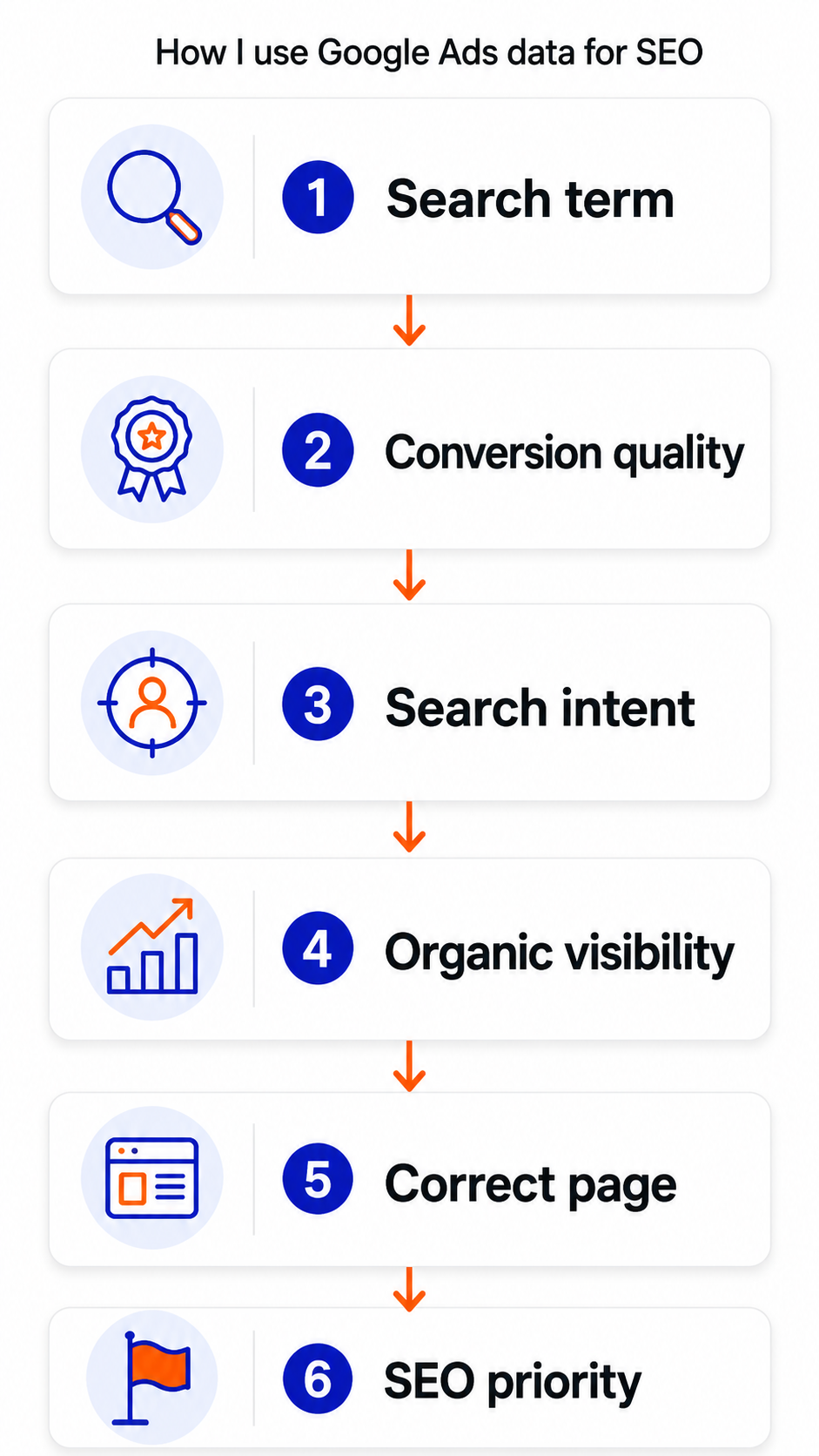
How I use Google Ads data when working on SEO
When I manage Google Ads and SEO for the same client, I use paid search data to help decide where SEO effort is most likely to produce commercial value.
The process is:
Search term → conversion quality → search intent → organic visibility → correct page → SEO priority
I start with the actual search terms generating clicks and conversions, not just the keywords added to the campaign. Then I look at what those conversions are worth. A term generating form submissions is only useful if those enquiries are relevant and have a realistic chance of becoming customers.
Next, I check the intent behind the query and the website’s current organic visibility. If a commercially valuable search is already generating good leads through Google Ads but the site ranks poorly for it, I look at whether the right organic page exists and whether that page properly satisfies the search intent.
I recently saw a client generating qualified leads through Google Ads for a search term where the site had almost no organic visibility. I treated that as evidence that the query deserved stronger organic coverage. The next step was to check whether the existing service page matched the intent or whether a different page was needed.
Sometimes the answer is to improve an existing service page. Sometimes a separate landing page or supporting article is justified. In other cases, the paid data shows that a keyword attracts the wrong audience and should not be an SEO priority at all.
I also compare paid and organic performance over time. If Google Ads is consistently responsible for most of the visibility and conversions around an important service, that can highlight an area where stronger organic rankings would reduce reliance on paid traffic.
For me, that is the real connection between Google Ads and SEO. Paid search gives me faster evidence about demand and commercial intent, and I can use that evidence to make better decisions about where to invest in organic search.
Can Google Ads hurt your SEO?
Running Google Ads does not hurt your organic rankings. Poor-quality paid traffic, high bounce rates or short visits from ads are not reasons for Google to lower a page in the organic results.
A badly managed campaign can still create problems, just not the kind of SEO penalty people sometimes assume. You can waste budget on irrelevant searches, send users to the wrong landing page, distort your reporting, or make it harder to understand how paid and organic search are contributing to conversions.
The landing pages themselves can also need work. If a page is slow, confusing or poorly matched to search intent, that can affect both Google Ads performance and its ability to perform well organically. The underlying page problem matters to both channels, but poor ad traffic is not what causes the SEO issue.
The same applies to dedicated PPC landing pages. If they are not intended to rank organically, they should be handled appropriately from an SEO and site-architecture perspective rather than assuming Google will ignore them simply because they were created for advertising.
So if organic rankings fall while Google Ads are running, I would investigate the SEO problem separately. I would not assume the campaign itself caused the decline.
Should you run Google Ads and SEO together?
For many businesses, yes. The two channels solve different problems.
Google Ads can generate visibility and leads quickly, particularly for important commercial searches where you do not yet rank organically. SEO takes longer, but stronger organic visibility can reduce how dependent you are on paid traffic over time.
Running both also gives you more information. Paid search can show which queries convert, while Search Console shows how the same topics perform organically. That makes it easier to decide where to increase SEO investment, where paid search is still needed, and where both channels are competing for the same clicks.
I would not run both simply for the sake of being visible twice. The mix should depend on the value of the search, your existing organic rankings, the cost of paid traffic and whether the additional clicks are producing worthwhile business.
For businesses that need leads now while building longer-term organic visibility, combining PPC management with SEO often makes sense. The important part is measuring the channels together rather than assuming one automatically improves the other.
FAQs about Google Ads and SEO
Does Google favour websites that spend money on Google Ads?
No. Spending money on Google Ads does not give your website preferential treatment in organic search. Paid advertising and organic rankings are handled separately.
Does Google Ads traffic count towards SEO?
Google Ads traffic appears in your analytics like other website traffic, but paid visits do not directly improve your organic rankings. The useful SEO value comes from what the campaign tells you about search terms, intent, conversions and landing-page performance.
Can bad Google Ads traffic hurt SEO?
Not in the way it is sometimes described. Irrelevant paid visitors, high bounce rates or short sessions do not automatically cause Google to lower your organic rankings.
Poor targeting can waste money and make your performance data harder to interpret, while a poor landing page may have problems that affect both paid and organic performance. Those are separate issues from Google Ads traffic damaging SEO.
Will pausing Google Ads hurt my organic rankings?
No. Pausing a campaign does not cause Google to lower your organic rankings.
You may see changes in overall traffic, branded searches or the proportion of clicks going to your organic listings after ads are paused. Check rankings and impressions in Google Search Console before assuming that an organic decline has occurred.
Does spending more on Google Ads improve SEO?
No. Increasing your Google Ads budget can increase paid visibility if the campaign has room to spend more, but it does not give your pages an organic ranking advantage.
Can I use Google Ads search terms for SEO keyword research?
Yes, and this is one of the most valuable connections between the two channels. Search-term and conversion data can show you which queries people actually use and which ones generate worthwhile business.
I would use that information alongside SEO data rather than replacing conventional keyword research with Google Ads data alone. Search volume, current rankings, SERP intent, competition and the role of the page still matter.
Need help with Google Ads and SEO?
If you are running Google Ads and SEO separately, there is often useful data sitting in one channel that can improve decisions in the other.
I work with businesses on both SEO and Google Ads, looking at search demand, conversion data and organic visibility together rather than treating them as isolated activities.
If you want to understand where your paid and organic search activity should overlap, where they should stay separate, and where your budget is likely to have the most impact, book a free consultation.
About the author
Alessandro Boscolo Conway — Hello Digital
I'm a Dublin-based freelance SEO and digital marketing consultant with over 20 years of experience, including time on Google Ireland’s Search Quality team.
I run Hello Digital, a consultancy that helps startups and small businesses across Ireland grow online through clear strategy, expert delivery, and practical support.
I've worked with over 50 Irish companies to improve their visibility, generate better leads, and grow sustainably through SEO and digital marketing.
I'm a certified Google Partner and a trusted advisor to e-commerce brands, local services, and fast-growing startups.
- Based in Dublin, 20+ years of experience
- Former Googler, certified Google Partner, SEO strategist, and performance marketer
- Trusted by 50+ Irish startups, e-commerce brands, and local businesses
- Learn more about Hello Digital