

SEO

Last updated: May 2026
If you run a building firm, SEO helps your business appear when people search for builders, extension contractors, renovation companies or construction services in your area.
A strong SEO strategy can help your building company show up in Google Search, Google Maps and AI search results when homeowners are researching house extensions, renovations, attic conversions, garage conversions, retrofit work or general building services.
For builders in Ireland, SEO is not just about getting more website traffic. It is about getting found by the right people, in the right locations, at the right stage of their project.
This guide explains how SEO for builders works, why it matters, and what your building firm should prioritise first.
SEO, or Search Engine Optimisation, is the process of improving your website and online presence so your business is easier to find on Google.
For a builder, this means appearing when someone searches for terms such as:
builder near me
extension builders Dublin
house renovation company Cork
attic conversion contractor Galway
garage conversion builder Kildare
SEAI retrofit contractor Wicklow
construction company near me
building contractor Ireland
Good builder SEO helps your business appear in three important places:
Google Maps and the local map pack
Standard Google organic search results
AI search results and AI-generated answers
If your building firm is not visible in these places, potential clients may never find you, even if you are better, more experienced or more reliable than the competitors appearing above you.
Most builders still get a lot of work through referrals. That is valuable, and SEO should not replace word of mouth. It should support it.
The problem is that referrals have limits. They depend on who already knows you. They can be inconsistent. They may not help if you want to attract larger projects, move into a new service area, promote retrofit work or grow beyond your current network.
SEO gives your building business another way to generate enquiries.
When someone searches online for a builder in your area, they are already showing intent. They may be researching a future renovation, comparing extension contractors, checking planning requirements or looking for a firm to contact now.
If your website, Google Business Profile, reviews and project examples are strong, SEO can help you turn that search demand into real enquiries.
For builders, SEO is especially important because trust is a major part of the buying decision. A homeowner is not choosing a low-cost product. They are choosing a firm to work in their home, manage a large budget and deliver work that must be safe, compliant and well finished.
Your online presence needs to prove that you are credible before they contact you.
SEO for builders has several moving parts, but the core idea is simple: make it easy for Google and potential clients to understand what you do, where you work and why you can be trusted.
The main parts of builder SEO are:
| SEO area | What it means for builders |
|---|---|
| Local SEO | Helping your building firm appear in Google Maps and local search results |
| Google Business Profile | Optimising the business listing that appears in Maps and local results |
| Keyword research | Finding the terms homeowners use when searching for builders |
| Service pages | Creating dedicated pages for extensions, renovations, attic conversions and other services |
| Location pages | Building pages for the towns, counties or suburbs you serve |
| Content marketing | Publishing useful guides, FAQs and project advice |
| Case studies | Showing completed projects with real photos, locations and results |
| On-page SEO | Optimising titles, headings, URLs, images and internal links |
| Technical SEO | Making sure your site is fast, mobile-friendly, secure and crawlable |
| Link building | Earning links and mentions from credible local and industry sources |
| Measurement | Tracking rankings, traffic, calls, forms and enquiry quality |
| AI SEO | Structuring content so AI tools can understand, summarise and cite it |
You do not need to master every part at once. Most small building firms should start with the basics: Google Business Profile, service pages, reviews, project photos and clear local content.
If you want a practical starting point, use this checklist.
| Priority | SEO action | Why it matters |
|---|---|---|
| High | Claim and complete your Google Business Profile | Helps you appear in Google Maps and local searches |
| High | Add your main services clearly | Helps Google match you to relevant searches |
| High | Collect Google reviews | Builds trust and supports local visibility |
| High | Create dedicated service pages | Helps you rank for searches such as “extension builders Dublin” |
| High | Add real project photos | Gives potential clients visual proof of your work |
| High | Publish project case studies | Shows experience in specific services and locations |
| Medium | Create location pages | Helps you rank in the areas you serve |
| Medium | Improve mobile speed | Reduces lost visitors on phones |
| Medium | Add local and industry directory listings | Reinforces your business details and credibility |
| Medium | Track calls and forms | Shows whether SEO is generating enquiries |
| Longer term | Optimise for AI search | Helps your content appear in AI-generated answers |
This is the order I would usually recommend for a small building firm in Ireland. Start with the actions most likely to improve local visibility and trust, then build out content and authority over time.
Search intent means what the person is trying to achieve when they type a query into Google.
For builders, search intent is more complex than for emergency trades. Someone looking for a plumber may need help immediately. Someone looking for a builder may spend weeks or months researching before they contact anyone.
Most builder searches fall into three stages.
At this stage, the homeowner is exploring an idea. They are not ready to hire a builder yet.
They may search for:
house extension ideas Ireland
how much does a house extension cost in Ireland
attic conversion ideas
garage conversion ideas Ireland
types of home renovations
These searches do not usually lead to immediate enquiries. But they can introduce your business early in the buying journey.
At this stage, the homeowner is getting more serious. They want to understand cost, planning permission, timelines, disruption and what the process involves.
They may search for:
do I need planning permission for a rear extension in Ireland
how long does a house extension take
can I live at home during a renovation
what should be included in a builder’s quote
SEAI retrofit grant eligibility
These searches are valuable because the person is actively preparing for a project. Useful content at this stage can build trust before the homeowner starts asking for quotes.
At this stage, the homeowner is ready to make a shortlist.
They may search for:
extension builders Dublin
builder near me
house renovation company Kildare
attic conversion contractor Cork
CIF registered builder Galway
SEAI registered contractor Wicklow
These are high-intent searches. Your service pages, location pages, Google Business Profile, reviews and case studies need to be strong enough to turn this searcher into an enquiry.
Good SEO for builders covers all three stages. Most builder websites only focus on the final stage. That leaves a large amount of search demand untouched.
The Irish construction and home improvement market continues to generate strong search demand.
The Central Statistics Office reported 36,284 new dwelling completions in 2025, a 20.4% increase on 2024 and the highest annual level since the CSO series began in 2011. The CSO also reported 2,328 planning permissions for extensions in Q3 2025. SEAI reported that overall home energy upgrade applications were up 96% in the first quarter of 2026 compared with the same period in 2025.
That activity creates online searches.
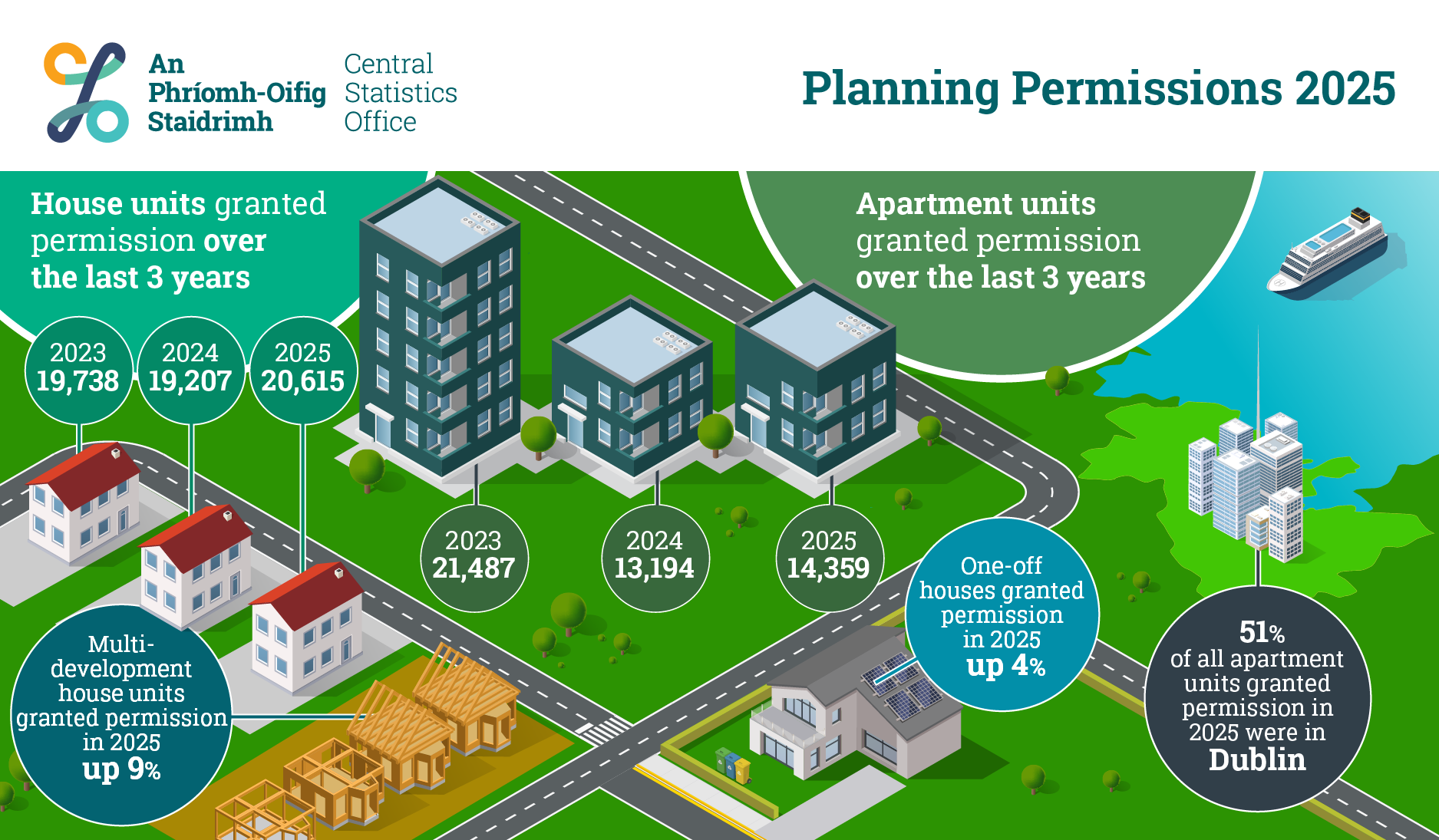
Source: CSO.ie
Homeowners are searching for builders, extension contractors, renovation companies, retrofit providers, planning advice, cost guidance and local recommendations.
Competition varies by location. Searches such as “extension builders Dublin” can be competitive. But many towns, suburbs and counties still have relatively weak online competition. In those areas, a building firm with a strong Google Business Profile, clear service pages, recent reviews and good case studies can often build visibility faster than expected.
The opportunity is not just to get more leads. It is to get better-qualified leads from people already researching the kind of work you want to win.
Your website needs to explain what you do, where you work and why someone should trust you.
A common mistake is having one generic “Services” page that lists everything: house extensions, home renovations, new builds, attic conversions, garage conversions, commercial work and more.
That is not enough for SEO.
Google ranks individual pages. If someone searches “house extension builders Dublin”, Google wants to show a page that is specifically about house extensions in Dublin. A generic services page that briefly mentions extensions alongside several other services is unlikely to be the strongest result.
A strong builder website should usually include:
Homepage
About page
Services overview page
Individual service pages
Location pages
Project case studies
Reviews or testimonials page
Blog or guides section
Contact page
The most important SEO pages are usually the individual service pages, location pages and case studies.
Each important service should have its own page.
For a domestic building firm, this may include:
House extensions
Home renovations
Full house refurbishments
Attic conversions
Garage conversions
New builds
Kitchen renovations
Bathroom renovations
Retrofitting and energy upgrades
Commercial fit-outs, if relevant
Each service page should answer the questions a potential client has before they contact you.
A useful service page should include:
What the service covers
The types of projects you handle
Where you provide the service
Planning or regulatory considerations
Typical process from enquiry to completion
Timelines, where possible
Cost factors, where possible
Credentials and insurance
Relevant project photos
Links to case studies
Clear calls to action
A strong local service page does not need to be unnecessarily long. Around 800 to 1,200 words is often enough if the content is specific, useful and well structured.
Local SEO helps your building firm appear when people search for services in your area.
For builders, local SEO is one of the highest-impact parts of SEO because most clients want a firm that works nearby. A homeowner in Swords is unlikely to hire a builder based several counties away unless the project is unusually specialised.
Local SEO for builders focuses on:
Google Business Profile
Google Maps visibility
Local service and location pages
Reviews
Local citations
Industry directories
Local backlinks
Consistent business details across the web
Google’s local rankings are mainly influenced by relevance, distance and prominence.
Relevance means how well your business matches the search. Distance means how close or locally relevant you are to the searcher or searched location. Prominence relates to how well known and trusted your business appears to be online, including reviews, links, citations and wider reputation.
Google Business Profile is one of the most important SEO assets for any builder.
It is the listing that appears in Google Maps and local search results. For searches such as “builders near me”, “extension builders Dublin” or “renovation company Cork”, the map pack can appear above the normal organic results.
For many builders, the Google Business Profile can generate calls before the website does.
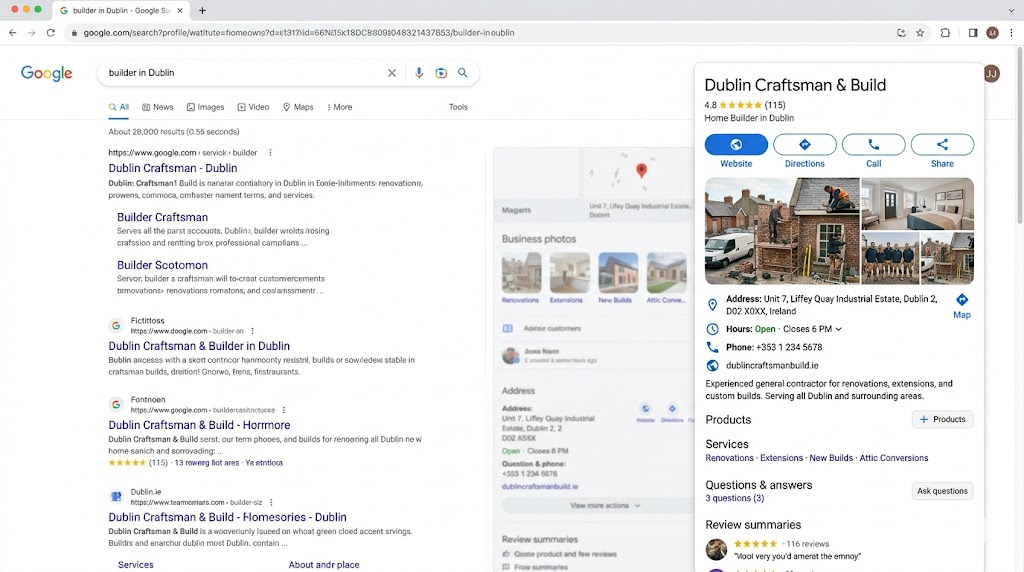
If you have not claimed your profile, start there.
Your profile should include:
Correct business name
Address or service area
Phone number
Website URL
Opening hours
Services
Business description
Photos
Reviews
Updates where relevant
Use your real business name. Do not add keywords unless they are part of your actual trading name. If your business is called “Murphy Construction”, do not list it as “Murphy Construction Dublin Extension Builders”. This can breach Google’s guidelines.
If you work from home and do not want to show your address, use the service-area business option and define the areas you cover.
Categories influence which searches your profile can appear for.
Useful categories for builders may include:
Building Contractor
General Contractor
Construction Company
Home Builder
Renovation Company
Secondary categories may include:
Attic Conversion Service
Kitchen Remodeler
Bathroom Remodeler
Garage Builder
Insulation Contractor
Only choose categories that genuinely apply to your business.
Your description should explain what you do, where you work and why people should trust you.
Example:
“Family-run building contractors based in Dublin, specialising in house extensions, home renovations and attic conversions across Dublin city and county. Established for over 15 years, fully insured and experienced in managing residential projects from initial consultation to handover.”
This is better than vague claims such as “best builders in Dublin” or “top-quality construction services”. Specific information builds more trust.
For builders, photos are proof.
Upload real photos of:
Completed extensions
Before and after renovation work
Attic conversions
Garage conversions
Retrofit or insulation projects
Your team on site
Detail shots showing workmanship
Use descriptive file names before uploading, such as rear-extension-rathfarnham-dublin.jpg rather than IMG_4729.jpg.
Add new photos regularly. A profile with current, real project photos looks more credible than a profile with old or generic images.
Reviews are one of the most important local SEO assets for builders.
They help potential clients decide whether to contact you. They also contribute to your wider local prominence.
The simplest way to get more reviews is to ask at the right time. Build review requests into your project completion process.
At handover, ask the client directly. Then follow up with a text or email containing your direct Google review link.
Do not offer incentives. Do not buy reviews. Do not ask people who were not genuine clients.
Respond to every review. For positive reviews, be specific. For negative reviews, stay calm, professional and solution-focused. Future clients are often judging how you respond as much as what the review says.
Keyword research helps you understand what potential clients type into Google when they are looking for building services.
For builders, the most valuable keywords usually combine a service with a location.
Examples include:
extension builders Dublin
house renovation company Kildare
attic conversion contractors Cork
builder Wicklow
garage conversion Dublin 15
SEAI registered contractor Meath
These searches are valuable because they show both need and location.
Builder SEO usually involves four main keyword types.
| Keyword type | Example | Best page type |
|---|---|---|
| Service and location | Extension builders Dublin | Service page or location page |
| Cost | House extension cost Ireland | Guide or blog article |
| Planning and process | Do I need planning permission for an attic conversion? | Guide, FAQ or blog article |
| Credentials | CIF registered builder Dublin | About page, service page or dedicated guide |
Do not focus only on broad terms such as “builders”. They are usually too vague. A person searching “house extension builder near me” is more likely to become a useful enquiry.
Local keywords are central to SEO for building firms.
A builder serving Dublin and surrounding counties may need to target searches such as:
builders Dublin
extension builders South Dublin
renovation company North Dublin
attic conversion contractor Dublin 15
builders Meath
house extension company Kildare
builders Wicklow
The right local terms depend on the services you offer and the areas you genuinely cover.
Do not create pages for places where you do not realistically work. That wastes SEO effort and can generate poor-quality enquiries.
Your clients are already telling you what your future clients are searching for.
Common questions can become useful SEO content.
Examples include:
How much does a house extension cost in Ireland?
Do I need planning permission for a rear extension?
Can I live in the house during a renovation?
How long does an attic conversion take?
What should I look for in a builder’s quote?
What is HomeBond?
What does a building contractor manage?
How do SEAI grants work?
Each of these could become a blog post, FAQ answer, service page section or downloadable guide.
SEO content for builders should not be written just to fill a blog. It should answer real questions from potential clients.
The best content helps homeowners understand the project before they contact a builder. This is important because building projects usually involve large budgets, disruption and careful planning.
Useful builder content includes:
Cost guides
Planning permission guides
Project timelines
Quote comparison advice
SEAI grant explainers
Case studies
FAQs
Maintenance or preparation guides
Service explainers
Cost-related searches are valuable because they show serious interest.
Many builders avoid cost content because every project is different. That is understandable, but avoiding the topic completely is a missed opportunity.
A homeowner researching costs does not expect a final quote from a blog post. They want to know whether their project is realistic and what affects the price.
A strong cost guide should cover:
Typical cost ranges, where you can provide them responsibly
What changes the price
Why quotes vary between builders
What is usually included
What may be excluded
Common red flags
When a site visit is needed
This kind of content builds trust because it helps the reader make a better decision.
Planning permission is one of the biggest areas of confusion for Irish homeowners.
Builder websites can perform well in search by explaining topics such as:
Planning permission for house extensions
Exempted development rules
Garage conversion planning rules
Attic conversion requirements
Building regulations versus planning permission
Local authority considerations
These guides should be accurate, plain-English and kept up to date. If a topic requires legal or architectural advice, say so clearly and explain when the homeowner should speak to an architect, engineer or planning consultant.
Project case studies are one of the strongest SEO assets for builders.
They show real work, real locations and real outcomes. They also naturally combine the exact elements people search for: the type of work, the location, the property type and the result. No competitor can copy your case studies because no competitor completed the same project in the same place for the same client.
For a building firm, case studies do three jobs at once:
They help Google understand what services you provide and where you provide them
They give potential clients evidence that you can deliver similar work
They create internal linking opportunities between service pages, location pages and project content
A builder with ten detailed case studies for extensions, renovations and attic conversions in specific local areas will usually have a stronger SEO foundation than a builder with one generic gallery page.
A strong case study should follow a clear structure.
Use a title that includes the project type and location.
Weak title:
“Recent extension project in Dublin”
Better title:
“Rear house extension in Drumcondra: creating an open-plan kitchen and dining space”
The second title is stronger because it includes the service, location and outcome. It is more useful to Google and more compelling for a homeowner with a similar project.
A good case study should then include these sections:
| Section | What to include | SEO value |
|---|---|---|
| Project summary | One short paragraph covering project type, location, property type and result | Gives Google and users a quick answer |
| Client brief | What the client wanted to achieve | Shows understanding of client needs |
| Property and location context | Property type, area, constraints and local considerations | Supports local relevance |
| Main challenges | Planning, access, structure, timing, budget or disruption issues | Shows expertise and problem-solving |
| Work completed | Specific building work carried out | Reinforces service relevance |
| Timeline | How long the project took, where appropriate | Answers a common client question |
| Materials or methods | Relevant construction details, finishes or systems used | Adds specificity and expertise |
| Result | What changed for the client | Makes the page more persuasive |
| Photos | Before, during and after images | Builds trust and supports image SEO |
| Testimonial | Client feedback, where available | Adds proof |
| CTA | Invite readers to discuss a similar project | Turns the case study into a lead source |
Useful headings might include:
Project overview
The client brief
The property and location
The challenge
Our approach
The work completed
The result
Before and after photos
Planning a similar project?
Every case study should connect to the wider site structure.
A case study about a rear extension in Drumcondra should link to:
Your house extensions service page
Your Dublin builders or North Dublin location page, if you have one
Related extension case studies
A relevant guide, such as house extension costs or planning permission for extensions
The service page should also link back to the case study. This creates a strong relationship between the commercial page and the proof page.
For example:
House extensions page links to “Rear house extension in Drumcondra”
Drumcondra case study links back to the house extensions page
Dublin location page links to the Drumcondra case study
Extension cost guide links to the house extensions page
This helps Google understand that your site has real depth around house extensions in Dublin, not just one isolated service page. It also helps users move naturally from research to proof to enquiry.
Publish a case study for every substantial project where you have permission, useful photos and a clear story to tell.
For a small building firm, one strong case study per completed project is more valuable than several generic blog posts. Even if you only publish six detailed case studies per year, those pages can become long-term SEO assets.
Your About page and location pages are important trust assets.
For builders, trust is central. A potential client wants to know who will be working in their home, what experience you have and whether you are credible.
Your About page should include:
The story of the business
Who owns or leads the company
Team photos
Years of experience
Credentials and memberships
Insurance details, where appropriate
Types of projects you specialise in
How you communicate with clients
What standards you work to
Avoid stock imagery where possible. Real photos of real people build more confidence.
Location pages help you rank in the areas you serve.
A useful location page should include:
Services offered in that area
Local project examples, where available
Photos from nearby work
Relevant local planning context, where appropriate
Property types common in the area
Clear contact details
Do not copy and paste the same location page with only the place name changed. That creates weak, duplicated content.
A page for “extension builders Swords” should include genuine information about Swords, nearby areas, relevant project experience and local context.
On-page SEO is the work you do on each page to help Google understand the page and encourage searchers to click.
For builder websites, on-page SEO has a specific challenge: you may need to manage several combinations of services and locations without creating duplicate or confusing pages. A building firm might offer extensions, renovations, attic conversions and garage conversions across Dublin, Meath, Kildare and Wicklow. If that structure is not planned carefully, the site can quickly become messy.
The goal is to give each important search intent a clear page without creating dozens of weak pages that compete with each other.
The page title, or title tag, is the clickable title that appears in Google results.
Each page should have a unique title that includes the main keyword and matches the specific page intent.
Examples:
House extension builders Dublin | Business Name
Attic conversion contractors Cork | Business Name
Home renovation company Kildare | Business Name
SEAI retrofit contractor Wicklow | Business Name
Avoid giving several pages titles that are too similar. For example, do not create three pages with near-identical titles such as:
Builders Dublin | Business Name
Building contractors Dublin | Business Name
Construction company Dublin | Business Name
Unless each page has a distinct purpose, these pages may compete with each other. One strong Dublin builder page is often better than several thin variations.
The meta description is the short summary under the title in Google results.
For builder pages, the description should usually include:
The service
The location
The type of client or project
A trust signal
A clear next step
Example:
“Planning a house extension in Dublin? We manage extensions from first consultation to handover. Fully insured local builders. Book a site visit.”
For a case study page, the meta description should summarise the project rather than sound like a service page.
Example:
“See how we completed a rear house extension in Drumcondra, creating a brighter open-plan kitchen and dining space for a Dublin family.”
URLs should be short, readable and relevant.
Good examples:
/services/house-extensions-dublin
/services/attic-conversions-cork
/locations/builders-wicklow
/guides/house-extension-cost-ireland
/projects/rear-extension-drumcondra
Avoid long URLs, page numbers, unnecessary words or inconsistent formatting.
Do not create too many near-duplicate URL variations. For example, you probably do not need all of these unless each page has a clear, different role:
/builders-dublin
/building-contractors-dublin
/construction-company-dublin
/home-builders-dublin
Choose the strongest primary page and support it with internal links, case studies and relevant content.
For builder SEO, the biggest on-page decision is how to organise service and location pages.
A simple structure might look like this:
/services/house-extensions
/services/home-renovations
/services/attic-conversions
/locations/builders-dublin
/locations/builders-kildare
/projects/rear-extension-drumcondra
This works well when your service pages are strong and your location pages explain where you work.
In more competitive markets, you may need more specific pages, such as:
/services/house-extensions-dublin
/services/attic-conversions-dublin
/services/home-renovations-kildare
Only create these pages if you can make each one genuinely useful and distinct. A thin page that says the same thing with a different county name is unlikely to perform well.
Internal linking deserves specific attention on builder websites because service pages, location pages, guides and case studies need to reinforce each other.
A strong internal linking structure might work like this:
Homepage links to the main service pages
Service pages link to related case studies
Case studies link back to the relevant service page
Location pages link to services available in that area
Service pages link to relevant location pages
Blog guides link to the most relevant service page
Related case studies link to each other where useful
For example, an article about “how much does a house extension cost in Ireland?” should link to your house extensions service page. The house extensions page should link to two or three extension case studies. Each case study should link back to the house extensions page and, where relevant, to the local area page.
Use descriptive anchor text. “House extension builders in Dublin” is more useful than “click here”. But keep it natural. Do not force the exact same anchor text into every link.
Builder websites need strong images, but image-heavy pages can create SEO problems if not managed properly.
On-page image optimisation should include:
Descriptive file names before upload
Compressed image files
WebP format where possible
Useful alt text
Captions where they add context
Images placed near relevant text
Separate galleries for major projects where useful
A useful file name is:
rear-extension-rathfarnham-dublin.jpg
A useful alt text example is:
“Completed rear extension on a semi-detached house in Rathfarnham, Dublin, showing open-plan kitchen and dining area.”
Avoid vague alt text such as “extension photo” or “building work”.
Technical SEO helps Google crawl, index and understand your website. It also affects user experience.
For builders, the most common technical SEO issues are usually practical rather than highly complex:
Slow mobile speed
Oversized images
Broken links
Missing page titles
Duplicate content
Poor URL structure
Pages not indexed by Google
No XML sitemap
Weak internal linking
Many homeowners research building projects on their phones. If your website is slow on mobile, some visitors will leave before they see your work.
This is especially common on builder websites because project images are often uploaded at large file sizes.
Use Google PageSpeed Insights to test key pages, including:
Homepage
Main service pages
Case studies
Contact page
Common fixes include:
Compressing images
Converting images to WebP
Lazy loading below-the-fold images
Removing unnecessary plugins
Improving hosting
Reducing unused JavaScript and CSS
Your website should load securely using HTTPS.
If it does not, browsers may show a “Not secure” warning. For a builder, this damages trust immediately.
Most hosting providers now offer free SSL certificates, often through Let’s Encrypt.
Structured data, also called schema markup, helps search engines understand your business and content more clearly.
Useful schema types for builders may include:
LocalBusiness or a more specific construction-related type where appropriate
Organisation
Service
Article
BreadcrumbList
Review schema, only where it accurately reflects visible reviews on the page and follows Google’s rules
For builder websites, structured data is most useful when it clarifies entities and relationships. It can help search engines understand that your business is a local building firm, that a page describes a specific service, that a guide is an article, and that your pages sit within a clear site structure.
FAQ schema needs careful handling. Google no longer shows FAQ rich results in standard search results as it previously did, so FAQ schema should not be used with the expectation of gaining extra dropdowns in Google.
However, FAQs are still useful. Clear question-and-answer sections help users scan the page, help search engines understand the topics covered, and make your content easier for AI systems to extract. AI search tools often work by identifying concise passages that answer specific questions. A well-written FAQ gives them clean, self-contained answer blocks.
The priority is not the markup alone. The priority is the format: clear questions, direct answers, accurate information and useful internal links to deeper pages where relevant.
Backlinks are links from other websites to yours. They help Google assess credibility and authority.
For builders, the best links usually come from genuine business relationships, industry bodies, supplier networks and local organisations. You do not need a large volume of links from random websites. You need credible links and mentions that make sense for a real building firm.
Industry and registration listings are usually more valuable than generic directories because they are relevant to construction, trusted by users and connected to real-world credibility.
Useful opportunities may include:
CIF member directory, if you are a member
HomeBond or BuildSmart registered builder visibility, where relevant
Construction Industry Register Ireland or Voluntary Construction Register Ireland, where relevant
SEAI registered contractor listings, if you carry out eligible energy upgrade work
These listings matter because they can support both SEO and client trust. A homeowner comparing builders may want to verify that you are registered, insured, qualified or approved for a specific type of work.
When creating or updating these listings, make sure the information is complete and consistent:
Business name
Trading name, if different
Address or service area
Phone number
Website URL
Email address
Services offered
Counties or areas served
Membership or registration number, where applicable
Logo and profile description, where supported
Do not assume these listings are correct. Many businesses have old, incomplete or inconsistent profiles in industry directories. Check them manually and update them where possible.
Many builders work with specific suppliers, systems or manufacturers. Some of these companies maintain approved installer directories, partner pages or project galleries.
Examples may include suppliers or manufacturers for:
Insulation systems
Windows and doors
Roofing systems
Heat pumps
External wall insulation
Timber products
Specialist finishes
Building materials
If you are trained, approved or regularly recommended by a supplier, ask whether they can list your business on their website. These links are often highly relevant because they connect your business to a real construction product or service.
Builders often work with architects, engineers, quantity surveyors and planning consultants. These relationships can create strong, natural link opportunities.
For example:
An architect publishes a project case study and credits your firm as the builder
Your case study credits the architect or engineer involved
A planning consultant links to your page as a recommended contractor
You collaborate on a guide about planning or renovation advice
These links are valuable because they reflect real professional relationships. They also help potential clients see that your firm works with credible partners.
Local links can support local SEO because they connect your business to the area you serve.
Potential opportunities include:
Local newspaper coverage
Chamber of commerce profiles
GAA club sponsorship pages
School or community fundraiser pages
Local business awards
Community project sponsorships
Local supplier features
These links do not need to be forced. If your firm sponsors a local club, contributes to a community project or completes a notable local build, there may be a natural reason for a mention and link.
Avoid buying links, using link networks or submitting your site to large numbers of low-quality directories.
Bad link building can create risk and may not help your business. A small number of relevant, credible links is better than a large number of weak links from unrelated websites.
A local citation is a mention of your business name, address and phone number online. Citations help reinforce that your business is real, active and located where you say it is.
For builders, citations also support trust. A potential client may check industry directories, registration sites and local business listings before making contact.
Useful listings may include:
Google Business Profile
Bing Places
Apple Maps
Golden Pages
CIF member directory, if you are a member
HomeBond or BuildSmart builder register, where relevant
Construction Industry Register Ireland or Voluntary Construction Register Ireland, where relevant
SEAI registered contractor finder, if eligible
Local chamber of commerce directories
County or town business directories
Supplier or manufacturer installer directories
Prioritise directories that are relevant, credible and likely to be used by real customers. Do not waste time submitting your business to dozens of low-quality directories that have no construction, local or industry relevance.
Start with your core business details. Decide the exact format you will use for your name, address, phone number and website. Then use that same format everywhere.
A simple process:
Check your Google Business Profile
Check your website footer and contact page
Check your main social profiles
Check industry body listings
Check SEAI, HomeBond or register listings where relevant
Check local directories
Update incorrect details
Keep a spreadsheet of all listings and login details
Track each listing with columns for directory name, URL, login email, business name used, address, phone number, website URL and status. This makes future updates much easier if your phone number, address or service area changes.
AI SEO, also called Generative Engine Optimisation or GEO, is the process of making your content easier for AI tools to understand, summarise and cite.
This matters because homeowners increasingly use AI tools to ask research-heavy questions such as:
What should I look for when hiring a builder in Ireland?
How much does a house extension cost in Dublin?
Do I need planning permission for a garage conversion?
How do I compare builder quotes?
Who are reputable extension builders in my area?
AI search tools tend to favour content that is clear, specific, well structured and supported by credible evidence.
Use direct answers near the top of each page. If a page is about house extension costs, answer the cost question early before going into detail.
Use question-based headings. These match the way people search and the way people prompt AI tools.
Use specific information. Cost ranges, timelines, planning references, service areas, credentials and project examples are more useful than vague claims.
Use clear sections. AI systems retrieve passages, not just full pages. Each section should make sense on its own.
Show credentials. Mention relevant memberships, registrations, insurance, years of experience and project types clearly.
Build third-party proof. Industry listings, reviews, local media mentions, supplier directories and partner links all help establish credibility beyond your own website.
Keep content updated. AI search is more likely to use current, accurate information, especially for grants, planning rules and costs.
Every quarter, test prompts that a homeowner might ask.
Examples:
Recommend a reputable builder for a house extension in [county]
What should I check before hiring a builder in Ireland?
What does a house extension cost in [location]?
Who are well-reviewed renovation companies in [town]?
What builders in [area] work on attic conversions?
Look at which businesses appear and why. Do they have more reviews? Better project pages? Stronger directory listings? More helpful content? Better third-party mentions?
Those gaps become your AI search action plan.
SEO should be measured by business value, not just traffic.
The key question is not simply “did traffic increase?” It is “did we get more qualified enquiries for the type of work we want?”
Track these metrics:
| Metric | Why it matters |
|---|---|
| Organic enquiries | Shows whether SEO is generating business value |
| Phone clicks | Important for local service businesses |
| Contact form submissions | Shows website conversion performance |
| Google Business Profile calls | Shows local visibility and map pack value |
| Organic traffic by page | Shows which pages attract searchers |
| Keyword rankings | Shows visibility for priority searches |
| Review growth | Shows reputation development |
| Enquiry quality | Shows whether SEO is attracting the right projects |
Google Search Console shows how your website performs in Google Search.
Use it to check:
Which queries bring impressions and clicks
Which pages get organic traffic
Which pages are indexed
Which pages have errors
Which websites link to you
Which keywords are close to page one
Queries with high impressions but low rankings are often good optimisation opportunities. Google already sees the page as relevant, but the page may need better content, internal links or authority.
GA4 shows what users do after they land on your website.
Set up events for:
Contact form submissions
Phone number clicks
Email clicks
Quote request clicks
Booking or consultation clicks, if relevant
Without conversion tracking, you are guessing.
For every enquiry, record:
How they found you
What service they asked about
Where the project is located
Approximate project value
Whether the enquiry became a client
Over time, this shows which pages and channels generate the best work, not just the most traffic.
SEO usually takes time, but not every part moves at the same speed.
Google Business Profile improvements can produce visible changes within weeks or a few months, especially if your profile was incomplete and you start collecting reviews.
Service and location pages usually take three to six months to show meaningful movement, depending on competition.
New guides and blog content can take longer, often four to twelve months, especially for competitive topics.
In less competitive local markets, progress can be faster. In Dublin and other competitive areas, it usually takes longer and requires stronger content, reviews, links and technical execution.
SEO compounds. A case study published today may generate visibility for years. A strong location page may keep producing enquiries long after it is created. A review profile built steadily over time becomes difficult for competitors to catch.
Some builders can handle the basics themselves. Others benefit from professional SEO support.
The right choice depends on your time, your competition, the condition of your website and how important online enquiries are to your growth.
Most building firms can manage these tasks internally:
Claim and complete Google Business Profile
Upload project photos regularly
Ask clients for Google reviews
Respond to reviews
Add basic service information to the website
Publish simple project case studies
Check Google Search Console monthly
Keep business details consistent online
These actions alone can make a meaningful difference, especially outside highly competitive markets.
It makes sense to hire an SEO expert when:
You are in a competitive market
Your website has technical issues
You need proper service and location pages
You want a structured content plan
You do not have time to manage SEO properly
You need tracking set up correctly
You want to compete for high-value search terms
You are not sure why your current SEO is not working
A good SEO consultant should be able to show a clear process.
For a building firm, that process should usually include:
Reviewing your Google Business Profile
Checking local rankings and map visibility
Reviewing service pages and location pages
Checking technical SEO issues
Reviewing image size and mobile speed
Analysing your competitors
Identifying priority keywords
Recommending case study and content opportunities
Checking your directory and citation profile
Setting up enquiry tracking
Reporting on leads, rankings, traffic and actions taken
They should explain what they are doing in plain English. They should also connect the SEO work to business outcomes, not just rankings.
Ask these questions before committing:
Have you worked with builders, trades, construction firms or local service businesses before?
What would you prioritise in the first 90 days?
How will you measure enquiries from SEO?
Will you work on Google Business Profile as well as the website?
How will you choose which service and location pages to create?
How will you avoid duplicate location pages?
What is your approach to link building?
Will I receive clear monthly reporting?
What work is included and what is not included?
Who writes or edits the content?
Be cautious if an SEO provider:
Guarantees first position on Google
Promises instant results
Talks about secret methods
Recommends buying links
Creates lots of thin location pages
Gives vague reports without explaining the work completed
Focuses only on traffic and not enquiries
Does not ask about your ideal projects or service areas
Ignores Google Business Profile
Cannot explain how they will track leads
Good SEO for builders is practical, measurable and tied to the type of work you want to win.
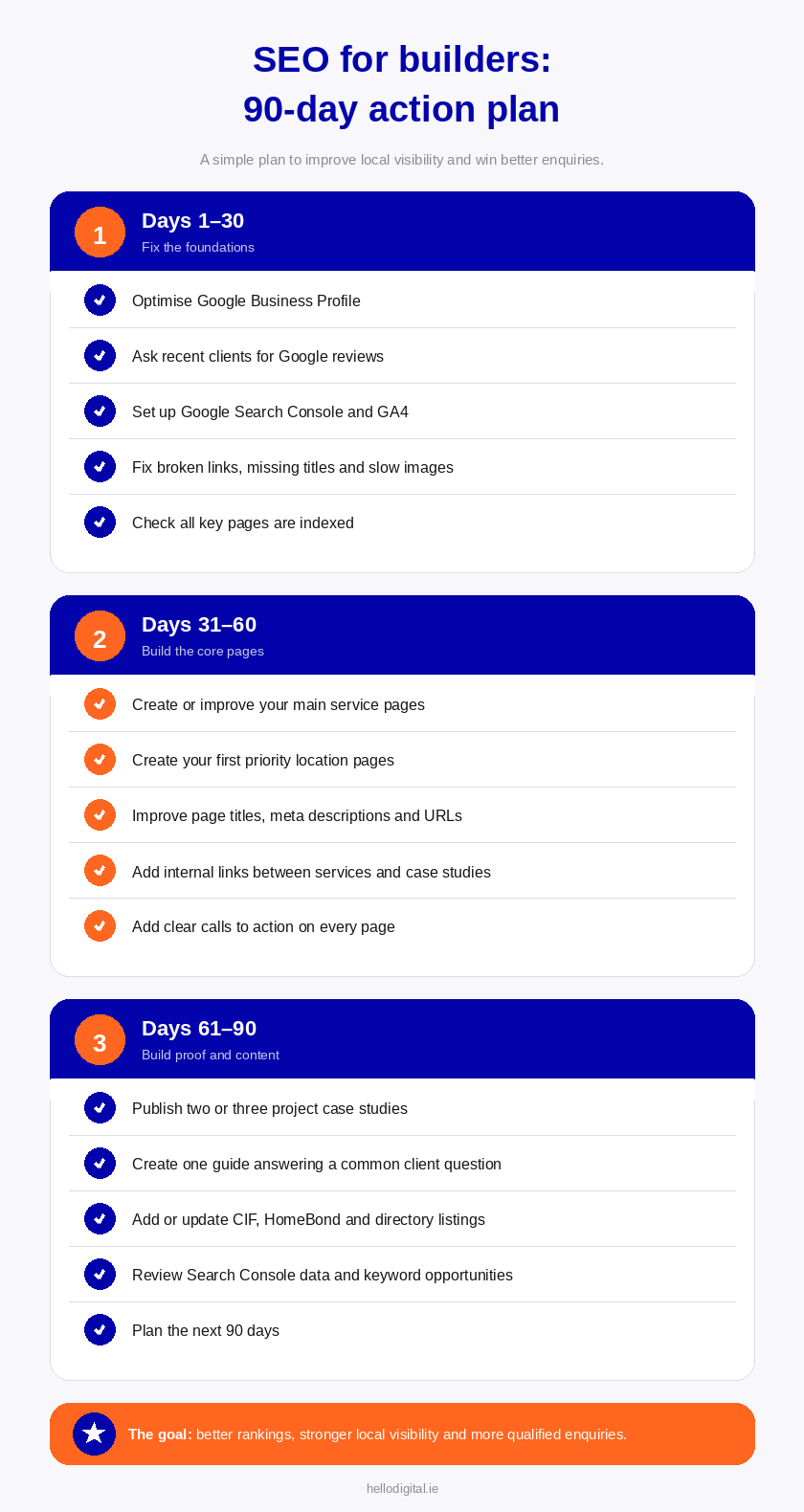
If you want to improve SEO without getting overwhelmed, start with a 90-day plan.
Claim and complete Google Business Profile
Check business name, address and phone consistency
Add 20 or more real project photos
Ask recent happy clients for reviews
Set up Google Search Console
Set up GA4 conversion tracking
Check whether key pages are indexed
Fix obvious website issues such as broken links, missing titles and slow images
Create or improve your main service pages
Add clear calls to action
Add project photos and credentials
Create your first priority location page
Add internal links between services, locations and case studies
Improve page titles and meta descriptions
Publish two or three project case studies
Create one detailed guide answering a common client question
Add or update directory listings
Review Google Business Profile insights
Review Search Console query data
Identify the next pages to improve
This is enough to build momentum. SEO does not need to start with a huge project. It needs a clear sequence.
A single services page is rarely enough. Each important service needs its own page.
Many builders set up the profile once and leave it untouched. Keep it active with photos, reviews and accurate information.
Good work does not automatically lead to reviews. You need a simple process for asking.
Duplicate location pages with only the town name changed usually perform poorly. Each page needs genuine local detail.
Do not write articles just to fill the blog. Each article should answer a question your potential clients are actually asking.
Large project photos can slow your site dramatically. Resize and compress images before uploading.
Traffic is useful, but enquiries matter more. Track calls, forms and enquiry quality.
SEO for builders is the process of improving a building firm’s website, Google Business Profile and wider online presence so it appears when potential clients search for building services, project advice and local contractors.
SEO is important for builders because homeowners often use Google to research costs, planning rules, local firms and project advice before contacting a contractor. If your business is not visible, those enquiries may go to competitors.
Local SEO for builders focuses on helping your firm appear in searches from the areas you serve, especially in Google Maps and location-based searches such as “builder near me” or “extension builders Dublin”.
Costs vary depending on the scope. Some basic SEO can be done internally. Professional SEO support for small and medium-sized Irish businesses often ranges from several hundred euro per month to more structured retainers, depending on the level of work required.
Yes, especially for local searches. A small builder with strong reviews, clear service pages, good case studies and a well-managed Google Business Profile can often outperform larger firms in specific towns, suburbs or counties.
For most builders, the first priority is Google Business Profile. It directly supports local visibility in Google Maps and can generate calls from people searching nearby.
A blog can help, but only if it answers real client questions. Cost guides, planning guides, grant explainers and project advice are more useful than generic company updates.
Yes. Case studies are excellent for builder SEO because they show real services, real locations and real proof of work. They also help potential clients understand the quality and type of projects you deliver.
Some local improvements can happen within weeks or months, especially through Google Business Profile. Website SEO usually takes longer, often three to six months for early movement and twelve months or more for stronger results in competitive markets.
Google Ads can generate enquiries while SEO is still building momentum. SEO is usually better for long-term visibility, while Google Ads can support short-term lead generation for priority services or locations.
Social media does not directly improve rankings, but it can support visibility, trust and traffic. It is useful for sharing project photos, case studies and updates, but it should not replace website SEO or Google Business Profile work.
SEO is working if organic enquiries increase, Google Business Profile calls grow, priority keywords improve, service pages receive more qualified traffic, and more enquiries come from the areas and project types you want.
Show up in search when people in your area need a builder.
If your building firm is relying too heavily on referrals, or if your website is not generating enough enquiries, SEO can help you build a stronger and more consistent source of local leads.
Book a free consultation and I will review your current online presence, identify the biggest opportunities and show you what to prioritise first.
Alessandro Boscolo Conway — Hello Digital
I'm a Dublin-based freelance SEO and digital marketing consultant with over 20 years of experience, including time on Google Ireland’s Search Quality team.
I run Hello Digital, a consultancy that helps startups and small businesses across Ireland grow online through clear strategy, expert delivery, and practical support.
I've worked with over 50 Irish companies to improve their visibility, generate better leads, and grow sustainably through SEO and digital marketing.
I'm a certified Google Partner and a trusted advisor to e-commerce brands, local services, and fast-growing startups.
- Based in Dublin, 20+ years of experience
- Former Googler, certified Google Partner, SEO strategist, and performance marketer
- Trusted by 50+ Irish startups, e-commerce brands, and local businesses
- Learn more about Hello Digital