

SEO
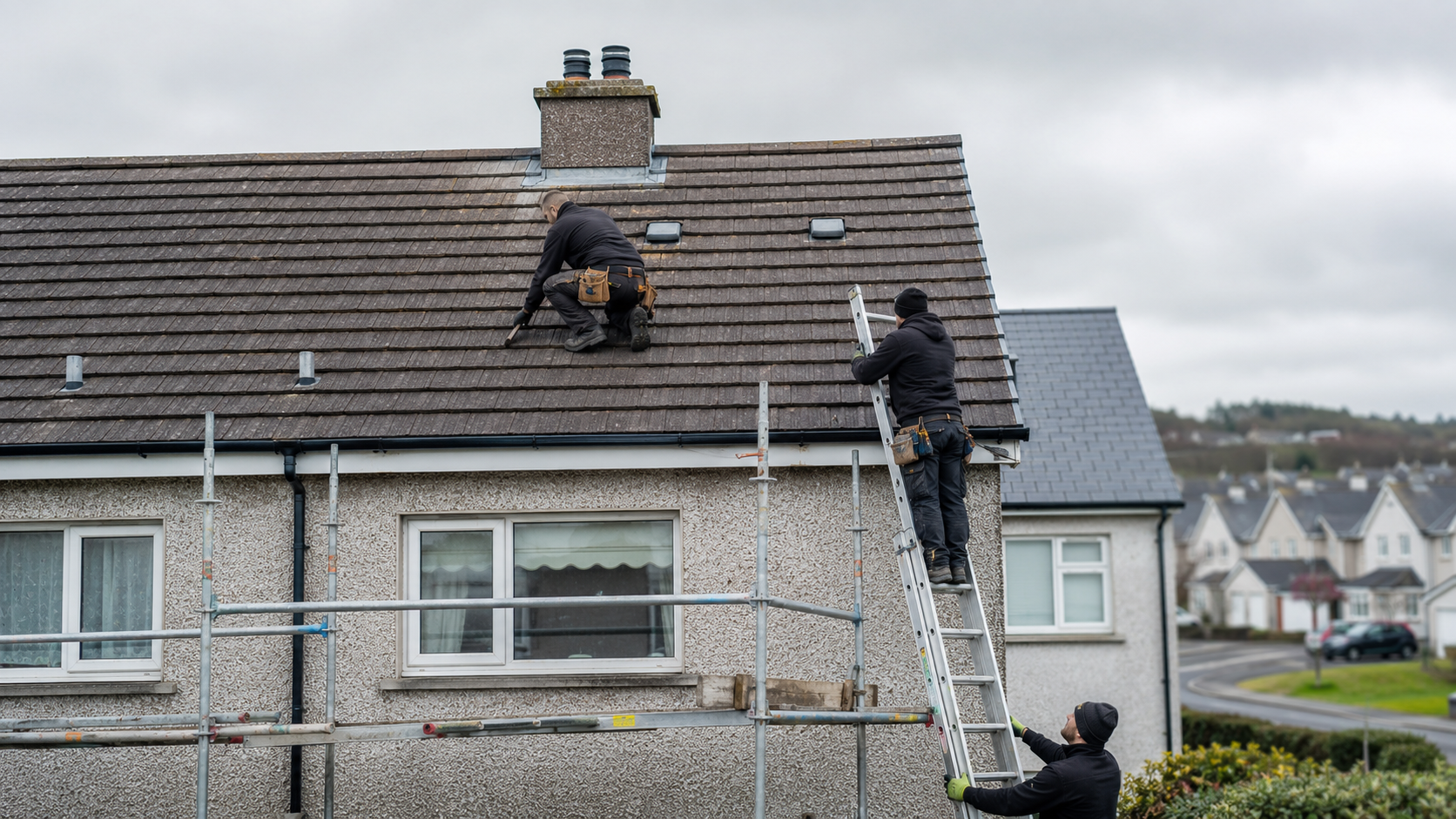

If you run a roofing business, SEO helps your company appear when people search for roof repairs, emergency roofers, flat roof repairs, roof leak repair, guttering, chimney repairs or roofing contractors in their area.
For roofers in Ireland, SEO is not just about website traffic. It is about being visible when someone has a roofing problem, needs a quote, or is comparing local roofing companies they can trust.
A well-planned SEO strategy can help your roofing company appear in Google Search, Google Maps and AI-generated search results when homeowners, landlords, property managers or businesses are looking for roofing services.
This guide explains how SEO for roofers works, why it matters, and what roofing companies in Dublin and Ireland should prioritise first.
SEO, or Search Engine Optimisation, is the process of improving your website and online presence so your business is easier to find on Google.
For a roofer, this means appearing when someone searches for terms such as:
roofer near me
roofers Dublin
roof repair Dublin
emergency roofer near me
flat roof repair Ireland
roof leak repair Dublin
roofing contractors Cork
guttering and fascia Dublin
chimney repairs near me
roof replacement Ireland
Good SEO for roofers helps your business appear in three important places:
Google Maps and the local map pack
Standard Google organic search results
AI search results and AI-generated answers
If your roofing company is not visible in these places, potential customers may never find you, even if you are more experienced, more reliable or better suited than the companies appearing above you.
Roofing searches are often urgent.
A homeowner may have water coming through a ceiling. A landlord may need storm damage repaired. A business may need a flat roof inspected before the problem becomes more expensive.
In those situations, people do not spend weeks researching. They search, compare quickly and contact a small number of roofing companies.
That makes visibility critical.
For roofers, SEO can help generate enquiries from people searching for:
Emergency roof repairs
Roof leaks
Flat roof repairs
Tile and slate roof repairs
Storm damage repairs
Gutter repairs
Chimney repairs
Roof replacement
Roof inspections
Commercial roofing services
SEO is also important because trust is a major part of the buying decision. Roofing work can be expensive, urgent and difficult for the customer to assess. Most people cannot easily inspect the quality of the work themselves, so they rely on reviews, photos, credentials, guarantees, local reputation and how credible the business looks online.
Your website and Google Business Profile need to prove that you are a legitimate roofing company before the customer picks up the phone.
Roofing is a local service. A person in South Dublin searching for a roof leak repair is unlikely to contact a roofer based several counties away unless the work is highly specialised.
That creates an opportunity for roofing companies that invest in local SEO.
Google says local results are mainly based on relevance, distance and prominence. Relevance means how well your Business Profile matches the search, distance is how close or locally relevant the business is, and prominence includes signals such as links, reviews and wider reputation. Google also says complete and accurate Business Profile information makes businesses more likely to appear in local search results.
For roofers, this means your visibility depends on more than your website alone. Your Google Business Profile, reviews, service pages, local content, directory listings and project examples all work together.
Ireland’s weather also creates ongoing roofing demand. Met Éireann reported that 2025 included Storm Éowyn bringing the highest winds ever recorded in Ireland, a very wet autumn, several named storms and heavy rainfall events. Roofing companies should not overstate this in their marketing, but weather-related demand is a reason people search for roof inspections, storm damage repairs, guttering, leaks and emergency roofing support.
SEO for roofers has several parts, but the main idea is simple: make it easy for Google and potential customers to understand what roofing services you provide, where you work and why your business can be trusted.
| SEO area | What it means for roofers |
|---|---|
| Local SEO | Helping your roofing company appear in Google Maps and local searches |
| Google Business Profile | Optimising your roofing business listing in Maps and local results |
| Keyword research | Finding the roofing searches customers use before contacting a company |
| Service pages | Creating dedicated pages for roof repairs, flat roofs, emergency roofing and other services |
| Location pages | Building pages for the towns, suburbs or counties you serve |
| Project examples | Showing completed roofing work with photos, locations and outcomes |
| Reviews | Building trust through recent customer feedback |
| On-page SEO | Optimising titles, headings, URLs, content, images and internal links |
| Technical SEO | Making sure your site is fast, secure, mobile-friendly and crawlable |
| Local citations | Keeping your business details accurate across directories |
| AI SEO / AEO | Structuring content so AI search tools can understand and cite your business |
| Measurement | Tracking calls, forms, rankings, traffic and enquiry quality |
Most roofing companies in Ireland should start with the basics: Google Business Profile, reviews, clear service pages, project photos and accurate local information.
Use this as a starting point.
| Priority | SEO action | Why it matters |
|---|---|---|
| High | Claim and complete your Google Business Profile | Helps you appear in Google Maps and local searches |
| High | Add your main roofing services clearly | Helps Google match you to relevant searches |
| High | Collect Google reviews | Builds trust and supports local visibility |
| High | Create dedicated service pages | Helps you rank for searches such as “roof repair Dublin” |
| High | Add project photos | Gives customers visual proof of your work |
| High | Make your phone number visible | Important for urgent roofing searches |
| High | Track calls and forms | Shows whether SEO is generating enquiries |
| Medium | Create location pages | Helps you rank in the areas you serve |
| Medium | Improve mobile speed | Reduces lost visitors on phones |
| Medium | Add directory and trade listings | Reinforces your business details and credibility |
| Medium | Publish project examples | Shows experience with specific roofing jobs and locations |
| Longer term | Optimise for AI search | Helps your content appear in AI-generated answers |
This sequence focuses on actions that can improve local visibility, trust and enquiry quality.
Search intent means what the person is trying to achieve when they search on Google.
For roofers, search intent is different from many other trades because some searches are urgent, while others are planned.
A person searching “emergency roof repair near me” may need help today.
A person searching “how much does a new roof cost in Ireland” may be planning a larger project.
A person searching “flat roof repair Dublin” may be comparing roofers and ready to request quotes.
Good roofing SEO needs to cover each of these situations.
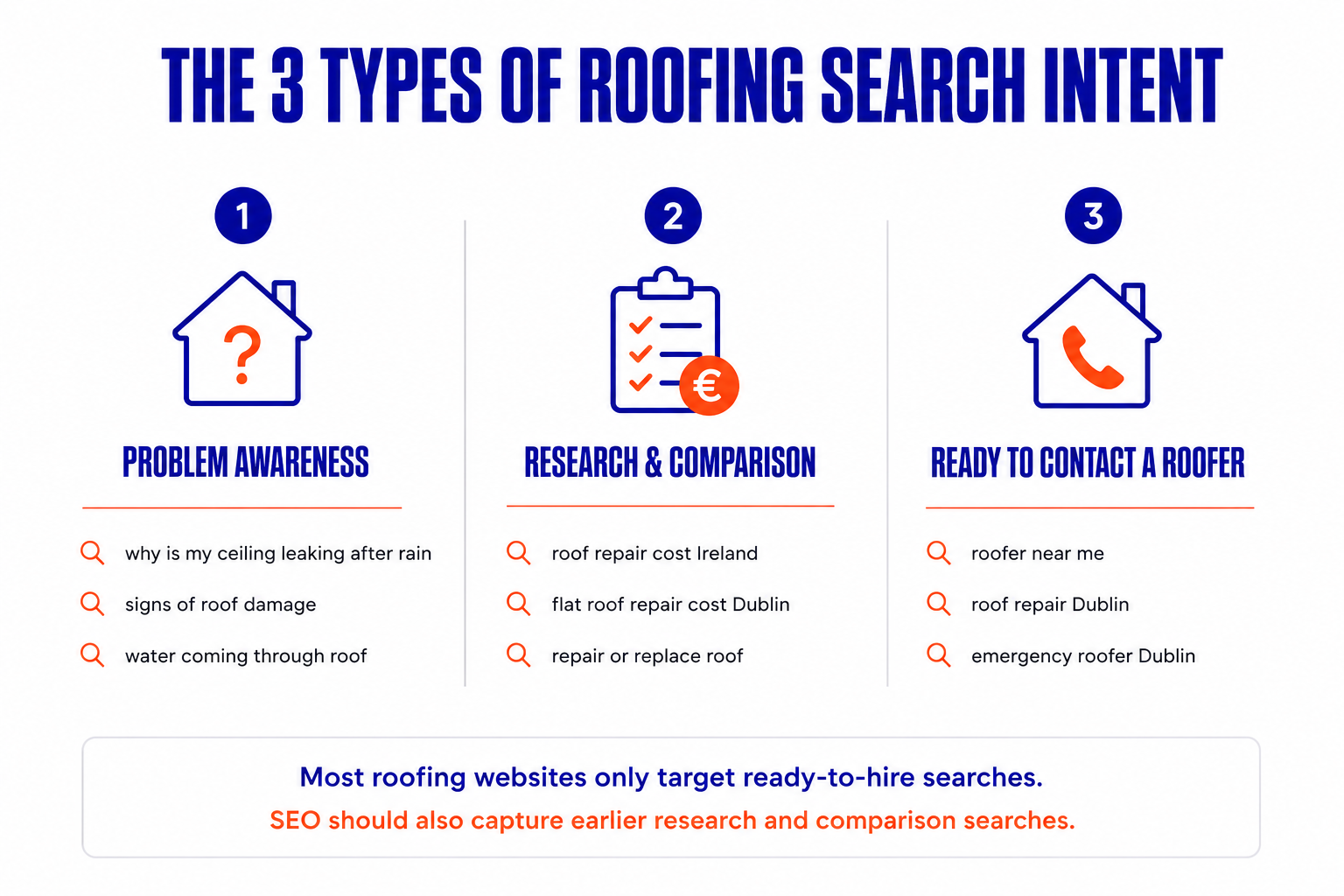
At this stage, the person knows something may be wrong but may not know what service they need.
They may search for:
why is my ceiling leaking after rain
signs of roof damage
how to know if roof tiles are loose
water coming through roof
damp patch on ceiling after storm
how long does a flat roof last
These searches may not convert immediately, but they can introduce your business before the customer starts comparing roofers.
At this stage, the person is looking at costs, options and providers.
They may search for:
roof repair cost Ireland
flat roof repair cost Dublin
how much does roof replacement cost
roof inspection Dublin
best type of flat roof Ireland
repair or replace roof
are roofing guarantees worth it
These searches are valuable because the person is actively evaluating the work and may soon request a quote.
At this stage, the person is ready to make contact.
They may search for:
roofer near me
roof repair Dublin
emergency roofer Dublin
flat roof repair near me
roofing contractors Wicklow
roof leak repair Cork
guttering repairs Dublin
chimney repair near me
These are high-intent searches. Your Google Business Profile, service pages, reviews, phone number and photos need to help the customer choose you.
Roofing companies often serve two different types of demand: emergency work and planned work.
Emergency roofing SEO is about fast trust. The customer wants to know whether you are local, available, contactable and credible.
Planned roofing SEO is about confidence. The customer wants to understand cost, materials, process, timelines, guarantees, insurance and past work.
You need different pages for different types of search intent.
For example:
Emergency roof repair page
Roof leak repair page
Flat roof repair page
Roof replacement page
Roof inspection page
Guttering and fascia page
Commercial roofing page
Trying to cover all of these on one general “roofing services” page will limit your ability to rank for specific searches.
Your website needs to explain what you do, where you work and why someone should contact you.
A common mistake is having one services page that lists every roofing service. That makes the website easy to build, but harder to rank.
Google ranks individual pages. If someone searches “flat roof repair Dublin”, Google is more likely to show a page specifically about flat roof repairs in Dublin than a generic roofing page that briefly mentions flat roofs.
A roofing website should include:
Homepage
About page
Services overview page
Individual service pages
Location pages
Project examples or case studies
Reviews or testimonials page
Blog or advice section
Contact page
Emergency contact information
The most important SEO pages are your service pages, location pages and project examples.
Each important roofing service should have its own page.
For a roofing company in Ireland, this may include:
Roof repairs
Emergency roof repairs
Roof leak repairs
Flat roof repairs
Flat roof installation
Slate roof repairs
Tile roof repairs
Chimney repairs
Guttering and fascia
Soffit repairs
Roof inspections
Roof replacement
Storm damage repairs
Commercial roofing
Industrial roofing
Leadwork
Velux window installation or repair
Each service page should answer the customer’s main questions before they contact you.
A well-structured roofing service page should include:
What the service covers
Common signs the customer needs this service
Where you provide the service
How the inspection or quote process works
What affects cost
Emergency availability, if relevant
Insurance and guarantee information
Photos of relevant work
Reviews or testimonials
Clear calls to action
A local service page does not need to be unnecessarily long. Around 800 to 1,200 words is often enough if the content is specific, accurate and easy to scan.
Local SEO helps your roofing company appear when people search in the areas you serve.
For roofers, local SEO is one of the most important parts of SEO because customers want a local company. This is especially true for leaks, storm damage and urgent repairs.
Local SEO for roofers focuses on:
Google Business Profile
Google Maps visibility
Local service pages
Location pages
Reviews
Project photos
Local citations
Trade directories
Supplier and partner mentions
Consistent business details across the web
Your goal is to make your business clearly relevant to the services and areas you want to win.
Google Business Profile is one of the most important SEO assets for a roofing company.
It is the listing that appears in Google Maps and local search results. For searches such as “roofer near me”, “roof repairs Dublin” or “emergency roofer Cork”, the map pack can appear above normal organic results.
For many roofers, the Google Business Profile can generate phone calls before the website does.
Your profile should include:
Correct business name
Address or service area
Phone number
Website URL
Opening hours
Emergency hours, if relevant
Business category
Services
Business description
Photos
Reviews
Updates where relevant
Use your business name. Do not add keywords unless they are part of your actual trading name.
If your company is called “Murphy Roofing”, do not list it as “Murphy Roofing Roof Repairs Dublin Emergency Roofer”. Keyword-stuffed business names can create trust issues and may breach Google’s guidelines.
If you work from a private address and do not want to display it, use the service-area business option and define the areas you cover.
Choose the category that best describes your core service.
Depending on what is available in your Google Business Profile account, suitable categories may include roofing contractor or related construction/service categories.
Only choose categories that genuinely apply.
Do not select categories for services you do not provide. A roofing company should not choose unrelated trade categories just to appear for more searches.
Your description should explain what you do, where you work and why people should trust you.
Example:
“Dublin-based roofing company providing roof repairs, flat roof repairs, roof leak detection, guttering, chimney repairs and storm damage repairs across Dublin and surrounding counties. Fully insured, experienced in residential and commercial roofing, with emergency call-outs available where required.”
This is more effective than vague claims such as “best roofers in Dublin” or “top roofing company”. Specific information helps customers understand whether you are the right fit.
For roofers, photos are proof.
Upload photos of:
Roof repairs
Before-and-after work
Flat roof projects
Slate and tile repairs
Chimney repairs
Guttering and fascia work
Storm damage repairs
Completed roof replacements
Your team on site
Workmanship details
Avoid relying only on stock images. Customers want to see real work.
Before uploading, use search-friendly file names, such as:
flat-roof-repair-south-dublin.jpg
roof-leak-repair-rathmines.jpg
slate-roof-repair-galway.jpg
roof-replacement-dublin.jpg
Alt text should describe the image plainly.
Example:
“Completed flat roof repair on a residential property in South Dublin, showing new waterproof membrane and finished edge detail.”
Avoid vague alt text such as “roof photo” or “roofing job”.
Reviews are critical for roofing SEO because customers are often nervous about choosing a roofer.
Roofing has a trust problem as a category. Many homeowners worry about poor workmanship, unclear quotes, hidden costs, lack of follow-up or difficulty checking whether the work was completed properly.
Recent, genuine reviews help reduce that concern.
Build review requests into your process.
Ask after the job is complete and the customer is satisfied. Send a short text or email with your direct Google review link. Do not offer incentives. Do not buy reviews. Do not ask people who were not customers.
Respond to every review. Keep responses specific where possible.
Example:
“Thanks John, glad we could help with the roof leak repair in Clontarf after the heavy rain.”
That response is natural, customer-focused and locally relevant.
Keyword research helps you understand how customers search before they contact a roofing company.
For roofers in Ireland, valuable keywords combine:
A roofing service
A problem
A location
A level of urgency
Examples include:
roof repair Dublin
roofer near me
emergency roofer Dublin
roof leak repair Cork
flat roof repair Kildare
chimney repairs Wicklow
guttering repairs Galway
roof replacement Ireland
commercial roofing contractors Dublin
These searches are valuable because they show need and location.
| Keyword type | Example | Best page type |
|---|---|---|
| Service and location | Roof repair Dublin | Service page or location page |
| Emergency | Emergency roofer near me | Emergency service page and Google Business Profile |
| Problem-led | Roof leak repair Dublin | Service page or guide |
| Roof type | Flat roof repair Cork | Dedicated service page |
| Cost | Roof repair cost Ireland | Guide or blog article |
| Trust-led | Insured roofing contractor Dublin | About page, service page or trust section |
| Commercial | Commercial roofing contractors Ireland | Dedicated service page |
| Seasonal/weather | Storm damage roof repair | Service page or seasonal guide |
Do not focus only on broad terms such as “roofer”. A person searching “roof leak repair Dublin” is more likely to become an enquiry than someone searching a vague term.
Local keywords are central to roofer SEO.
A roofing company serving Dublin and surrounding counties may need to target searches such as:
roofers Dublin
roof repair South Dublin
emergency roofer North Dublin
flat roof repair Dublin 6
roof leak repair Dublin 15
guttering repairs Wicklow
roofing contractors Kildare
chimney repairs Meath
The right local terms depend on where you work and which jobs you want more of.
Do not create pages for areas where you do not serve customers. That creates poor enquiry quality and weakens the site structure.
Your customers are already telling you what future customers search for.
Common questions include:
How much does roof repair cost in Ireland?
How do I know if my roof is leaking?
Should I repair or replace my roof?
How long does a roof repair take?
What should be included in a roofing quote?
Do roofers offer guarantees?
Will insurance cover storm damage to a roof?
How often should a roof be inspected?
Can a flat roof be repaired or does it need replacing?
Each of these can become a guide, FAQ answer, service page section or downloadable checklist.
SEO content for roofers should answer customer questions.
The best content helps people understand the problem, assess urgency and decide what to do next.
Roofing content ideas include:
Roof repair cost guides
Roof leak guides
Flat roof repair guides
Storm damage checklists
Roof inspection guides
Guttering maintenance guides
Chimney repair explainers
Roof replacement guides
Before-and-after project examples
FAQs
Seasonal roofing advice
Cost searches are valuable because they show serious intent.
Many roofers avoid discussing cost because every roof is different. That is understandable, but avoiding the topic completely leaves the customer to get answers elsewhere.
A roofing cost guide does not need to give fixed prices. It can explain what affects the price.
A roofing cost guide should cover:
Type of roof
Type of repair
Access requirements
Height and safety considerations
Materials
Labour
Urgency
Weather conditions
Waste removal
Whether scaffolding is needed
When an inspection is required
This type of content helps the customer understand why quotes vary.
Emergency roofing content should be clear and careful.
You should explain what customers can do safely, what they should not attempt themselves, and when to call a professional.
Good emergency content can cover:
What to do if water is coming through the ceiling
When to call an emergency roofer
How to identify storm damage
What photos to take for insurance
When not to climb onto a roof
How temporary repairs work
What happens during a roof inspection
Keep safety advice cautious. Do not encourage people to inspect roofs themselves if it creates risk.
Some roofing searches relate to grants or support.
For example, Ireland’s Housing Aid for Older People Grant can cover essential structural repairs, including roof repairs, subject to eligibility and local authority assessment. The 2026 government guidance states that covered work can include structural repairs such as roof repairs, and that roof or structural works may require an inspection report detailing the defect.
A roofer should not present themselves as a grant advisor unless they provide that service. But a page or FAQ explaining when a customer should check local authority support can capture relevant search demand and help older homeowners or family members researching repair options.
Project examples are one of the most valuable SEO assets for roofing companies.
They show real work, real locations and real outcomes.
A roofing case study naturally includes the things customers search for:
Service type
Roof type
Problem
Location
Repair method
Result
Photos
For example:
Flat roof repair in Rathgar
Roof leak repair in Swords
Slate roof repair in Galway
Storm damage repair in Wicklow
Guttering replacement in Lucan
A roofing company with detailed project examples across different services and locations will have a better SEO foundation than a company with one generic gallery page.
Use a title that includes the service and location.
Weak title:
“Recent roofing job”
Better title:
“Flat roof repair in Rathgar after recurring water leaks”
The second title is clearer because it includes the service, location and problem.
A roofing case study should include:
| Section | What to include | SEO value |
|---|---|---|
| Project summary | Service, location, roof type and result | Gives Google and users a quick answer |
| Client problem | What the customer noticed | Matches problem-led searches |
| Roof context | Roof type, age, access and condition | Adds specificity |
| Inspection findings | What caused the issue | Shows expertise |
| Work completed | Repairs, materials and methods used | Reinforces service relevance |
| Timeline | How long the work took | Answers a common question |
| Result | What changed for the customer | Builds confidence |
| Photos | Before, during and after images | Provides proof |
| Review | Customer feedback, where available | Adds trust |
| CTA | Invite readers to request an inspection or quote | Turns the page into a lead source |
Useful headings include:
Project overview
The customer’s roofing issue
What we found during inspection
The work completed
The result
Before and after photos
Need help with a similar roof repair?
Every roofing case study should connect to your main SEO structure.
A case study about a flat roof repair in Rathgar should link to:
Your flat roof repair page
Your roof repair page
Your Dublin or South Dublin location page
A related guide, such as roof repair costs
Other flat roof case studies
The service page should also link back to relevant case studies.
This helps Google understand the relationship between your services, locations and completed work. It also helps users move from research to proof to enquiry.
Your About page matters because roofing is trust-led.
A potential customer wants to know who they are hiring, whether you are insured, what experience you have and whether you stand over your work.
Your About page should include:
Who owns or leads the company
Years in business
Team photos
Areas served
Types of roofing work you specialise in
Insurance information
Guarantee information, where applicable
Trade memberships or registrations, where relevant
Health and safety approach
Photos
Contact details
Avoid vague claims. Specific details are more persuasive.
Location pages help you rank in the areas you serve.
A roofing company covering Dublin, Kildare, Wicklow and Meath may need location pages for priority areas, especially where there is search demand and business value.
A location page should include:
Roofing services available in the area
Common roof types or property types in that location
Nearby project examples
Photos from local work
Emergency availability, if relevant
Travel or service-area information
Reviews from nearby customers
Clear contact details
Do not copy and paste the same page with only the place name changed. That creates thin content.
A page for “roof repairs in South Dublin” should include information that is genuinely relevant to South Dublin.
On-page SEO helps Google understand each page and helps searchers decide whether to click.
For roofing websites, on-page SEO needs to organise services, locations and urgency without creating duplicate pages.
Every page should have a unique title tag.
Examples:
Roof repair Dublin | Business Name
Emergency roofer Dublin | Business Name
Flat roof repairs Cork | Business Name
Roof leak repair Wicklow | Business Name
Commercial roofing contractors Ireland | Business Name
Avoid creating several pages with titles that target almost the same search intent, such as:
Roofers Dublin
Roofing contractors Dublin
Roofing company Dublin
Unless each page has a different purpose, these pages may compete with each other.
A meta description should explain the service, location and reason to click.
Example:
“Need roof repairs in Dublin? Local roofing company providing leak repairs, flat roof repairs, guttering and emergency call-outs. Request a quote.”
For a case study page, describe the project.
Example:
“See how we repaired a leaking flat roof in Rathgar, including inspection findings, repair work and finished photos.”
URLs should be short and readable.
Good examples:
/services/roof-repairs-dublin
/services/emergency-roof-repairs
/services/flat-roof-repairs
/locations/roofers-dublin
/guides/roof-repair-cost-ireland
/projects/flat-roof-repair-rathgar
Avoid long URLs, page numbers or vague slugs.
Internal linking helps connect service pages, location pages, guides and project examples.
A roofing website might use this structure:
Homepage links to main service pages
Service pages link to related project examples
Project examples link back to relevant service pages
Location pages link to services available in that area
Guides link to service pages
Related case studies link to each other
For example:
A guide about roof repair costs links to the roof repair service page.
The roof repair page links to roof leak and flat roof repair case studies.
Each case study links back to the roof repair page and the relevant location page.
Use natural anchor text, such as “roof repair in Dublin” or “flat roof repairs”, rather than “click here”.
Technical SEO helps Google crawl, index and understand your website.
For roofers, the most common technical SEO issues are:
Slow mobile speed
Oversized images
Broken links
Missing page titles
Duplicate content
Poor URL structure
Pages not indexed by Google
No XML sitemap
Weak internal linking
Contact forms not tracking correctly
Phone numbers not clickable on mobile
Many roofing searches happen on phones.
If someone has a leak or storm damage, they are likely searching from a mobile device and comparing companies quickly.
Your website should load fast, make your phone number visible and make it easy to request a quote.
Common fixes include:
Compressing images
Converting images to WebP
Lazy loading below-the-fold images
Removing unnecessary plugins
Improving hosting
Reducing unused JavaScript and CSS
Testing the site on mobile
Your website should load securely using HTTPS.
If it does not, browsers may show a “Not secure” warning. For a roofing company, that can damage trust before the customer reads the page.
Most hosting providers now include SSL certificates.
Structured data, also called schema markup, helps search engines understand your business and pages.
Relevant schema types may include:
LocalBusiness
Organisation
Service
Article
BreadcrumbList
Review schema, only where it reflects visible reviews and follows Google’s rules
Google’s LocalBusiness structured data guidance explains that structured data can help Google understand business details such as opening hours, departments, reviews and contact information.
For roofers, structured data is not a shortcut. It supports a clear website structure, accurate business information and well-written pages.
Backlinks are links from other websites to yours. They help Google assess credibility and authority.
For roofers, the best links come from business relationships, construction directories, suppliers, local organisations and project partners.
You do not need large numbers of weak links. You need relevant links and mentions that make sense for a roofing company.
Relevant opportunities may include:
Local chamber of commerce directories
County business directories
Supplier or manufacturer installer directories
The Construction Industry Register Ireland has been described by CIF as an online register for competent builders, developers, specialists and trades. The Voluntary Construction Register Ireland describes itself as an official online register of competent builders, contractors, specialist subcontractors and tradespersons.
Only use directories that are relevant, credible and accurate. Do not submit your business to dozens of low-quality directories.
Roofers often work with manufacturers and suppliers of:
Roofing membranes
Flat roofing systems
Slates and tiles
Leadwork products
Velux or roof windows
Guttering and fascia systems
Insulation materials
Safety equipment
Some suppliers maintain approved installer lists, partner pages or case study sections.
If you have a genuine supplier relationship, ask whether your company can be listed or featured.
Local links can support local SEO because they connect your business to the area you serve.
Potential opportunities include:
Local newspaper coverage
Local business directories
GAA club sponsorship pages
Community sponsorships
School or charity projects
Supplier features
Local awards
Project features with architects or builders
These links should come from genuine activity, not manufactured link schemes.
AI SEO, also called Answer Engine Optimisation or Generative Engine Optimisation, is the process of making your business and content easier for AI tools to understand, summarise and cite.
This matters because customers may ask AI tools questions such as:
Who are reliable roofers in Dublin?
What should I check before hiring a roofer?
How much does roof repair cost in Ireland?
Should I repair or replace my roof?
What should be included in a roofing quote?
How do I know if a roof leak is serious?
Google’s guidance says SEO remains relevant for generative AI features because Google’s AI features are rooted in its core search ranking and quality systems. Google also says AEO and GEO are terms people use, but from Google Search’s perspective, optimising for generative AI search is still SEO.
For example, if a page is about roof repair costs, answer the cost question early before explaining the details.
These match how people search and how they ask AI tools.
Service areas, roof types, emergency availability, inspection process, guarantees, insurance and project examples are more helpful than vague claims.
AI tools often extract passages. Each section should make sense on its own.
Mention insurance, guarantees, trade memberships, years of experience, customer reviews and completed work.
Directory listings, reviews, supplier mentions, local articles and partner links help confirm that your business exists beyond your own website.
Roofing cost guidance, emergency advice, grant information and service availability should be reviewed regularly.
Google says website owners do not need special AI markup, special machine-readable files or llms.txt files to appear in Google Search’s generative AI features.
That does not mean AI SEO is pointless. It means the priority should be crawlable pages, accurate information, expert-led content, good structure and proof.
SEO should be measured by enquiries, not traffic alone.
Track these metrics:
| Metric | Why it matters |
|---|---|
| Organic enquiries | Shows whether SEO is generating business value |
| Phone clicks | Critical for urgent roofing searches |
| Contact form submissions | Shows website conversion performance |
| Google Business Profile calls | Shows local map visibility |
| Organic traffic by page | Shows which pages attract searchers |
| Keyword rankings | Shows visibility for priority services |
| Review growth | Shows reputation development |
| Enquiry quality | Shows whether SEO attracts the right jobs |
Google Search Console shows how your website performs in Google Search.
Use it to check:
Which searches bring impressions and clicks
Which pages receive organic traffic
Which pages are indexed
Which pages have errors
Which websites link to you
Which roofing terms are close to page one
Queries with high impressions and low clicks can reveal optimisation opportunities.
GA4 shows what users do after they land on your website.
Set up tracking for:
Contact form submissions
Phone number clicks
Email clicks
Quote request clicks
Emergency call buttons
Booking or inspection request buttons
Without conversion tracking, you are guessing.
For every enquiry, record:
How the customer found you
What service they asked about
Where the job is located
Whether it was urgent or planned
Approximate value
Whether it became a customer
Over time, this shows which pages and channels generate the best work.
SEO takes time, but different parts move at different speeds.
Google Business Profile improvements can create visible changes within weeks or a few months, especially if the profile was incomplete and you start collecting reviews.
Service and location pages often need three to six months to show meaningful movement, depending on competition.
Guides and blog content can take longer, often four to twelve months.
In less competitive local markets, progress can be faster. In Dublin and other competitive areas, you will need better service pages, reviews, project examples, internal links and technical execution.
SEO compounds. A project page published today can keep attracting visibility long after the job is complete.
Some roofing companies can handle the basics internally. Others benefit from professional SEO support.
The right choice depends on your time, competition, website condition and how important search enquiries are to your business.
Most roofing companies can manage these tasks internally:
Claim and complete Google Business Profile
Add service areas
Upload project photos
Ask customers for Google reviews
Respond to reviews
Add service information to the website
Publish basic project examples
Check Google Search Console monthly
Keep business details consistent online
These actions can make a difference, especially if competitors are not doing them well.
It makes sense to hire an SEO consultant when:
You are in a competitive market
Your website has technical issues
You need proper service and location pages
You want a content plan
You do not have time to manage SEO
You need tracking set up correctly
You want to rank for higher-value services
You are not sure why your current SEO is not working
A good SEO consultant should connect the work to enquiries.
For a roofing company, the process should include:
Reviewing Google Business Profile
Checking local rankings and map visibility
Reviewing service pages and location pages
Checking technical SEO issues
Reviewing image size and mobile speed
Analysing competitors
Identifying priority keywords
Recommending project and content opportunities
Checking directory and citation listings
Setting up enquiry tracking
Reporting on leads, rankings, traffic and actions completed
They should explain the work clearly and avoid vague reporting.
Ask these questions before committing:
Have you worked with roofers, trades or local service businesses before?
What would you prioritise in the first 90 days?
How will you measure enquiries from SEO?
Will you work on Google Business Profile as well as the website?
How will you choose which service and location pages to create?
How will you avoid duplicate location pages?
What is your approach to link building?
Will I receive monthly reporting?
What work is included?
Who writes or edits the content?
Be cautious if an SEO provider:
Guarantees first position on Google
Promises instant results
Talks about secret methods
Recommends buying links
Creates lots of thin location pages
Gives vague reports
Focuses only on traffic
Ignores phone call tracking
Ignores Google Business Profile
Does not ask which roofing jobs you want more of
Good SEO for roofers is measurable and tied to the kind of work you want to win.
Claim and complete Google Business Profile
Check business name, address and phone consistency
Add service areas
Add your main roofing services
Upload project photos
Ask recent customers for reviews
Set up Google Search Console
Set up GA4 conversion tracking
Check whether key pages are indexed
Make phone numbers clickable on mobile
Fix broken links and missing titles
Compress oversized images
Create or improve main service pages
Add clear calls to action
Add photos and trust signals to service pages
Create your first priority location page
Improve page titles and meta descriptions
Add internal links between services, locations and project examples
Add FAQs to key pages
Publish two or three roofing project examples
Create one detailed guide answering a common customer question
Add or update directory listings
Review Google Business Profile performance
Review Search Console query data
Identify the next service or location pages to improve
This plan is enough to build momentum without turning SEO into an unmanageable project.
Each priority service needs its own page. Roof repairs, emergency repairs, flat roofs and guttering should not all rely on one short paragraph.
Many roofers create the profile once and leave it untouched. Keep it accurate, active and supported with photos and reviews.
Completed work does not automatically lead to reviews. You need a simple review request process.
Roofing is visual. Customers want to see proof.
For urgent roofing searches, the phone number should be visible immediately, especially on mobile.
Duplicate location pages with only the place name changed perform poorly.
Roofing photos are important, but oversized files slow the website.
For roofers, calls are often the most important conversion. Track them.
SEO for roofers is the process of improving a roofing company’s website, Google Business Profile and wider online presence so the business appears when potential customers search for roofing services, roof repairs, emergency roofers and local roofing contractors.
SEO is important for roofers because many customers use Google when they need roof repairs, leak repairs, flat roof work, guttering or emergency roofing help. If your business is not visible, those enquiries go to competitors.
Local SEO for roofers focuses on helping your business appear in the areas you serve, especially in Google Maps and local searches such as “roofer near me” or “roof repair Dublin”.
For most roofers, the first priority is Google Business Profile. It supports local map visibility and can generate calls from people searching nearby.
Yes. Roof repairs, emergency roof repairs, flat roof repairs, chimney repairs, guttering and roof replacement should have dedicated pages if they are important services.
Yes. Roofing project photos help show real work, build trust and support service pages and case studies. They should be compressed, named clearly and supported with relevant alt text.
A blog can help if it answers customer questions. Cost guides, leak guides, storm damage advice, roof inspection checklists and flat roof explainers are more valuable than generic updates.
Some local improvements can happen within weeks or months, especially through Google Business Profile. Website SEO takes longer, often three to six months for early movement and longer in competitive areas.
Google Ads can generate enquiries while SEO is still building momentum. SEO is better for long-term visibility, while Google Ads can support urgent services, seasonal demand and competitive locations.
Yes. Customers may use Google AI features, ChatGPT or other AI tools to ask questions about roof repairs, costs and local roofing companies. Clear, specific, well-structured content helps your business become easier for these systems to understand.
SEO is working if organic enquiries increase, Google Business Profile calls grow, priority keywords improve, service pages receive more qualified traffic and more enquiries come from the services and locations you want.
Show up in search when people in your area need a roofer.
If your roofing company is relying too heavily on referrals, or if your website is not generating enough enquiries, SEO can help you build a more consistent source of local leads.
Book a free consultation and I will review your current online presence, identify the biggest opportunities and show you what to prioritise first.
Alessandro Boscolo Conway — Hello Digital
I'm a Dublin-based freelance SEO and digital marketing consultant with over 20 years of experience, including time on Google Ireland’s Search Quality team.
I run Hello Digital, a consultancy that helps startups and small businesses across Ireland grow online through clear strategy, expert delivery, and practical support.
I've worked with over 50 Irish companies to improve their visibility, generate better leads, and grow sustainably through SEO and digital marketing.
I'm a certified Google Partner and a trusted advisor to e-commerce brands, local services, and fast-growing startups.
- Based in Dublin, 20+ years of experience
- Former Googler, certified Google Partner, SEO strategist, and performance marketer
- Trusted by 50+ Irish startups, e-commerce brands, and local businesses
- Learn more about Hello Digital