

SEO


Last updated: 9 August 2026
Local SEO works by helping Google decide which businesses are the best match for a search with local intent. When someone searches for a plumber in Dublin, a dentist near them or a café in Galway, Google considers what the business offers, where it is located and how established and trustworthy it appears.
For small businesses in Ireland, local SEO is about strengthening the signals you can influence, such as your Google Business Profile, website, reviews and local relevance. You cannot control every factor, particularly how far you are from the person searching.
This guide explains how those signals work together, where local results appear and what you should focus on if you want more visibility in Google Search and Maps.
Local SEO helps your business appear when people search for products or services in a specific area.
Google mainly evaluates relevance, distance and prominence when deciding which local businesses to show.
Your Google Business Profile is important, but local SEO also depends on your website, reviews, business information and links.
You can improve many local ranking signals, but you cannot control how close your business is to every searcher.
The goal is not just higher rankings. Local SEO should lead to more relevant calls, enquiries, bookings, visits or sales.
Local SEO is the process of improving your visibility when people search for businesses, products or services in a particular area. That includes searches with an obvious location, such as “accountant Dublin”, as well as searches where Google infers local intent, such as “accountant near me”.
Unlike broader SEO, local SEO is concerned with more than where your website ranks in the standard organic results. It can also affect whether your business appears in Google Maps and the Local Pack, where people can see details such as your location, opening hours, reviews and contact information without visiting your website.
This is why Google Business Profile optimisation is an important part of local SEO, but it is only one part. Your website, reviews, business information across the web and local authority signals all contribute to how Google understands and evaluates your business.
Local SEO can influence your visibility in several parts of Google, not just the standard organic listings.
The most obvious is the Local Pack, the map and business listings that often appear for searches with local intent. These results can show your business name, reviews, opening hours, location and other details directly in the search results.
Your business can also appear in Google Maps, where people may search specifically for nearby businesses, compare options, check reviews or ask for directions.
A customer does not always need to visit your website before taking action. From a local result, they may be able to call you, check your opening hours, read reviews or request directions directly from Google. That is one reason Local Pack and Maps visibility can be valuable even when it does not produce a website click.
Local SEO can also improve your visibility in the regular organic results. Google can localise these results based on the searcher’s location, even when the query does not include a town or city.
That means a local business can potentially appear in both the map results and the organic listings for the same search. The factors influencing those positions are not identical, which is why local SEO needs to consider both your business profile and your website rather than treating one as a substitute for the other.
Google says local rankings are mainly based on three factors: relevance, distance and prominence. These work together, which is why the business closest to the searcher does not always rank first.
Relevance is how closely your business matches the search.
If someone searches for “emergency plumber Dublin”, Google needs to understand that you provide emergency plumbing services and serve the relevant area. Your business categories, services, Google Business Profile and website content all contribute to that understanding.
Adding a town name repeatedly will not make an unrelated or poorly defined business more relevant. Google still needs to understand what you offer and which searches your business should appear for.
Distance is based on how far the business is from the location used in the search. If the searcher does not specify a place, Google estimates their location.
This means two people searching for the same service can see different local results simply because they are in different parts of Dublin.
Distance is also the ranking factor you have least control over. Creating extra location pages or mentioning neighbouring towns will not change the physical location of your business. You can target areas you serve, but you should not expect equal Maps visibility across every town or neighbourhood.
Prominence reflects how established and well known a business appears to Google.
Signals can include reviews, links, mentions of the business across the web and the authority of its website. Review quantity and ratings can also contribute to local rankings.
This helps explain why two businesses offering the same service at a similar distance from the searcher can rank differently. One may have a better-established online presence, more relevant reviews or stronger website authority.
You cannot optimise away distance, but you can improve relevance and prominence. Most local SEO work therefore focuses on making your services and locations easier for Google to understand, maintaining accurate business information, earning legitimate reviews and building authority around the business.
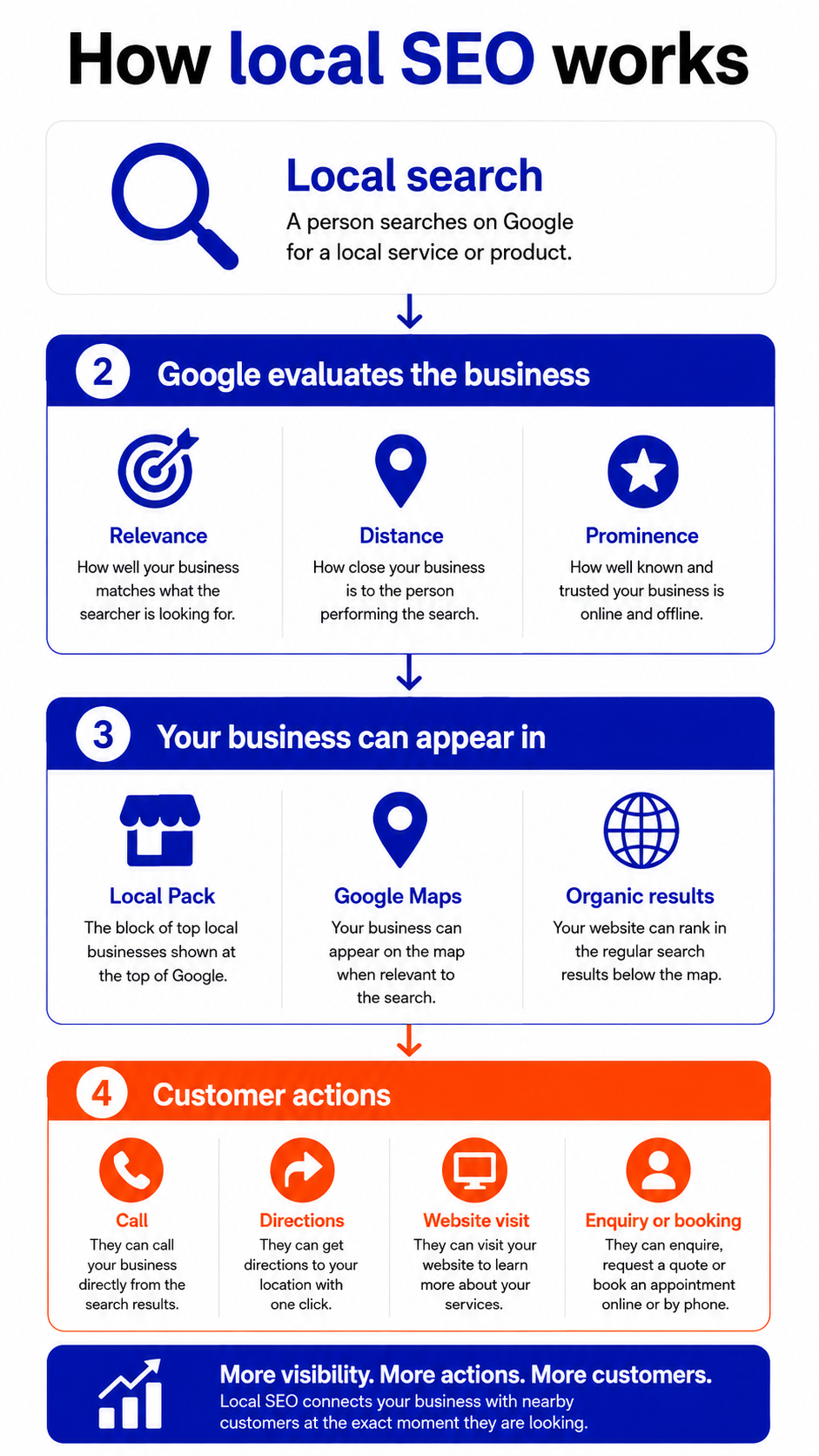
Relevance, distance and prominence explain how Google evaluates local results. Local SEO is the work you do to improve the signals behind those factors.
Your Google Business Profile tells Google what your business does, where it operates and how customers can contact you. The primary category, additional categories, services, address or service area, opening hours and other business details all help Google match your profile with relevant searches.
Keeping the profile accurate matters more than filling it with keywords. The priority is to represent the business correctly, choose the right categories and maintain information customers can rely on.
Your website gives Google considerably more context than a Google Business Profile alone. Service pages explain what you offer, while location information helps establish where those services are available.
A Dublin electrician, for example, needs pages that properly describe the electrical services provided and make the geographical coverage understandable. Creating dozens of near-identical pages with only the location name changed adds little value.
Your SEO content should answer the questions potential customers have about the service rather than exist simply to target a location keyword. The same principle applies to on-page SEO: page titles, headings, copy and internal links should help search engines understand each page without forcing place names into every sentence.
Reviews influence both local visibility and the decision to contact a business. Google considers review signals when ranking local results, while potential customers use the same reviews to compare businesses.
The objective is not to collect a large batch of reviews as quickly as possible. Businesses need a repeatable way to ask real customers for feedback and continue earning reviews over time. Buying reviews, asking employees to leave them or manufacturing a sudden influx creates unnecessary risk and does little to build customer trust.
Google encounters information about your business on your own website, directories, maps, social platforms and other websites. Your core details, particularly your business name, address and phone number, should accurately identify the same business across those sources.
Local citations can help confirm that information, but submitting a business to every directory you can find is not a strategy. Relevant Irish, local and industry-specific listings are generally more worthwhile than accumulating low-quality directory entries simply to increase the number of citations.
Links still help Google assess the authority of a website, including in local search. For a local business, relevant links might come from industry organisations, suppliers, local publications, business associations, sponsorships or organisations you have a legitimate relationship with.
The location of the linking website alone does not make a link valuable. A relevant editorial mention from a respected industry source can be more meaningful than dozens of links from generic local directories.
These elements reinforce one another. A Google Business Profile can establish your location and services, your website can explain them in depth, reviews provide evidence of customer experience, and third-party mentions help establish the business beyond its own website.
Local SEO and traditional SEO share many fundamentals, including relevant content, technically sound pages and authoritative links. The difference is the type of search you are trying to win.
Traditional SEO can target people anywhere in Ireland or beyond. Local SEO focuses on searches where location affects the result, such as “accountant Dublin”, “dentist near me” or simply “electrician” when Google detects that the searcher wants someone nearby.
That changes what matters most. A national SEO campaign may depend heavily on website content, technical performance and backlinks. Local SEO adds signals such as:
your Google Business Profile
your physical location or service area
proximity to the searcher
reviews
consistent business information across relevant websites
local relevance on your website
It also gives businesses another place to compete. A company can appear in the Local Pack or Google Maps as well as the standard organic results.
For a business serving customers in a defined area, these local signals can matter as much as the traditional SEO work on the website. For a business selling nationally with no meaningful local customer base, they may matter very little.
If you are starting from scratch, do not try to improve every local ranking signal at once. Fix the foundations first, then build on them.
Start with your Google Business Profile and website. Make sure your business name, contact details, opening hours, services and locations are accurate and consistent.
Choose the most appropriate primary Business Profile category rather than the broadest one available. Google needs to understand what the business does before other signals can reinforce its relevance.
A common problem I see is a business trying to rank locally when its website barely explains what it offers.
If plumbing is one paragraph on a general services page, for example, Google has much less information about that service than if the business has a dedicated plumbing page covering it properly.
Use keyword research to understand how potential customers describe your services, then prioritise the pages that matter commercially rather than creating one for every keyword variation.
Identify the towns, cities or service areas that matter to the business before creating location pages.
A business based in Dublin does not need a page for every suburb simply because those keywords exist. Create location pages where you genuinely serve customers and have enough specific information to make the page worthwhile. Changing only the place name across dozens of otherwise identical pages is not a local SEO strategy.
Do not treat reviews as a campaign you run once or twice a year. Ask satisfied customers for feedback as part of the normal follow-up after a purchase, appointment or completed job.
In practice, asking for reviews is rarely the difficult part. The businesses that build a consistent review profile are usually the ones that make the request part of their normal customer process rather than relying on someone to remember occasionally. The aim is a steady flow of legitimate feedback, not a sudden burst of reviews followed by months of inactivity.
Once the foundations are in place, work on relevant citations, local mentions and links. Prioritise sources that make sense for your business, industry or location rather than submitting your details to every directory you can find.
The sequence is straightforward: make the business understandable, establish where and for what it should be relevant, then strengthen the signals that support its prominence.
Local SEO should be measured against business visibility and outcomes, not just whether one keyword moved up a few positions.
Start by checking whether your business is appearing more often for relevant local searches. Google Search Console can show which queries generate impressions and clicks to your website, while Google Business Profile performance data can show actions such as calls, website visits and direction requests.
For website traffic, Google Analytics can help you measure SEO performance, including which landing pages attract organic visitors and whether those visitors go on to enquire, book or complete another valuable action.
Local rankings still matter, but they need context. A business may rank well close to its premises and much lower a few kilometres away because proximity changes the results. For that reason, local rank tracking is more meaningful when it measures visibility across the areas where your customers are actually located.
The metrics worth watching are:
visibility for relevant local searches
Local Pack and Google Maps positions across your target area
organic clicks to important service and location pages
calls, bookings, enquiries and direction requests
changes in review volume and rating over time
The final measure is whether local search is bringing you more of the customers you want. A higher Maps position has little value if it does not lead to more enquiries, visits or sales.
Local SEO is often reduced to a checklist of Google Business Profile updates, reviews and directory listings. In practice, none of those tactics works in isolation.
Reviews can contribute to local prominence and influence whether someone chooses your business, but there is no review count that guarantees a Local Pack position.
A competitor with fewer reviews may still outrank you because it is closer to the searcher, more relevant to the query or has a more authoritative website. Google says more reviews and positive ratings can help local rankings, but review count is still only one signal among several.
Adding towns or counties to your Google Business Profile service area describes where you provide your services. It does not make your business equally competitive across every location you add.
A plumber based in Swords can serve customers in Dún Laoghaire, for example, but listing Dún Laoghaire as a service area does not remove the advantage a nearby business may have for Maps searches there.
Use service areas to describe where you operate, not as a way to expand your local ranking radius.
That distinction is supported by Google's own documentation: service areas describe where a business serves customers, while distance remains one of the main local ranking factors.
Consistent business information on relevant directories and platforms can support local SEO. Submitting the same details to hundreds of low-quality directories simply to increase your citation count is unlikely to be the best use of your time.
Prioritise platforms customers use, established Irish directories, industry-specific listings and legitimate local organisations.
A well-managed profile can generate calls, directions and enquiries directly from Google, but it gives you limited space to explain complex services, target different searches or demonstrate why someone should choose you.
Your website and Google Business Profile serve different purposes. The strongest local presence normally uses both.
Moving from fifth to second in the Local Pack matters only if it produces more relevant business.
That is why I would not judge local SEO solely by ranking reports. Search visibility needs to translate into calls, enquiries, appointments, visits or sales. Whether that investment makes sense also depends on how much of your customer demand is genuinely local, which is why the importance of local SEO varies considerably between business models.
Yes, but there are limits. A Google Business Profile can appear in Google Maps and the Local Pack without a website, so some businesses can generate calls, direction requests and enquiries directly from Google.
A website gives Google much more information about your services, locations and expertise. It also gives you the opportunity to rank in the organic results alongside your Business Profile. In competitive markets, relying on a profile alone can restrict how much visibility you can build.
Local SEO is most relevant to businesses that serve customers in a defined geographical area. That includes tradespeople, clinics, restaurants, retailers, solicitors, accountants, gyms and businesses with several physical locations.
It is less important for businesses whose customers can be anywhere. An ecommerce company selling nationwide, for example, may get more value from broader SEO than from targeting local searches.
Start by making sure Google can correctly understand your business.
Claim and complete your Google Business Profile, select the right categories, check your business details and make sure your website properly explains your main services and where you provide them.
There is little value in building citations, links or extra location pages if the basic information Google receives about the business is incomplete or inconsistent.
Many of the fundamentals can be handled in-house. You can maintain your Google Business Profile, correct inaccurate business information, ask customers for reviews and make sure your website properly explains your services and locations.
Professional help becomes more valuable when the problem is less obvious: understanding why competitors outrank you, deciding which locations are realistic targets, improving website structure, resolving technical SEO issues or building the authority needed to compete in a difficult local market.
There is no fixed timeframe. Updating an incorrect Google Business Profile or improving an under-optimised page can produce changes relatively quickly, while moving into competitive Local Pack positions can take considerably longer.
Your starting position, location, competitors, website authority, reviews and existing local presence all affect how quickly results move. I would measure progress through visibility, calls, enquiries and other business outcomes rather than expecting a particular ranking by a set date.
Yes. Plumbers, electricians, cleaners and other service-area businesses can use Google Business Profile without displaying a public storefront address, provided they meet Google's eligibility requirements.
The challenge is that distance still affects local results. Defining a large service area in your profile does not make your business equally competitive across every town within it. Your website can support wider organic visibility, but Maps rankings will still vary depending on where the searcher is located.
The cost depends on how competitive your market is, how many locations you target, the condition of your website and how much work is needed across your Business Profile, content, reviews, citations and links.
A single-location business with a well-built website may need far less work than a multi-location company competing across several cities. A quote for local SEO might cover anything from a one-off Google Business Profile and citation clean-up to ongoing work on service and location pages, reviews, links and local search performance. Compare the scope, not just the monthly price.
If your business is not appearing for the local searches that matter, the first step is finding out whether the problem is your Google Business Profile, website, location targeting, reviews or authority.
I help small businesses in Ireland identify what is limiting their local visibility, prioritise the work most likely to make a difference and improve how they appear across Google Search and Maps.
If you want to understand where your business is losing local visibility and what to fix first, get in touch for a free 30-minute consultation.