

SEO


Google Ads Customer Match lets you upload customer details, such as email addresses and phone numbers, and use the people Google can match in your Google Ads campaigns. You can target existing customers, exclude them from acquisition campaigns, compare their performance with other users, or give Smart Bidding and optimised targeting another signal.
The upload is the easy bit. The harder question is whether the list is worth using.
A clean list of genuine customers can be useful. A spreadsheet containing every enquiry, outdated contact and poor-quality lead gives Google a muddled picture of the people you actually want.
This guide explains how Customer Match works, how to set it up and how to control where your lists are used. I’ll also cover when I would leave Google’s automatic list inclusion switched on, and when I would be more cautious.
Customer Match in Google Ads lets you use customer information you already hold, such as email addresses, phone numbers and postal details, to build an audience in Google Ads.
The process is fairly simple. You upload the data or connect it from another system, and Google tries to match those details with its signed-in users. The people it recognises become an audience segment you can use across services such as Google Search, Shopping, Gmail and YouTube.
The important word here is match. Uploading 2,000 contacts does not mean you will get an audience of 2,000 people. Some customers may use a different email address for their Google account, some details may be outdated and others may not match at all.
Customer Match is also different from website remarketing. Remarketing starts with what someone did on your website. Customer Match starts with information they shared directly with your business, perhaps after buying something, requesting a quote or joining your mailing list. That difference matters because the value of the audience depends on who is actually included in your data.
Let’s say you have a list of customers who have bought from you before. You cannot simply hand Google the file and assume every person will start seeing your ads. There are a few steps in between.
You choose which customers to include. This might be every current customer, people who bought a particular service or customers who have not purchased in a while.
You upload the details or connect your data source. Google converts information such as email addresses and phone numbers into encrypted codes and compares them with the details used by signed-in Google users.
Google creates an audience from the people it can match. You will see the size of the resulting segment, but not the names of the individual people Google recognised.
You decide how to use the audience. You can apply it while setting up a Google Ads campaign, add it to an existing campaign or exclude it from campaigns where showing ads to current customers would waste money.
Google may also make eligible Customer Match lists available to Smart Bidding and optimised targeting, even when you have not manually added them to a campaign. That is one reason I would think carefully before uploading a large, mixed list labelled something vague like “all contacts”.
The technical matching process is clever. The business decision is still yours: which people are on the list, what do they have in common and what do you want Google to do with them?
Customer Match is useful when you have a clear reason for using it. Uploading a customer database simply because Google gives you the option is not a strategy.
Start with the business question. Are you trying to:
Stop existing customers seeing a new-customer offer?
Bring previous customers back?
Promote a related product or service?
Help Google understand what your better customers look like?
Compare how existing customers behave against everyone else?
Once the objective is clear, it becomes much easier to decide who belongs on the list and how the list should be used.
Customer Match tends to be most valuable when your data is recent, accurate and divided into meaningful groups.
For example, a business might create separate lists for:
Existing paying customers.
Repeat or higher-value customers.
Qualified leads that did not buy.
Customers who bought a particular service.
Customers who have not purchased for some time.
These groups tell Google far more than a single spreadsheet called “all contacts”.
Exclusions can be useful even when your list is relatively small. An Irish service business offering an introductory discount, for example, may want to stop existing customers seeing an offer they cannot use. That avoids confusion and keeps the acquisition budget focused on new prospects.
Customer Match can also make sense for businesses with repeat purchases, renewals or related services. A customer who already knows the business may need a different message from someone discovering it for the first time.
I would be cautious when the list contains a mixture of customers, newsletter subscribers, job applicants, suppliers and every person who has ever completed a form.
The same applies when the data is old, incomplete or dominated by poor-quality enquiries. Google may be able to match those people, but that does not mean they represent the audience you want more of.
Customer Match will not rescue a weak campaign either. It cannot fix inaccurate conversion tracking, unsuitable keywords, a poor offer or a landing page that fails to convert. Those problems need to be addressed as part of improving your Google Ads conversion rate, rather than covered up with another audience signal.
For many smaller businesses in Ireland, the first challenge is not deciding which Customer Match setting to use. It is building a clean enough customer database to make the list useful in the first place.
Before you start cleaning spreadsheets, check three things: what your account is allowed to do, where the customer data came from and whether you have permission to use it for advertising.
Your account needs a good payment history and a good record of complying with Google Ads policies.
Policy-compliant accounts can use Customer Match lists in Observation and for exclusions. That means you can compare how people on the list perform or stop them seeing particular ads.
Using a list for Targeting has a higher threshold. The account needs:
At least 90 days of Google Ads history.
More than US$50,000 in total lifetime spend.
Google converts spend in euro into US dollars when it assesses the account.
This distinction matters for smaller advertisers in Ireland. You may be able to upload a list and exclude existing customers, but not run a campaign aimed only at those customers. It is an account restriction, not a problem with your CSV file or how you went about setting up the Google Ads account.
Google can match customers using:
Providing more than one accurate identifier can give Google a better chance of finding the right account. It still will not match everyone.
The data must come directly from your own relationship with the customer. That could include someone who bought from your website, registered for an account, joined a loyalty programme or signed up to receive marketing from you.
You cannot buy a database, borrow another company’s list or upload contact details scraped from websites.
This is the part I would not treat as a box-ticking exercise.
Your privacy notice needs to explain that customer information may be shared with third parties that provide services on your behalf. You must also obtain consent where required by law and Google’s policies.
For an Irish business, that includes complying with GDPR and Google’s EU User Consent Policy. Do not assume that someone giving you an email address to receive a quote automatically means you can use it for personalised advertising.
Before uploading a list, make sure you can answer two simple questions:
If the answer to either question is unclear, sort that out before sending the data to Google.
You can upload a Customer Match list manually as a CSV file or connect Google Ads to a data source that keeps the list updated for you.
For many small businesses, a manual upload is the easiest place to start. You do not need an API connection or a complicated technical setup to test whether the list is useful.
The spreadsheet is where most problems start, so keep it clean.
Each row should represent one person. You can include:
Email address.
Phone number.
First name and surname.
Country and postcode.
Use Google’s exact English column headings, such as Email, Phone, First Name, Last Name, Country and Zip. The file must contain at least 100 customer records and be saved as a CSV.
A few formatting details make a big difference:
Remove unnecessary spaces.
Use lowercase email addresses.
Include the full domain in every email address.
Add the country code to phone numbers.
Keep different details for the same person on the same row.
For an Irish mobile number, that means changing something like 087 123 4567 to +353871234567.
You do not need to hash the file yourself. Google Ads can recognise an unhashed file and hash personal details on your computer before sending them to Google. Unless you have a technical reason to handle the hashing yourself, I would let Google do it. One less opportunity to turn a perfectly good email address into an unusable string of characters.
In your Google Ads account:
Open Tools.
Under Shared library, select Audience manager.
Open Your data segments.
Click the plus button and choose Customer list.
Give the segment a clear name.
Upload the CSV file.
Confirm that the data complies with Google’s Customer Match policies.
Choose the membership duration.
Select Upload and create.
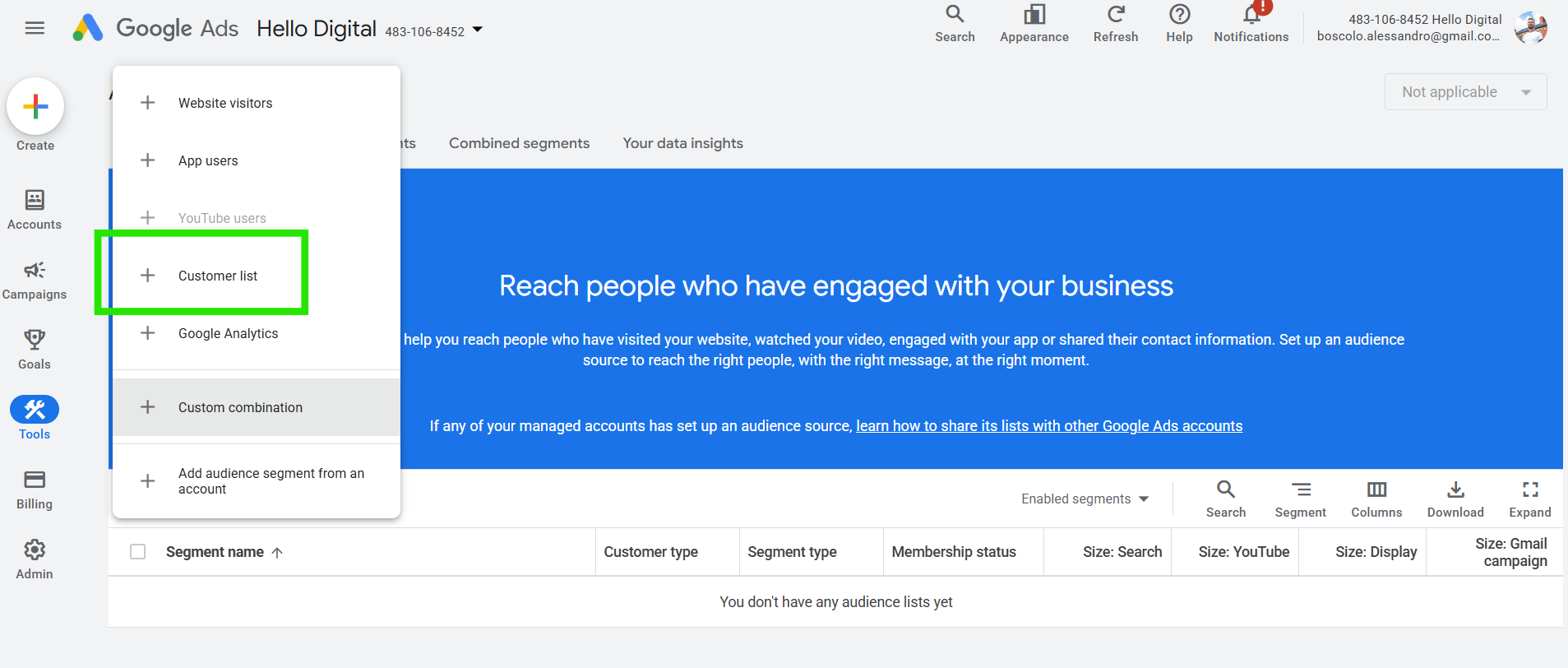
The maximum membership duration is 540 days. That does not mean you should upload a file and ignore it for 18 months. Customer information changes, and the list becomes less useful as it gets older.
Name the segment so that someone else could understand it six months later. “High-value customers, last 12 months” is useful. “Customer list final v2” is how account archaeology begins.
You can also connect a CRM, ecommerce platform or other data source through Google Ads Data Manager. That makes more sense when the list changes regularly and someone would otherwise need to upload a new file every week.
Google can take up to 48 hours to process the list. Once it has finished, you will see:
How many rows uploaded successfully.
The percentage Google could match.
The estimated audience size available on different Google services.
Do not confuse the match rate with campaign quality. A high match rate only means Google recognised more of the people you uploaded. It does not mean those people are valuable customers or that advertising to them will perform well.
Creating the list does not apply it to a campaign either. You still need to decide whether to target, observe or exclude the audience when you create or edit a Google Ads campaign.
Uploading the list does not tell Google what you want to do with it. That depends on whether you choose Targeting, Observation or Exclusion.
The names are not especially helpful, so here is the practical difference.
Targeting restricts your ads to people on the Customer Match list.
In a Search campaign, those people must still meet the campaign’s other conditions. They need to search for one of your eligible keywords, be in the location you target and match the customer list. Adding the list does not replace your keywords.
Observation does not restrict who can see your ads. It lets you compare how people on the list perform against everyone else reached by the campaign.
For example, you could add existing customers to a Search or Google Shopping campaign in Observation. Your ads can still reach other people, but you can see whether matched customers click, buy or convert at a different rate.
When Smart Bidding is active, lists added in Observation can also become bidding signals.
Exclusion does what you would expect. People Google matches with the list are prevented from seeing the ads in that campaign.
If your aim is to advertise only to known customers, choose Targeting, not Observation.
You should also:
Avoid adding other audience segments unless you want to reach them too.
Check whether optimised targeting or audience expansion is active.
Keep your location settings accurate.
Confirm that the campaign type allows you to restrict the audience in the way you intend.
That last point is easily missed.
In Performance Max, a Customer Match list is an audience signal, not a fence around the campaign. You are giving Google an idea of who you want to reach, but it can show ads to other people if it believes they are likely to convert.
So, if the brief is genuinely “show these ads to our customers and nobody else”, Performance Max is not the right tool for that job.
Google can reach people outside your Customer Match list when:
The list is set to Observation.
Optimised targeting is switched on.
The list is being used as a Performance Max audience signal.
You create a lookalike audience designed to find new people similar to those on the list.
This is where advertisers can get caught out. They select a Customer Match list, see it attached to the campaign and assume the audience is now restricted.
It may not be.
The word signal is the clue. A signal helps Google decide where to look. It does not tell Google where it must stop.
Google can automatically make eligible Customer Match lists available to Smart Bidding and optimised targeting, even when you have not manually added them to a campaign.
Google says its systems decide which lists are useful for each campaign. I would still check what is sitting in the account before leaving this switched on.
I am comfortable making clean, meaningful lists available, such as:
Confirmed customers.
Repeat customers.
Higher-value customers.
Properly qualified leads.
Customers of a clearly defined product or service.
I would be less comfortable with an old “all contacts” list containing customers, poor leads, newsletter subscribers, suppliers and people who applied for jobs.
Google may be clever enough to ignore an irrelevant list. That is not a good reason to give it messy data and hope for the best.
In most accounts, I would remove or withhold specific poor-quality lists rather than switch automatic inclusion off for everything. If the account contains years of badly named or unexplained audiences, however, I would audit those lists before allowing Smart Bidding to use them.
Turning automatic inclusion off does not change the campaign’s visible audience targeting. It changes which Customer Match lists Google can use behind the scenes as additional bidding or optimisation signals.
Exclusion is often the simplest and most useful application of Customer Match.
An Irish ecommerce business offering 15% off a first order may not want to keep paying to show that promotion to existing customers. A service business may also want to separate campaigns intended to acquire new clients from those promoting additional services to current ones.
Just remember that the exclusion only covers customers Google successfully matched. It will not identify every existing customer, so it should reduce wasted exposure rather than be treated as a perfect block.
A Customer Match list should have a clear purpose.
If you cannot explain who is on the list and why you want Google to use it, the list is probably too broad. “Everyone in the CRM” might be easy to upload, but it rarely tells Google anything useful.
A customer, a qualified lead and someone who downloaded a guide are not the same thing.
For a service business, I would separate:
This distinction matters even more in B2B PPC campaigns, where a small number of genuine opportunities may be far more valuable than hundreds of form submissions.
If you feed every enquiry into the same list, you may be telling Google that all leads are equally desirable. Your sales team probably knows that is not true.
You do not need dozens of lists. You need segments that would change how you advertise.
That might include:
Recent customers.
Repeat customers.
Higher-value customers.
Customers who bought a particular product or service.
Customers due for a renewal.
Previous customers who have not bought for some time.
A Dublin accountancy firm, for example, might separate clients who only use its annual tax-return service from businesses already paying for monthly accountancy support. The two groups have different relationships with the firm and may respond to different offers.
The difference should be commercially meaningful, not just something you happened to find in the spreadsheet.
Segmentation is helpful until every list becomes too small to use.
This is relevant for many Irish small businesses. A database of 600 customers may support one or two useful lists, but splitting it by service, location, year, customer value and favourite biscuit could leave you with ten tiny audiences that never become practical campaign segments.
Google requires at least 100 members to be added or refreshed within the 540-day membership period for a Customer Match list to remain eligible. Even then, a list can be technically eligible but too small to contribute much data or serve reliably in the campaign you have in mind.
Start with the largest meaningful groups. Create narrower lists when the database can support them.
A customer who bought last month sends a different signal from someone whose last interaction was six years ago.
That does not make older customers worthless. It means they should not automatically be mixed with current ones. A separate dormant-customer list may be useful if you have a genuine reactivation offer.
Refresh manual lists when the underlying database changes. If customers are added and removed every day, connecting Google Ads to your CRM or ecommerce platform may be more sensible than relying on someone to remember another CSV upload.
Where you have collected the information properly, include several identifiers for the same customer, such as an email address and phone number.
That gives Google more ways to find a match. It does not mean adding information from outside sources or enriching the database with details the customer never gave you.
Accuracy matters more than quantity. Two correct identifiers are useful. Five old or incorrectly formatted ones are not.
Finally, name each list clearly. “Repeat customers, last 12 months” tells you what it contains. “New customer list final FINAL 3” tells you that someone had a long afternoon.
Customer Match can be confusing because Google shows several numbers that sound as though they should mean the same thing.
They do not.
The number of rows uploaded, the match rate, the audience size and the number of people currently available for ads are all different.
First, give Google time to process it. A new upload can remain In progress for up to 48 hours.
If it still shows zero after that, check:
Whether at least 100 people matched.
Whether the file uploaded successfully.
Whether the email addresses and phone numbers were formatted correctly.
Whether the details are recent enough to match current Google accounts.
Whether the list contains enough active users for the campaign and Google service you are using.
Google may show a list size of zero until it contains at least 100 matched members. It also reports active users rather than simply displaying every row you uploaded. Someone can be on your customer list without being active on Search, Gmail, YouTube or Display when Google calculates the available audience.
Suppose you upload 2,000 customers and Google reports an 80% match rate. That does not necessarily give you an audience of 1,600 people ready to receive ads.
Some matched users may not be active on the Google service where the campaign runs. Google also applies privacy thresholds and rounds the audience figures it reports.
This is particularly noticeable with smaller Irish databases. A healthy-looking match rate can still leave a local business with too few active users for consistent delivery.
The match rate tells you how successfully Google recognised the data. The audience size tells you how many of those matched people are currently available for use. Neither tells you whether they are good customers.
Customer Match uploads can take up to 48 hours. If an automated connection replaces or updates the list every day, Google may start another processing cycle before the previous status has cleared.
That does not always mean the connection is broken. Check the upload history before taking the whole thing apart and starting again.
If the list uploaded correctly but Targeting is unavailable, check the account’s Customer Match eligibility.
All policy-compliant accounts can use Customer Match for Observation and exclusions. Targeting requires at least 90 days of Google Ads history and enough lifetime spend to exceed Google’s additional eligibility threshold. For accounts billed in euro, Google converts that spend automatically.
This is easy to misdiagnose as an audience problem. Reformatting the spreadsheet will not unlock an account-level feature.
Also check the list size. A list can be available in Audience Manager but still contain too few active users to serve ads reliably.
This normally comes down to how the audience has been applied.
Ads can reach people outside your Customer Match list when:
The audience is set to Observation.
Optimised targeting is switched on.
The list is being used as a Performance Max audience signal.
Other audience segments have been added to the same targeting group.
Optimised targeting is designed to look beyond the audience segments you selected. In a Google Display Ads campaign, you need to switch it off when the intention is to reach previous customers rather than find additional people likely to convert.
Performance Max works differently again. Its audience signals guide Google towards people who may convert, but they do not restrict delivery to those people.
So, when someone says, “I added my customer list, but Google is still showing ads to strangers”, my first question would be: Did you add the list as a restriction, or did you give Google a suggestion?
Those are two very different campaign setups.
Google compares the customer details you provide with information attached to Google accounts. It does this using hashed versions of details such as email addresses and phone numbers rather than comparing the original text directly.
Google then gives you an audience segment containing the matched users. It does not tell you which individual customers matched, and you cannot download a list of the Google accounts it found.
Once the matching process is complete, Google says it deletes the uploaded data and the temporary matching files. The resulting audience remains in your account until the membership expires or you remove it.
It can, but uploading a list does not guarantee better results.
Customer Match gives Smart Bidding more information about people who already have a relationship with your business. If the list contains genuine customers or well-qualified leads, that may help Google recognise auctions where someone is more likely to convert or generate greater value.
If the list contains every enquiry you have ever received, including spam and poor-quality leads, the extra information may not be very useful.
Google says Smart Bidding learns which Customer Match lists help each campaign and can ignore those that do not. I would still keep the account tidy rather than rely on Google to make sense of a cupboard full of mystery spreadsheets.
Adding a list also does not automatically reduce your CPC or what you pay for Google Ads. Smart Bidding may bid more for some auctions and less for others depending on the conversion goal and bid strategy.
Turning automatic Customer Match inclusion on or off is not the same as replacing your bid strategy or changing the campaign’s main conversion goal.
Google does not describe it as a learning reset. You are changing one of the signals available to Smart Bidding, however, so campaign performance may adjust as Google responds to the new information.
I would not keep switching the setting on and off every few days to see what happens. Make a considered change, record the date and give the campaign enough time and conversion data before judging it.
There is no useful rule that every business should update its lists weekly or monthly.
Update the list when the underlying customer data changes enough to matter. An ecommerce business with daily orders may benefit from a continuous connection. A small professional-services firm might only need to refresh a manually uploaded list after gaining a meaningful number of new clients.
Customer Match membership lasts for no more than 540 days. A list must also have at least 100 members added or refreshed during that period to remain eligible.
That is the technical limit, not the recommended schedule. Waiting 539 days to update a fast-changing customer list would be compliant, but not especially sensible.
Since 1 April 2026, most new Customer Match integrations must use the Google Data Manager API rather than the Google Ads API.
Existing integrations that were already using eligible Google Ads API developer tokens can continue to manage Customer Match lists through the Google Ads API.
This change matters to developers, software providers and businesses building automated CRM connections. It does not affect someone manually uploading a CSV file through the Google Ads interface.
Yes, when you have good customer data and a clear reason for using it.
No, when the plan is simply to upload every contact you have and hope Google works some magic.
For many small businesses in Ireland, the most useful starting point is not a standalone campaign aimed only at a Customer Match list. The audience may be too small for that. Excluding existing customers from acquisition campaigns or adding a clean customer segment in Observation can still be worthwhile.
I would start with one or two lists that are easy to explain:
Confirmed customers.
Higher-value or repeat customers.
Qualified leads that did not convert.
Existing customers who should not see a new-customer offer.
Then decide what job each list should do. Should Google target it, observe it, exclude it or use it as an additional Smart Bidding signal?
That question matters more than the upload itself.
Customer Match can make an already well-run account more precise. It will not fix poor conversion tracking, weak targeting or a campaign that was never commercially sound in the first place. Those fundamentals still determine whether Google Ads are worth using for the business.
My view is simple: clean lists are worth testing. Messy lists are better left out until you understand who is on them and why Google should care.
If you need help deciding how Customer Match should fit into your campaigns, my Google Ads management service includes account reviews, audience strategy and ongoing optimisation.
Customer Match can be useful, but only when the lists, campaign settings and conversion tracking are working together. If you are not sure whether Google is using your customer data in the right way, I can review the account, check how the lists are built and applied, and recommend what to keep, change or remove.
My Google Ads management service is designed for Irish businesses that want practical support without handing the account over to a large agency. Get in touch to discuss your campaigns and see where Customer Match fits.
Alessandro Boscolo Conway — Hello Digital
I'm a Dublin-based freelance SEO and digital marketing consultant with over 20 years of experience, including time on Google Ireland’s Search Quality team.
I run Hello Digital, a consultancy that helps startups and small businesses across Ireland grow online through clear strategy, expert delivery, and practical support.
I've worked with over 50 Irish companies to improve their visibility, generate better leads, and grow sustainably through SEO and digital marketing.
I'm a certified Google Partner and a trusted advisor to e-commerce brands, local services, and fast-growing startups.
Based in Dublin, 20+ years of experience
Former Googler, certified Google Partner, SEO strategist, and performance marketer
Trusted by 50+ Irish startups, e-commerce brands, and local businesses